
AI + Blockchain Global University Autumn Camp Hackathon Opening Ceremony Recap
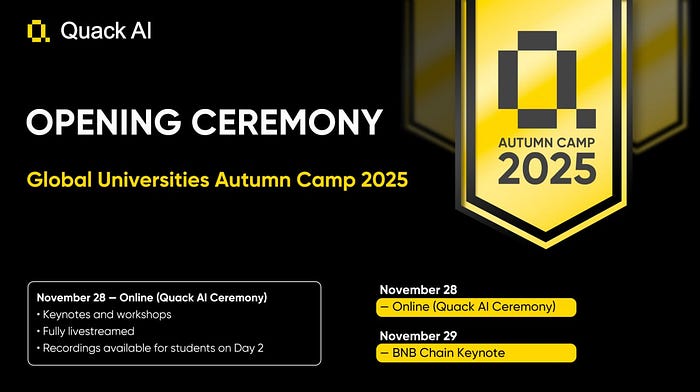
The Opening Ceremony for the AI + Blockchain Global University Autumn Camp Hackathon was held last week.
Hosted by Quack AI in collaboration with Imperial College London and powered by BNB Chain, the Opening Ceremony brought students together for two days of keynotes, discussions, and warm up workshops before the hackathon begins in full.
Below is a complete recap of what happened across November 28 and November 29.
How the Opening Ceremony Unfolded
The program started online on November 28 with a full evening hosted by Quack AI. Students joined for a sequence of keynotes, a cross project panel, and technical workshops designed to prepare them for the hackathon tracks.
All sessions were streamed live and recorded for students who needed to revisit the material during their build phase.
On November 29, BNB Chain delivered its keynote online, completing the Opening Ceremony sequence and closing the learning portion of the event before teams begin building.
Highlights From the Keynotes and Workshops
The Opening Ceremony brought together multiple ecosystem partners who shared frameworks, technical insights, and practical guidance for students entering the hackathon.
Quack AI
Keynote: Governance Layer for the Agent Economy
Riiix introduced students to the foundations of agent based governance and the role of on chain execution in multi agent coordination. The session established the theme for this year’s hackathon and gave students a high level view of where agent systems are heading.
Akedo
Keynote: The Market Trend and What’s Next
Workshop: AI, MEME and Monetization
Elliott covered emerging consumer AI patterns, creative monetization models, and tools that help teams capture attention in fast moving digital environments. Akedo’s workshop focused on practical use cases and how developers can apply their SDKs inside community products.
Unibase
Keynote: Build an On Chain Immortal AI
Workshop: AI Agent Economy using Unibase Memory, ERC8004 and x402
Valerio walked students through Unibase’s memory layer and new token standards that support persistent agents. The workshop expanded on this with examples of how agents can interact with networks using composable execution paths.
ChainGPT
Keynote: The Next Wave of AI Native Startups
Workshop: BD and Sales Tactics for Early Stage Projects
Vlad shared observations on AI native startup opportunities and gave students a view of how early teams win in competitive markets. The workshop focused on practical outreach, positioning, and BD frameworks useful for early stage builder teams.
Aethir
Workshop: Introduction to Aethir
Sheej introduced students to decentralized GPU networks and how distributed compute can support training, inference, and agent execution. The session gave students clarity on when to rely on decentralized compute and how it can be integrated into AI workflows.
SpaceAgri
Workshop: Agriculture Agents Using Real World Agricultural Data
Conor presented how agriculture can benefit from AI agents that use real world datasets and trait based intelligence. The session opened up a unique RWA driven perspective on agents that many students had not explored before.
BNB Chain
Keynote: November 29
BNB Chain’s keynote rounded off the Opening Ceremony with insights into their vision for AI, infrastructure, and developer alignment across the broader ecosystem.
Hackathon Bounty Tracks
With the Opening Ceremony completed, students now move into the hackathon where they can submit projects to the following bounty tracks. Each bounty is provided by an ecosystem partner and will be awarded to the strongest submissions.
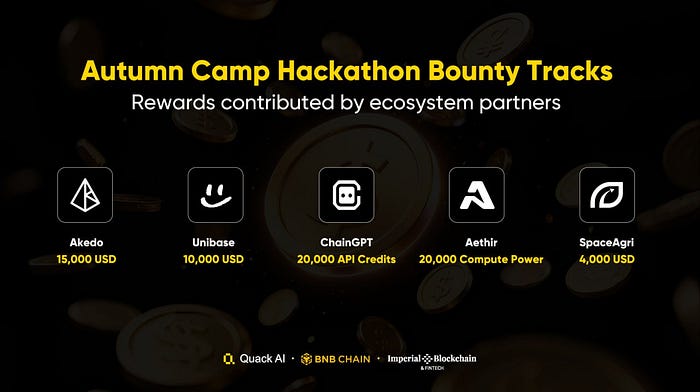
1. Akedo — AI Robot Shopping Assistant
Prize Pool: 15,000 USD
Get Quack AI’s stories in your inbox
Join Medium for free to get updates from this writer.
Akedo challenges teams to build an autonomous home shopping agent that can manage groceries end to end. Projects should show real inventory tracking, need prediction, and cart creation using Amazon or Walmart test integrations. The agent must include user approvals, privacy safeguards, preference models, and a functional demo hosted on Akedo.
Ten winners will be selected, with rewards distributed across multiple tiers. Akedo expects working MVPs, clear demos, and privacy-first design.
2. Unibase — Immortal AI Agent with Decentralized Memory
Prize Pool: 10,000 USD
Unibase invites teams to build a decentralized AI agent powered by sovereign memory and cross-platform interoperability using Membase and BitAgent. Submissions should demonstrate an agent that stores and evolves knowledge, interacts across surfaces, and uses Unibase’s memory layer in a meaningful way.
A functional prototype, demo video, GitHub repository, and documentation are required. Projects will be judged on innovation, technical depth, user experience, and clarity of presentation.
3. Quack AI × ChainGPT — Super Web3 Agent
Prize Pool: 20,000 API Credits
Teams are asked to create a chat-first Web3 agent that can research, build, audit, and execute on-chain actions through a single interface. ChainGPT provides the Web3 LLMs for contract generation, auditing, and token intelligence. Quack’s x402 BNB layer enables policy-aware, gas-sponsored execution for swaps, transfers, staking, deployment, or other interactions.
Submissions must show at least one full research-to-execution flow using both ChainGPT and x402. Safety controls, previews, spend caps, and activity logs are required. Ten winners will be selected with rewards split across multiple tiers.
4. Aethir — Decentralized Compute Grant
Prize Pool: 20,000 USD worth of compute
Aethir offers compute grants for projects that rely on decentralized GPU resources. This track is ideal for compute-heavy AI agents, training pipelines, or advanced inference workloads. Grants are awarded to the top two teams as six-month compute allocations, along with direct access to Aethir’s BD and technical teams for integration support.
Projects must demonstrate genuine GPU needs, scalability, and a clear use case for distributed compute.
5. SpaceAgri — Agriculture Agent Track
Prize Pool: 4,000 USD
SpaceAgri’s track focuses on agents and tools built using agricultural RWA, trait scoring, or environmental simulation models. Teams can work on breeding optimization, yield prediction, supply-chain verification, trait asset creation, or any biologically grounded use case powered by SpaceAgri’s APIs and registry.
Submissions must include a functioning MVP that integrates SpaceAgri components. Mockups, generic chatbots, or demos without real API interactions will not qualify.
What Happens Next
All bounty tracks are open now. Teams will refine their ideas over the next several days, work with mentors, and prepare their final submissions. Winners will be selected at the end of the hackathon based on technical depth, usability, innovation, clarity, and alignment with each track’s requirements.
Submit your project through the official DoraHacks portal:
https://dorahacks.io/hackathon/1733/bounties
The full list of rewards will be awarded once judging is complete.
Good luck to all builders participating in this year’s Autumn Camp Hackathon.
To stay updated on workshops, support sessions, and results, follow the official channels and join the Imperial College Hackathon Discord.