Blockchain Under the Hood: A Deep Technical Journey
A visual and descriptive walkthrough for the curious mind
The Chain That Cannot Be Unrung
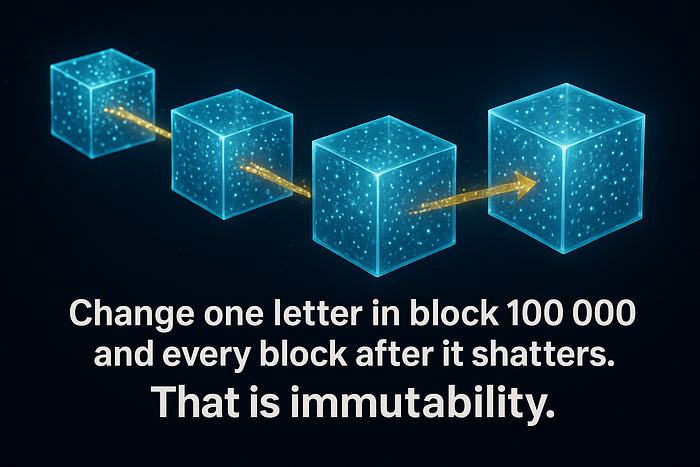
Picture a library made entirely of glass, stretching across every continent. Every book in this library is identical. Whenever a new page is written, thousands of librarians simultaneously copy it into the next blank book. The moment the ink dries, the page is dipped in diamond: impossible to erase, impossible to alter. The only thing anyone can ever do is add the next page.
This is a blockchain.
It is not magic. It is not even particularly fast. It is simply the most stubborn database humanity has ever built.
Inside a Single Block — The Anatomy Lesson
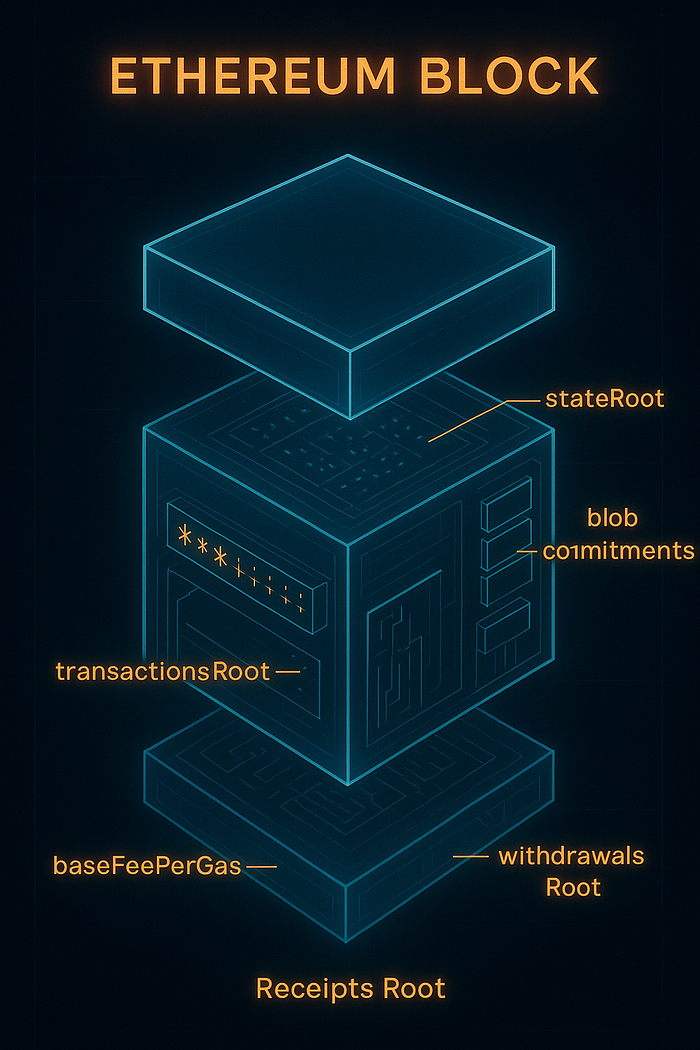
Let’s walk around one modern Ethereum block the way a biologist dissects a specimen.
You are standing on the surface of block #21 342 987.
At the very top, etched in light, is the parentHash — a 66-character hex string that looks random but is actually the fingerprint of everything that happened before this moment in history. Touch it and you feel the weight of 21 million previous blocks pressing down like geological strata.
Beneath that sits the Merkle root — imagine an upside-down tree made of light. Every leaf is a transaction; every branch is a hash of its children. Fold the entire tree and you’re left with 32 bytes that prove, without showing the details, that all 1 842 transactions in this block are exactly where they claim to be.
Deeper still: the stateRoot. This is the fingerprint of the entire world at this moment — every ETH balance, every smart-contract storage slot, every DeFi position for 120 million addresses. One byte off in a single DeFi pool in Vietnam and this root would be completely different.
Finally, since early 2024, six glowing “blobs” hover beside the block like jellyfish — each carrying 128 KB of compressed rollup data. Their KZG commitments (polynomial witchcraft) let any node sample just 20 random points and be 99.999999 % sure the entire blob is available forever.
How the Network Agrees on Reality — Consensus Up Close
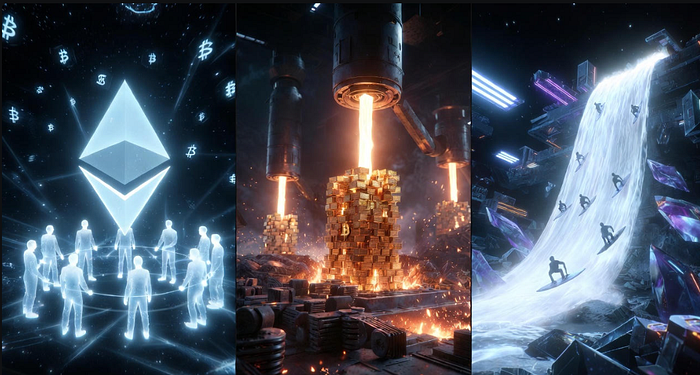
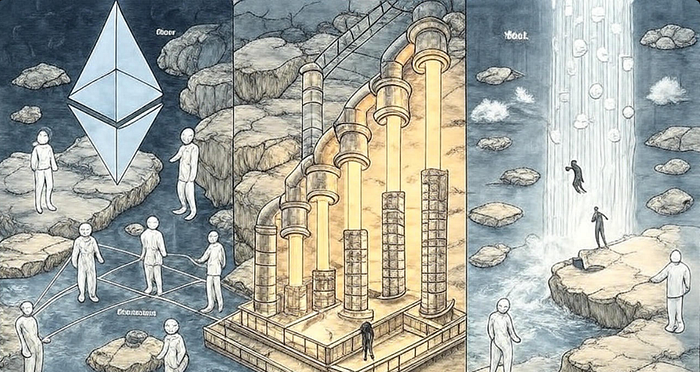
Imagine 12 000 validators (real humans and institutions staking 32 ETH each) sitting in a circle around a campfire that never goes out.
Every 12 seconds, one of them is chosen — pseudo-randomly, weighted by stake — to stand up and propose the next block. The moment they do, the other 11 999 begin shouting “ATTESTATION!” across the internet.
If at least two-thirds shout within the first four seconds, the block becomes justified — think of it as “very probably final.” Another 8–12 seconds later, when two-thirds have seen the previous justification, they shout again. Now the block is finalized. It is written in diamond.
Get Giulio Sistilli’s stories in your inbox
Join Medium for free to get updates from this writer.
This is Gasper, Ethereum’s consensus in 2025. It feels like watching time crystallize.
Meanwhile, in the Bitcoin valley far away, miners are still racing to solve impossible jigsaw puzzles (Proof-of-Work). Every ten minutes the tallest pile of solved puzzles wins, and everyone else throws their work away and starts attaching to the winner. It’s brutal, wasteful, and has never been reversed in 16 years.
And then there’s Solana — a single continuous SHA-256 waterfall cascading at 400 milliseconds per “tick.” Validators vote on which droplet they heard first. The waterfall is the clock. The votes are the consensus. Sub-second finality feels like watching light move through water.
The Great Scaling Escape — How We Broke the Trilemma
In 2021, sending a transaction on Ethereum felt like mailing a letter via carrier pigeon during a hurricane. In late 2025, it feels like sending a WhatsApp message.
The trick? We stopped trying to make every computer in the world execute every DeFi trade.
Instead, we built rollups — entire parallel universes that do the heavy computation off-chain and only mail Ethereum a cryptographic receipt saying “everything in our universe followed the rules.”
There are two species of rollup:
- Optimistic rollups (Arbitrum, Optimism, Base) They assume everyone is honest and give you seven days to prove fraud. It’s like publishing a scientific paper and waiting for someone to spot an error.
- Zero-knowledge rollups (zkSync, Starknet, Scroll, Linea) They attach a mathematical proof that a supercomputer could verify in milliseconds. It’s publishing the paper with an unbreakable seal that says “I already verified every equation.”
Both post their data as Ethereum “blobs” — cheap, temporary storage that disappears after ~18 days but is guaranteed to be available long enough for anyone to reconstruct the full rollup state if needed.
The result? A single Ethereum block quietly enables more than 1 500 real-world transactions per second across all rollups combined — with fees under one cent and security inherited from a chain worth $600 billion.
The Quiet Revolution
Sixteen years after an anonymous cryptographer pressed “send” on a mailing list, the machinery is still running exactly as described — appending blocks, verifying proofs, rewarding honesty, punishing malice.
No CEO can shut it down. No government can freeze your account without your key. No hacker has ever successfully rewritten history on a major chain.
It is slow, expensive, over-engineered, and occasionally ridiculous. It is also the first time in history that millions of untrusting strangers have managed to maintain a single source of truth without any of them being in charge.
That, more than any token price or NFT sale, is the real technical achievement of blockchain in 2025.