Chatbots, Blockchain, Metaverse: What Businesses Should Focus on in 2️⃣0️⃣2️⃣6️⃣
How Chatbots, Blockchain, and the Metaverse Will Lead to a New Era of Business Innovation
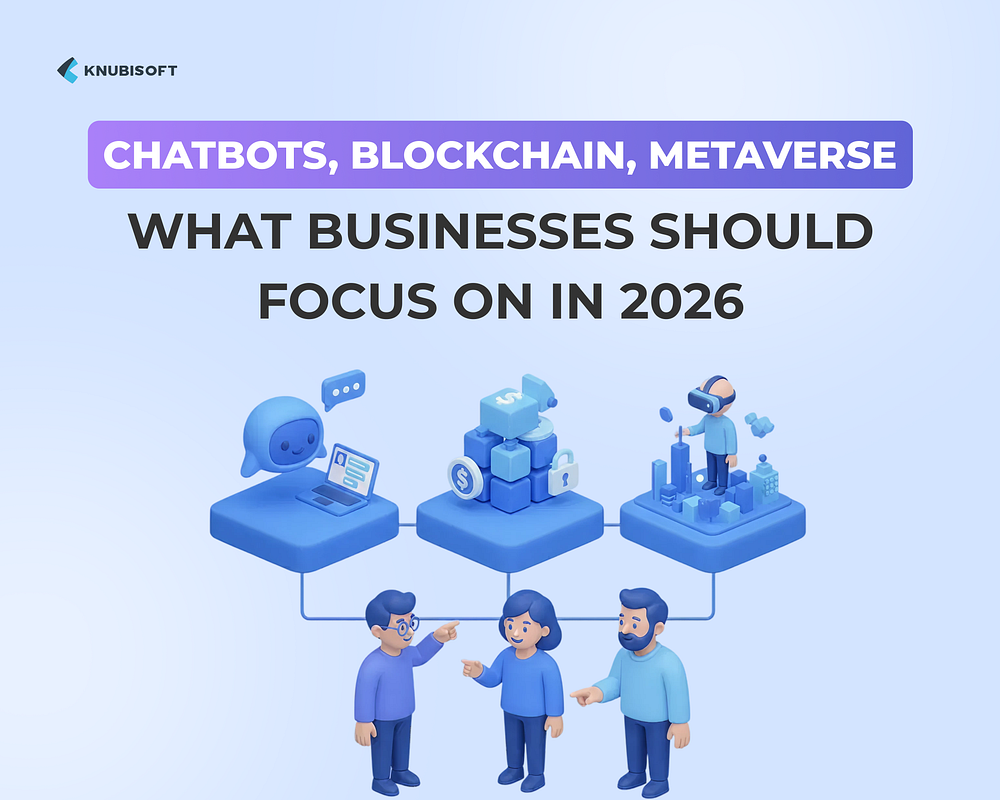
As we approach 2026, frontier technologies are set to drive transformation across industries, adding trillions to the global economy by enabling hyper-personalized experiences, secure transactions, and immersive ecosystems. According to McKinsey’s 2025 Technology Trends Outlook, businesses that focus on integration, ethics, and scalability will thrive, while laggards risk obsolescence.
At this article we will explore the projected impact of these technologies in 2025 and key trends for 2026, highlighting how they will reshape business models and outlining priorities for staying competitive. By 2026, AI chatbots will handle 80% of customer interactions, blockchain will secure 50% of supply chains, and the metaverse will generate over $300 billion in enterprise value.
Chatbots 🤖💬
Chatbots have evolved from simple rule-based responders to sophisticated AI agents capable of natural language processing, sentiment analysis, and predictive personalization. In 2025, they’re already reducing operational costs by automating routine tasks, think 24/7 support without the payroll overhead. The global chatbot market is projected to reach $9.56 billion in 2025, up from $7.76 billion in 2024, growing at a CAGR of 23.3% through 2030. Another forecast pegs it at $9.30 billion in 2025, surging to $27.07 billion by 2030 at 23.8% CAGR.
Impact on Businesses in 2025 💡
- Efficiency Gains: 97% of corporations have adopted voice-tech integrations, with 84% planning budget increases for AI-driven bots. In BFSI (banking, financial services, and insurance), chatbots exceeded $2 billion in market value in 2025, streamlining fraud detection and claims processing.
- Customer Experience: 96% of shoppers expect chatbot support, and 64% of CX leaders aim to enhance bot capabilities to cut call volumes by 30–50%. Sectors like retail and healthcare see bots handling 70% of queries, boosting satisfaction scores by 20%.
Forecast for 2026: Hyper-Personalized Agents 🚀
By 2026, the market could hit $11–12 billion, with voice and multimodal bots (text, audio, video) dominating at a 25%+ CAGR. Integration with generative AI will enable “agentic” chatbots, autonomous systems that not only respond but anticipate needs, like recommending products based on real-time behavior.
Business Focus Areas:
- Adopt Hybrid Models: Combine cloud and on-premise deployments for latency-sensitive industries like healthcare.
- Ethical AI Training: Address biases to ensure inclusivity; 44% of North American teams has planed chatbot investments, but trust is key.
- Omnichannel Integration: Link bots to social media and payment gateways (e.g., Stripe, PayPal) for seamless transactions.
Blockchain ⛓️🔐
Blockchain’s promise of immutable, transparent ledgers is moving beyond crypto into enterprise-grade applications. In 2025, it’s revolutionizing supply chains, payments, and data security, with the global market reached $57.72 billion, up from $31.28 billion in 2024, at a staggering 90.1% CAGR to $1,431.54 billion by 2030. Alternative projections cite $31.18 billion in 2025, growing to $393.42 billion by 2032 at 43.65% CAGR.
Impact on Businesses in 2025 💡
- Supply Chain Resilience: 55% of healthcare apps are using blockchain for traceability, valued at $5.61 billion. In energy, peer-to-peer trading could cut costs by 20–30%.
- Financial Inclusion: 60% of users leverage it for cross-border transfers; BFSI holds 24% market share, with KYC/AML processes 20% faster.
- Sustainability: Global spending on blockchain solutions hits $19 billion, enabling carbon credit tracking and reducing fraud in high-value goods.
Forecast for 2026: Interoperable Ecosystems 🚀
Market size could exceed $67.4 billion in 2026, with hybrid (public-private) chains leading at 64.2% CAGR. Expect widespread adoption in DeFi (decentralized finance) and IoT integrations, adding $360 billion in business value. Venture funding reached $10 billion in Q2 2025, fueling AI-blockchain hybrids for smart contracts.
Get KnubiSoft’s stories in your inbox
Join Medium for free to get updates from this writer.
Business Focus Areas:
- Regulatory Compliance: Navigate frameworks like EU’s MiCA; U.S. integrations (e.g., Ethereum recognition) will drive $9.32 billion domestically.
- Scalability Solutions: Invest in layer-2 protocols for faster transactions; 81% of enterprises plan zero-trust models by 2026.
- Cross-Industry Pilots: Start with proof-of-concept in payments (26% market share), expanding to supply chains (29.8% CAGR).
Metaverse 🌐🚀
The metaverse, persistent, shared virtual spaces blending AR/VR/MR, is transitioning from gaming novelty to business powerhouse. Valued at $105.40 billion in 2024, it’s forecasted to hit $139.07 billion in 2025, growing at 46.4% CAGR to $936.57 billion by 2030. Other estimates: $165.57 billion in 2025, reaching $950.23 billion by 2030 at 41.83% CAGR.
Impact on Businesses in 2025 💡
- Revenue Streams: Gaming and entertainment lead, with virtual events generating $130.5 billion globally. Retail sees branded stores (e.g., Nike, Walmart) attracting 3.2 million monthly users.
- Workforce Transformation: 52% of users seek metaverse jobs; VR training reduces costs by 30% in sectors like aerospace.
- Global Reach: 400 million monthly active users, with 600 million total; U.S. alone at $32.1 billion.
Forecast for 2026: Mainstream Adoption 🚀
Revenues could surpass $300 billion in 2026, with 25% of the global population spending 1+ hour daily in metaverses. Industrial applications hit $150 billion by 2035, but 2026 marks the tipping point for enterprise twins and blockchain-NFT economies.
Business Focus Areas:
- XR Hardware Investments: Backed by $100 billion from Meta, Nvidia, etc.; prioritize AR glasses for mixed-reality commerce.
- Content Creation: Use AI for 3D worlds; 92.5% of new capacity in renewables ties into green metaverse simulations.
- Interoperability Standards: Address fragmentation; EU’s 2025 privacy directive could add $1.9 billion in compliance costs.
Synergies for 2026 and Beyond
By 2026, AI chatbots in blockchain-secured metaverses could enable seamless virtual economies, with DeFi platforms hosting metaverse transactions worth $176 billion. PwC’s Essential Eight highlights how combining AI, blockchain, and VR creates “human-led, tech-powered” models, potentially adding $3.1 trillion in blockchain value by 2030.
Challenges like cyber risks ($10.5 trillion annual cost by 2025) and regulatory hurdles persist, but opportunities abound: 81% of firms eye zero-trust by 2026, and metaverse investments in manufacturing could boost productivity 40%.
Strategic Priorities for Businesses in 2026
To harness these shifts, companies must act decisively:
1.Assess and Invest
Conduct tech audits; allocate 10–15% of IT budgets to pilots, targeting high-ROI areas like customer service (chatbots) and traceability (blockchain).
2.Build Talent and Partnerships
Upskill for AI ethics and VR design; collaborate with giants like Microsoft or Meta for metaverse access.
3.Prioritize Security and Sustainability
Embed blockchain for data trust; use metaverse for eco-simulations to meet green mandates.
4.Measure ROI Holistically
Track metrics beyond revenue: e.g., engagement rates (up 25% via metaverse) and cost savings (30% from bots).
5.Foster Innovation Culture
Experiment with “agentic” AI in metaverses; early adopters could capture 20–30% market share gains.
To wrap it up
As 2026 unfolds, chatbots, blockchain, and the metaverse will redefine competitiveness, turning digital friction into fluid experiences. Businesses that view these as interconnected enablers, rather than isolated tools, will lead the charge.
The forecast is clear: $100+ billion in combined market value, trillions in economic impact. The question isn’t if your company will engage, but how boldly.
Start now: prototype a metaverse storefront, secure your supply chain with blockchain, or deploy an AI chatbot fleet.
💡 What do you think, how can integrating chatbots, blockchain, and the metaverse drive novel business models, and what risks arise from their convergence?