
Could Hollow Knight Work With Blockchain?
I challenged myself to come up with ideas that live up to this modern classic
Two days ago, I found myself replying to a Wolves DAO article written by Artemis, one of their members. In it, he was making the point that, if this industry wants to break out, developers need to stop building games just for the sake of making NFTs work. They need to respect players’ time by putting out products that are fun first. Let the blockchain figure itself out later.
He’s right. Most Web3 titles I’ve played lately mint NFTs and tokens early. They ask players to make “investments” on the promise of future airdrops, leaderboard earnings and resale. Because of that, we keep getting the same three or four genres over and over again (TCGs, MMO-lites, FPS, and auto-battlers), not because players are asking for them, but because those genres conveniently support reward loops and extraction mechanics.
Artemis suggested two possible fixes:
- Give players the choice between a Web2 track and a Web3 one, or
- Throttle the economic incentives to make games less attractive for extractors.
Those are perfectly reasonable and valid ideas, but here’s where I pushed back. Both are just variations of the same loop — grind, craft, collect, liquidate. They don’t fundamentally rethink how blockchain could be leveraged to give players a better experience.
So in my reply, I challenged him to think about how blockchain could improve the web2 cult hit Hollow Knight.
In hindsight, that may have been a douchey thing to say, and I think it may have cost me some followers 😬. But after thinking about it, I still think it’s an exercise worth doing, so I turned that question on myself.
And that’s what this article is — a thought exercise. Not about turning Hollow Knight into a NFT printing machine, but about seeing whether blockchain can enhance a game that absolutely does not benefit from trading or a token. Because if Web3 can’t deliver value in a masterpiece like this, then maybe the tech has nowhere to go except in circles.
Why This Matters
Hollow Knight is arguably the best Metroidvania ever made. It didn’t need a token economy, a marketplace, or ownership. It found success with gameplay that pushed players towards mastery, and top notch world building and lore.
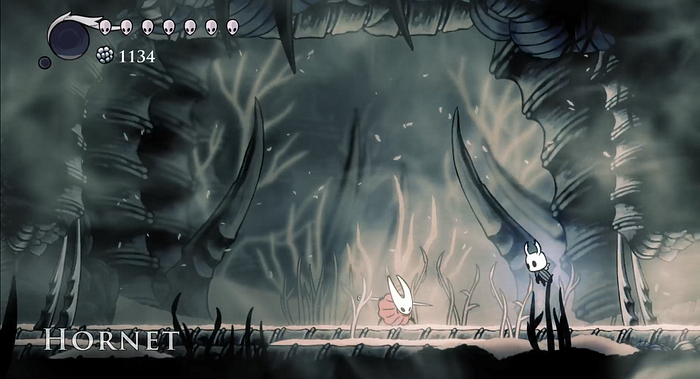
That’s exactly why it’s the right test case for this conversation. I chose Hollow Knight for two reasons.
First, it started out as an Indie title, just like pretty much every Web3 game out there. But unlike a lot of early Web3 games, it only had a shoestring Kickstarter budget to get started. That cancels out any excuses about AAA funding.
Second, Metroidvanias are completely absent from Web3. These games aren’t about collecting skins or playing a range of different NFT characters. They thrive on exploration, skill-based gameplay, and accomplishment. That means any suggestions I come up with can’t involve the usual Web3 trappings. Doing so would actually cheapen the game.
Hollow Knight received a Game of the Year Award from PC Gamer, a Platform Game of the Year award from IGN, and it was nominated for Best Debut Indie Game Award by the Game Awards. Its Successor, Silksong, is nominated for Game of the Year Award by the Game Awards and it will probably lose to Clair Obscur: Expedition 33 — another lore-rich skill-based Indie title that has no use for an open in-game economy.
These are the titles that so-called mainstream gamers (or “normies”) want to play. If Web3 wants to be taken seriously by them, it has to demonstrate value beyond just selling items and cashing in on free tokens.
In that sense, Hollow Knight is a benchmark, and if the industry can’t clear it, the rest of the conversation doesn’t matter.
Breaking Down Blockchain
Sometimes, I get the feeling most people both in and out of Web3 think of blockchain as just the thing that powers tokens, NFTs, and speculative marketplaces. To be fair, that’s how most games use it. They focus on digital ownership and scarcity to create live economies that enable peer-to-peer trading using real world currency.
But blockchain isn’t inherently about buying and selling.
At its core, it’s just a public ledger — a database that anyone can verify, but that no one can quietly rewrite. It stores data in a way that’s tamper-proof, platform-agnostic, and permanent. That data can be images, metadata, executable logic, account balances, or proof of identity. Basically, developers and game clients can use it to store things off-server or off-device without worrying that it’ll get exploited.
When you stop thinking of blockchain as an ATM, and start thinking of it as a persistent, independent save system, things get interesting. That’s the angle I’m taking here. Not “How do we add tokens to Hollow Knight?” But rather “What could a tamper-proof, platform-agnostic, developer-neutral data layer do for a single-player masterpiece?”
Packing More Value Into Hollow Knight
Here’s what I came up with. Again, these ideas aren’t meant to “fix” Hollow Knight. There’s nothing to fix. The goal is to explore whether or not blockchain could be used in the game to improve a player’s experience, and not to turn Hallownest into a yield farm.
Here’s how that might look like.
1. Dynamic Paths and Narrative Continuity
One of Hollow Knight’s greatest strengths is that the world subtly reacts to your discoveries. Unlocking certain items changes dialogue options, completing certain actions gives you a new ending and makes new parts of the game accessible.
Those events are limited to within Hollow Knight itself, but what if they could extend to Silksong as well?
Since blockchain can record everything about your sessions and publish that data safely in a public place, Silksong could read it and change dynamically as a result.
Actions you take in Hollow Knight, like destroying parts of the environment, speaking (or not speaking) to certain NPCs, unlocking certain upgrades or secret rooms could all have an impact on the sequel.
For example, unlocking the Abyss in Hollow Knight could spawn different shade enemies in Silksong. Finding all the grubs could unlock a special shop in Pharloom. Finishing the game with ending 2 could lead to a different opening sequence in Silksong explaining how Hornet got out of the black egg in the first place.
None of these enhancements have anything to do with pay-to-win or grinding tokens. They just deepen the impact of player decisions way beyond the confines of the original game. They also enhance Hollow Knight’s replayability as players experiment with different choices to see their effects.
As an added bonus, exposing gameplay data on a public database leads to richer community content and tools. The fact that this database will outlive the game’s infrastructure means less chance of those tools becoming obsolete because the studio shut down its servers. As a content creator and game tester, I can tell you that live game data is worth its bytes in gold.
2. Player-Driven Cannon
Ok, so the first example relied on Hollow Knight having a sequel in the first place. But what about something that applies to the game itself.
Well, if it can write gameplay data to a public database, it could also aggregate player actions and evolve based on what the community does.
What if Team Cherry were to release a seasonal event called Fading Lights. During the season, the sum of all player actions determines whether Hallownest drifts toward Radiance or the Void.
Get Woody’s stories in your inbox
Join Medium for free to get updates from this writer.
Your individual choices, like defeating certain radiance or shade-aligned bosses, clearing specific endings, performing certain tasks, or unlocking optional areas, would contribute to a live “world state” that slowly tips one way or the other.
In Web3 terms, players would control the game through a decentralized autonomous organization (DAO), but with their gameplay as the currency rather than tokens. This works because blockchain can also enforce a 1-game-1-vote mechanic to prevent players from abusing the system.
The final state of the season could be locked-in as canon, and could lead to different NPC dialogue options, shade or light enemies populating different areas, new dream sequences, environment changes and so forth.
It’s a completely new form of social play for a single-player game that doesn’t disrupt the experience, and allows the community to shape the game together.
3. Non-Tradable NFTs
This next one targets something Hollow Knight players often talk about in their content — meaningful references between Hollow Knight and Silksong.
There’s a myth that all NFTs have to be tradable collectibles. They don’t. Transferability is just a function you include (or don’t include) when you write the smart contract that creates them.
So imagine if, when you finish Hollow Knight, the game mints the Vessel’s nail exactly as is. That would include all upgrades, all modifiers, and any relevant charm effects. And if you finish the game again? Well, it would just burn your previous NFT and mint a new one.
Since it’s non-transferable, there’s no point in grinding the game. It’s simply your personal relic that immortalizes your accomplishment of beating one of the hardest platformers ever made.
Then, when you start Silksong using the same account, the game can recognize that relic and give Hornet a tiny boost based on your build. If you ran Mark of Pride, she gets a slight range boost on her pin. If you maxed the nail, she gets a slight damage boost, and so on.
Team Cherry could even elevate things and let Hornet find the nail in a late game event or DLC narrative. The game would then treat it as a crest, changing her fighting style to the Vessel’s.
These are the kinds of small lore connections that fans love, and blockchain can serve as a vehicle for that.
4. Validating Accomplishments
Hollow Knight’s community is all about achievements: speedruns, no-hit challenges, charm restrictions, Steel Soul attempts, you name it. The problem is verification. Unless you streamed the entire run, someone can always claim you cheated, spliced, modded, or macro’d your way to glory.
Blockchain solves that instantly.
The game could mint a small, untradeable badge each time you finish a run that encodes things like:
- total playtime
- hits taken
- boss order
- charm loadout
- weapon state
- whether perma-death mode was active
- whether or not mods were active
All of it would be freely visible on-chain and tamper-proof. No more arguments about authenticity, and no more needing to record hours of footage just to prove you really did something amazing. And best of all, it creates zero economic incentive. It’s just transparency for a community that genuinely values mastery.
Could Developers Do This Without Blockchain?
Of course they could. With enough time, money, and hardware, developers can build almost anything. If Team Cherry wanted to stand up their own authentication servers, maintain cross-platform save infrastructure, store player histories indefinitely, build anti-cheat tools, and maintain a public API, then sure — they could make most of these ideas work without blockchain.
But the real question isn’t “Is it technically possible?” It’s “Is it practical?”
Hollow Knight is a single-player indie title. Team Cherry has no reason to run long-term infrastructure for it, no reason to maintain servers after launch, and no reason to build a whole verification stack just so the community can prove a Steel Soul run wasn’t faked. That’s the kind of overhead you expect from a giant live-service studio, not three people making a handcrafted side-scroller.
Blockchain removes that pressure because a decentralized tamper-proof database handles all of that.
Using blockchain also means the data outlives the game. Ten years from now, Silksong or a completely new project could still validate your original Hollow Knight accomplishments because the ledger doesn’t vanish when a studio sunsets a title.
So yes, developers could recreate these features using private infrastructure, but they’d just be spending extra time, money, and effort solving problems the blockchain already solves for them — especially for features that rely on permanence, verification, and cross-platform access.
That’s where the tech actually earns its keep.
Web3 Needs a Different Design Philosophy
The point of all this isn’t that Hollow Knight needs NFTs. It doesn’t. It’s already a phenomenal game, and nothing I’ve laid out here would magically make it “better” in the traditional sense.
What these ideas do show, though, is that blockchain has potential beyond minting loot boxes and handing out tokens. If you treat it as a public, persistent data layer rather than an economy engine, it can actually deepen how a player engages with a game world.
It can do things like track gameplay data down to the button press and associate it with you personally, carry choices across sequels, anchor community-driven lore, and reward players with mementos of their accomplishments that can power features in future titles.
In other words, it can give small studios tools they’d never build on their own to manage the state of their games.
The bigger message here echoes what Artemis said in his Wolves DAO piece: Web3 devs need to start thinking about maximizing value for players, not extracting value from them or letting them extract value from each other. That means designing features that make sense for the game, and not the other way around.
Hollow Knight is a tightly crafted, skill-driven, lore-heavy title that stands on its own. If Web3 can’t produce games like it, then it’s never going to be taken seriously by mainstream gamers. It’ll stay a niche limited to mobile ports, MMO-lites and leaderboard friendly genres.
And honestly? If the tech can’t clear that bar, maybe it should.
Disclosure: I write articles with the help of AI. If you want to learn more about how I use it in my content, you can read about it here. I don’t accept sponsorships from developers or take part in ambassador programs.
If you enjoyed this article, consider clapping for it by pressing and holding the hand icon in the bottom right. I don’t paywall my content, but I appreciate the support and it helps me understand what my readers like.