Future-Proof Skills for Rust/Blockchain Developers
To stay ahead, Rust/Blockchain developers must combine advanced technical expertise with strong soft skills and adapt to shifting industry landscapes. Leading job-market studies show blockchain roles growing ~23% annually, with Rust developers (especially in Polkadot, Solana, NEAR) among the top in-demand positions. Key areas of focus include emerging cryptographic tools (e.g. zero-knowledge proofs), WebAssembly-based platforms, AI/ML integration, and secure decentralised system design. Equally important are “Web3-ready” soft skills: critical thinking, teamwork across distributed teams, adaptability to new tools, and clear communication. Together, these skills prepare developers for a future of modular blockchain architectures, cross-chain ecosystems, and AI-enhanced automation.
Technical Skills and Tools
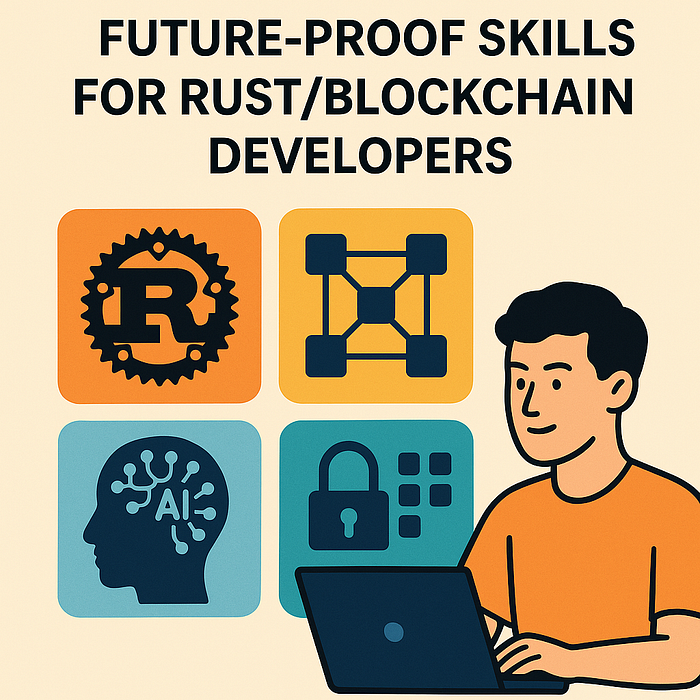
Figure: A blockchain developer working with complex code and multiple monitors. Modern blockchain developers must master a broad technical stack. Rust remains foundational — Rust’s memory-safe, concurrent programming model is ideal for high-performance blockchains. Substrate (Polkadot’s framework) skills in building custom runtimes and pallets are highly valued. For example, Rust developers are the 2nd fastest-growing crypto role (+39%), in part due to Polkadot and Solana’s Rust-based ecosystems. WebAssembly (WASM) is likewise critical: many next-gen blockchains compile Rust code to WASM (for browser or chain execution). WASM “merging of Rust and WASM will be seamless,” enabling high-performance dApps and smart contracts. Developers should practice compiling Rust to WASM and using WASM runtimes like WasmEdge or Wasmtime.
Zero-Knowledge and Cryptography: Privacy-preserving techniques are booming. Expertise in zk-SNARKs/zk-STARKs and related Rust libraries (e.g. Arkworks, Halo2, zksync) will be crucial. Job reports rank “ZK Engineer (ZK-SNARKs/ZK-Rollups)” as the fastest-growing role (+52%). A solid grasp of advanced cryptographic primitives (elliptic-curve crypto, hash functions, digital signatures) is also essential for security. Stay current on post-quantum algorithms (e.g. Kyber, Dilithium) as blockchain projects explore quantum-resistant security.
AI/ML Integration: AI is now a baseline in Web3. Developers should be familiar with AI tooling (e.g. GPT-based code assistance, ML libraries in Rust like tch-rs for PyTorch or tract for ONNX) and how to embed machine learning models in decentralized apps. Roles merging AI and blockchain are emerging: e.g. oracle or on-chain inference developers. Rust’s performance suits ML/AI – “more libraries and toolkits for deep learning” are expected in Rust. At minimum, prompt-engineering and workflow integration with AI tools (ChatGPT, Claude) are now expected skills.
DevOps, Cloud, and Infrastructure: Familiarity with cloud-native deployments and blockchain infrastructure tooling is a plus. Rust is used in cloud/WebAssembly services (like Cloudflare Workers) and backend systems. DevOps skills (CI/CD, containerization, Kubernetes) complement Rust’s strengths in low-level systems. According to industry analysis, Rust will power more “reliable and scalable” cloud tools. Developers should learn popular cloud providers (AWS, GCP) and blockchain node infrastructure (validators, indexers).
Interoperability & Cross-Chain: With multi-chain networks (Polkadot, Cosmos, Ethereum bridges) on the rise, knowing cross-chain protocols (Polkadot XCM, Cosmos IBC) is increasingly valuable. Industry reports note that “cross-chain technology has evolved”, enabling multi-chain asset flow, with ~$20B locked in cross-chain DeFi by 2025. Rust devs can specialise in bridge development, multi-chain tooling, or SDKs (e.g. building Cosmos modules, Substrate XCM pallets).
Key Frameworks & Tools: Beyond the language itself, developers should learn ecosystem tools: Substrate (pallet development, FRAME), Ink! (Rust smart contracts on Substrate), Parity tools, Polkadot JS, Graph Node, etc. Also monitor new frameworks (e.g. NEAR SDK, CosmWasm). According to recruiters, companies now expect “Solidity/Rust with audit-readiness” and familiarity with ZK tools — reflecting the hybrid environments (Ethereum + Polkadot/Cosmos) prevalent in Web3.
Core Technical Skills Shaping the Future of Blockchain and Systems Development
As the blockchain and systems landscape continues to evolve, developers need more than just surface-level coding skills. They need depth — an understanding of systems, cryptography, distributed computation, and security.
Here’s a breakdown of key technical areas, the tools that power them, and the opportunities they open up.
⚙️ Rust & Systems Programming
Why it matters: Rust isn’t just another language — it’s a philosophy of safety and performance. Its ownership model eliminates memory leaks and data races, making it ideal for concurrent, low-level systems.
Key Tools: Tokio, async-std
Opportunities:
- Blockchain core engineer
- Consensus/runtime developer
- Systems programming specialist
🏗️ Substrate & Parachain Development
Why it matters: Substrate powers the Polkadot ecosystem, allowing developers to build modular blockchains with custom logic using FRAME and Rust.
Key Tools: FRAME Pallets, Cumulus, Frontier (EVM), Ink! smart contracts
Opportunities:
- Parachain developer (Polkadot)
- Custom chain architect
- Runtime developer
🧩 WebAssembly (WASM)
Why it matters: WASM is bridging the gap between web and blockchain. It enables fast, secure execution of smart contracts and decentralized apps across environments.
Key Tools: WasmEdge, Wasmtime, Rust→WASM toolchain
Opportunities:
- Smart contract developer (e.g. CosmWasm)
- Browser-based dApp developer
- Edge computing engineer
🧮 Zero-Knowledge Proofs (ZKPs)
Why it matters: ZKPs are redefining privacy and scalability in Web3. Understanding them unlocks doors to the most cutting-edge areas of cryptographic research.
Key Tools: Arkworks, Halo2, ZKSync SDKs
Opportunities:
- ZK researcher/engineer
- Privacy protocol developer
- DeFi Layer-2 developer
🔐 Cryptography & Security
Why it matters: Every blockchain is only as secure as its cryptography. Engineers who understand encryption primitives can build safer wallets, signatures, and consensus mechanisms.
Key Tools: ECC, Threshold Signatures, Post-Quantum Cryptography libraries
Opportunities:
- Security auditor
- Blockchain cryptographer
- Wallet and custody developer
🤖 AI/ML Integration
Why it matters: The fusion of AI and blockchain is creating intelligent decentralized systems — from predictive oracles to adaptive dApps.
Key Tools: Rust ML libraries (tch-rs), OpenAI APIs, data analytics stacks
Opportunities:
- On-chain AI/ML developer
- AI-augmented dApp engineer
- Smart oracle developer
🧰 DevOps, Cloud & Infrastructure
Why it matters: Running blockchain infrastructure at scale requires mastery of automation, deployment, and reliability.
Get Fenn Ignatius Saji’s stories in your inbox
Join Medium for free to get updates from this writer.
Key Tools: Docker, Kubernetes, CI/CD pipelines, AWS/GCP, Validator/Node Ops
Opportunities:
- Blockchain infrastructure engineer
- Web3 DevOps specialist
- Toolchain and deployment developer
🔗 Interoperability & Cross-Chain Development
Why it matters: The future isn’t a single chain — it’s a network of networks. Cross-chain communication protocols are essential for seamless interoperability.
Key Tools: Polkadot XCM, Cosmos IBC, Layer-2 SDKs
Opportunities:
- Cross-chain protocol engineer
- Bridge developer
- Integration specialist
Soft Skills and Work Practices
Technical prowess must be paired with strong soft skills. Industry guides emphasise that top blockchain developers excel in problem-solving, critical thinking, adaptability, and collaboration. For example, Teal’s Web3 skills analysis lists “Problem-Solving and Critical Thinking,” “Adaptability and Continuous Learning,” “Collaboration and Teamwork,” and “Effective Communication” as essential. These are crucial in a fast-evolving field: developers often work in open-source, remote teams and must learn new protocols or languages quickly.
- Adaptability & Continuous Learning: New tools and paradigms emerge rapidly (e.g. new consensus algorithms or smart contract platforms), so a willingness to upskill is vital.
- Communication & Teamwork: As projects become more complex, clear communication across cross-functional teams (developers, designers, business stakeholders) is key. Web3 developers are noted to frequently “collaborate across decentralized teams” in open-source environments.
- Project Coordination & Systems Thinking: With Web3 in an “execution phase,” coordinating complex projects matters. Web3 industry reports find that project/program management roles now surpass pure engineering roles. A new “Web3 Systems Thinker” archetype is emerging — professionals who understand technical fundamentals and can integrate multiple technologies into business outcomes. Rust/Substrate devs should thus practice high-level design and documentation, and if possible contribute to governance or roadmap planning.
- Leadership & Mentorship: Given the experience bias in crypto hiring, mid-level devs who mentor others or lead DAO working groups can fast-track their careers. Emotional intelligence, stakeholder management, and the ability to explain complex ideas are important for senior roles.
Developers can strengthen these skills through community engagement (contributing to open-source projects, writing technical blog posts or tutorials) and by participating in DAOs or local tech groups. One recruiter advises that candidates stand out with “verifiable credentials and endorsements, public proof of work (GitHub, case studies) and a clear Web3-native profile” In practice, this means sharing project code, design docs, or running workshops can be as valuable as coding ability.
Industry Trends Impacting Rust/Web3 Devs
Rust/Substrate developers should watch several macro trends reshaping Web3:
- AI & Automation: AI tools have moved from “optional to mandatory” in Web3 roles. Expect AI-driven development workflows (code generation, intelligent testing), as well as blockchain/AI convergence (e.g. decentralized AI compute, oracles feeding ML models). Companies report 30%+ productivity boosts from AI integration, and now expect baseline AI fluency (prompt engineering, tool use) in hires. Longer term, custom AI service development and strategy (on-chain or off-chain) could become roles of their own.
- Modular Blockchain Architectures: Emerging “modular” chains separate consensus, execution, and data availability layers. Projects like Celestia (modular execution/consensus) are cutting development overhead (70% lower L2 cost). Developers should learn about Data Availability layers, rollup frameworks, and how to plug Substrate chains into these modular stacks. The shift away from monolithic chains means expertise in layering protocols (e.g. rollups on custom parachains) will be prized.
- Cross-Chain & Interoperability: Interoperability is maturing: Polkadot and Cosmos protocols allow asset circulation across chains. Web3 devs should be comfortable building bridges and multi-chain dApps. Knowledge of cross-chain messaging (XCM for Polkadot, IBC for Cosmos, or generalized Layer-2 solutions) will open roles in infrastructure projects and DeFi primitives.
- On-Chain Governance & DAOs: As decentralized governance evolves, understanding on-chain voting, treasury management, and DAO legal frameworks is important. For instance, the emerging DUNA model gives DAOs US legal standing, boosting growth of tokenized communities. Substrate developers often build governance pallets and treasury modules; staying fluent in DAO tooling (e.g. tools like Democracy, OpenGov on Polkadot) is relevant. Roles in this space include DAO operations, governance research, or treasury engineers.
- Reusable Infrastructure: Industry analysis warns that teams will “reuse, not rebuild” core stack components in 2025. Developers should leverage proven frameworks (Substrate, Cosmos SDK, Ethereum clients, zk proof libraries) rather than coding from scratch. Focus on integrating existing consensus engines or wallets, and on building value-added features (new dApps, services) on top. This shift favors specialists who know the ecosystem deeply: e.g. a Rust dev who masters Substrate and its ecosystem pallets can rapidly spin up chains instead of writing low-level code.
- Regulatory & Compliance Trends: Although not purely technical, evolving crypto regulations (EU’s MiCA vs US patchwork) affect where projects launch and hire. For career planning, EU’s unified framework may offer more stable opportunities for blockchain innovation, whereas US roles may focus more on compliance (AML/KYC tooling, legal frameworks). Fintech and DeFi sectors will especially demand knowledge of regulation (e.g. MiCA, FATF travel rule). Rust developers might intersect with these trends by working on privacy or compliance protocols (e.g. confidential transactions, VASP-compatible wallets).
Use Cases and Market Signals
The market indicates strong demand for Rust/Substrate skills across different companies and roles:
- Blockchain Core and Protocol Roles: Many Layer-1/2 projects (Polkadot parachains, Solana, NEAR, Avalanche subnets) actively hire Rust developers. A recent report ranks “Rust Developer (Solana, NEAR, Polkadot)” as the #2 fastest-growing crypto role. These roles involve building core protocol features, consensus logic, or runtime modules in Rust/Substrate. For example, Polkadot parachains regularly recruit engineers to implement custom pallets, integrate XCM, or optimize consensus.
- zk and Privacy Engineering: The rise of ZK-rollups and privacy blockchains has created a “hiring war” for zk experts. Rust devs who can write efficient proof generators or integrate ZK verification into chain code will find opportunities at projects like Zcash, zkSync, StarkWare, or any new privacy-focused chain.
- Smart Contract and DApp Development: Although Solidity dominates some ecosystems, Rust is key on others (e.g. CosmWasm, NEAR). Solidity/Rust proficiency is now often required. Roles include smart contract engineers (on Substrate/Ink! or WASM-based chains) and full-stack Web3 devs. The Crypto Recruiters note that Solidity hiring alone is ~35% of Web3 listings, but Rust skills open doors to high-performance chains.
- Blockchain Security & Audit: With growing scrutiny, companies seek Rust devs who can audit code and design secure contracts. The focus on “audit-readiness” of Rust and Solidity codethecryptorecruiters.io underscores roles in security teams. Skills in formal verification or security best practices for Rust (e.g. using
proptest,cargo-audit) are valuable. - DevOps & Infrastructure: Many Web3 firms need engineers to deploy and maintain blockchain infrastructure (validators, APIs, explorers). Rust devs with sysadmin and DevOps chops can fill roles at node provider companies or exchanges. Projects like Parity or Infura occasionally hire Rust devs for backend systems.
- DAO/Operations Roles: The tokenized economy also creates non-traditional roles. For example, “DAO Operations Specialist” is among the top in-demand roles. Rust developers who understand Web3 stacks can transition into operations or grant-managing roles at DAOs by leveraging their technical background.
- Interdisciplinary Roles: Companies value developers who bridge tech and business. For instance, “Growth Marketer (Web3-native)” and “Tokenomics Analyst” are rising roles. A Rust dev with strong communication could move into product or strategy, leveraging their deep technical credibility.
In summary, candidates with Rust experience will find opportunities especially in blockchain protocol companies, DeFi projects, and tech-driven DAOs. Many of these roles are remote or global. In fact, over 60% of blockchain roles are now offered remotely, allowing developers worldwide to join cutting-edge projects. However, the market is competitive: roles in creation (engineering) see 10–20x more applicants than strategy/ops roles. Standing out requires visible proof-of-work (e.g. open-source commits) and a clear track record of Web3 projects.
Geographic and Sector Context
Regional Differences: Opportunities vary by region. Europe (especially crypto-friendly countries like Portugal or Malta) offers a unified regulatory market under MiCA, which has attracted crypto enterprises (e.g. Binance expanding into EU). US jobs are abundant but often focus on compliance and finance-related Web3 (due to fragmented SEC/CFTC oversight). Asia sees fast-moving markets (stablecoin use, CBDC pilots). Developers might consider geography: a recent analysis notes Eastern Europe, Latin America, and India/Southeast Asia produce strong mid-level Web3 talent, often at lower cost, while North America and Western Europe tend to supply senior engineers. Thus, savvy developers can leverage this “geographic arbitrage” early in their careers.
Industry Sectors:
- Fintech & Banking: Many banks and payment firms are exploring blockchain for cross-border payments and digital assets. Rust skills are useful for building secure payment rails, CBDC prototypes, or regulatory compliance tools.
- DeFi and Crypto Finance: Decentralized exchanges, lending protocols, and NFT platforms rely heavily on blockchain engineers. Solidity remains dominant, but many DeFi infrastructure projects (oracles, cross-chain routers) use Rust. Roles here often blend smart-contract dev with systems engineering.
- Enterprise Infrastructure: Traditional companies (supply chain, logistics, healthcare) use blockchain for transparency and traceability. Though many enterprise blockchains (Hyperledger, Quorum) use Java/Golang, open-source projects like Substrate are making inroads. Rust devs may work on interoperability layers or data availability solutions for enterprise consortia.
- Infrastructure Tooling: Startups building block explorers, wallets, analytics, or Layer-2 frameworks need Rust expertise for performant backends. These roles often involve large data handling or low-latency systems.
In each sector, the core skills (secure Rust coding, protocol knowledge) apply, but domain knowledge (e.g. regulatory policies in finance, privacy standards in healthcare) can give developers an edge.
Recommendations
To future-proof your career as a Rust/Substrate developer:
- Master Emerging Blockchain Frameworks: Continuously learn Substrate, CosmWasm, and related SDKs. Build toy parachains or smart contracts in Rust to stay sharp. Experiment with new consensus or sharding modules as they arise.
- Deepen Cryptography and ZK Expertise: Study advanced crypto (ECDSA, Schnorr, lattice-based) and practical ZK toolkits (Circom, Bellman, Arkworks). Completing courses or building a simple zk app can differentiate you.
- Develop AI & Data Skills: Practice using AI tools (code assistants, ML libraries in Rust). Understand how to feed blockchain data into ML models or use AI to optimize smart contracts. Familiarize yourself with on-chain data analysis (e.g. using Python/Rust for blockchain analytics).
- Strengthen DevOps and Security Practices: Learn containerization (Docker), infrastructure-as-code, and continuous integration for blockchain projects. Gain proficiency in monitoring and securing nodes. Contribute to security audits or bug bounties to build experience.
- Cultivate Soft Skills: Actively improve communication by writing technical articles or giving talks. Seek roles that require cross-team collaboration. Aim to lead small project efforts in open-source or at work to build coordination and leadership experience.
- Engage with the Community: Contribute to open-source projects (Substrate pallets, Polkadot forums). Network in Web3 developer communities (Discords, conferences) to stay aware of emerging trends and opportunities.
- Stay Informed on Regulation and Markets: Follow crypto regulatory news (MiCA, SEC rulings) as it may affect project viability. Adapt by learning about compliance standards (AML/KYC frameworks) if targeting finance roles.
- Focus on High-Demand Roles: Position yourself for in-demand jobs: e.g. specialize in zk engineering, cross-chain development, or blockchain security. Highlight any blockchain certifications or relevant projects on your resume.
- Balance Breadth and Depth: While specializing, maintain a broad view of the ecosystem. The most valued professionals can connect multiple domains — for example, a developer who understands both Rust runtime development and how to integrate AI or work within a DAO’s governance will stand out.
By combining cutting-edge technical skills (e.g. WASM, ZK-proofs, AI/ML) with adaptability and strong collaboration, Rust/Substrate developers can remain essential contributors in the evolving Web3 landscape.