
The TPS illusion: Why high-speed blockchains lie about decentralization
And why Monad, Solana and many shiny “future L1s” fail the decentralization test — while small, slow chains like Bitcoin and ADAMANT stay truly sovereign.

The brutal truth: TPS kills decentralization
Every new “future-proof” chain promises 100,000 TPS and sub-second finality, “next-gen consensus”.
It always sounds magical.
It never is.
Because physics, networking, and hardware reality immediately destroy the marketing fairy tale:
You cannot have both extreme throughput and extreme decentralization.
The higher the TPS, the fewer people can run a node.
Once you understand that, the entire L1 landscape looks very different.
To process 10–20k transactions per second, a node must:
- Validate 600k–1.2M tx/minute
- Keep state updates in RAM
- Write massive data volumes to NVMe
- Sync blocks across the network under 100ms
- Execute EVM or custom VM at datacenter speeds
This instantly eliminates:
- home validators
- cheap VPS servers
- hobby nodes
- Raspberry Pis
- anyone without enterprise-grade hardware
Decentralization isn’t a philosophy. It’s simply:
“Can an average person run a full node?”
If the answer is no, the chain is centralized — no matter how good the marketing sounds.
Reality check: BTC vs ETH vs Solana vs Monad vs ADM vs LTC
Let’s check the hardware requirements for running nodes, as well as the costs to mine or validate blocks.
🟢 Bitcoin — the decentralization gold standard
TPS: ~7
Node requirements:
- Any consumer hardware
- HDD/SSD 400–600 GB
- 4–8 GB RAM
- Even a Raspberry Pi works
Mining:
- Cost to run a mining node: $500 one-time hardware
- Some electricity costs
Result:
- Maximum decentralization
- Tens of thousands of nodes
- Anyone can run it
- Profitable miners expensive, but nodes remain cheap
Bitcoin is slow on purpose.
Slow = accessible = decentralized.
🟠 Ethereum — the middle ground
TPS: ~15–30
Node requirements:
- SSD 2 TB
- 16–32 GB RAM
- Multi-core CPU
- Stable bandwidth
Validating blocks:
- Validator requires 32 ETH (~$100k+)
- Plus hardware (~$1500)
Result:
- Moderately decentralized
- Thousands of validators
- But too heavy for casual users
- Economically centralized, technically semi-decentralized
ETH scales via L2 rollups, not via L1 inflation.
This is the correct design.
🔴 Solana — fast, but centralized by default
TPS: Advertised 50k+, real-world 300–1500
Node requirements:
- 256 GB RAM
- High-end 16–32 core CPU
- NVMe 2–4 TB
- 1–10 Gbps bandwidth
- Constant babysitting
Validating blocks:
- Hardware: ~$5,000–$10,000
- Plus access to datacenter tier internet
- Stake required: 50,000–200,000+ SOL delegated
Result:
- Only datacenters can run validators
- Exposure to coordinated downtime
- Economic + technical centralization
Solana sacrifices decentralization for throughput — knowingly.
🔴 Monad — the “Solana-performance EVM” with Solana-level hardware needs
Promised TPS: 10k–20k
Get ADAMANT Messenger’s stories in your inbox
Join Medium for free to get updates from this writer.
Expected hardware:
- 64–256 GB RAM
- 8–32 core CPU
- NVMe SSD 2–4 TB
- High-bandwidth networking
Validating blocks:
- Hardware: $5,000+
- Stake: unknown, but likely high (VC-heavy allocation)
Result:
- Will be fast
- Will not be decentralized
- Validators = datacenter actors only
- Economic + technical centralization
Monad is simply Solana with Solidity — a valid design, but not a decentralized one.
🟢 Litecoin (LTC) — stable, conservative, boring, decentralized-enough
TPS: ~56
Node requirements:
- Light SSD
- 4–8 GB RAM
- Home hardware friendly
Mining:
- Cost to run a mining node: $500 one-time hardware
- Some electricity costs
Result:
- Truly decentralized
- Works everywhere
- Reliable PoW model
LTC is decentralized because it stayed small and conservative.
🟢 ADAMANT (ADM) — small, fast enough, and genuinely decentralized
TPS: tens
Node requirements:
- VPS with 2 vCPU
- 2 GB RAM
- 60–80 GB SSD
Validating blocks:
- $5/month VPS can run a full validator node
- Stake: ~500k ADM ≈ $7k
- Forging pools available with nearly zero-cost entrance
Result:
- Anyone can run a node
- Extremely accessible
- No datacenter lock-in
- High participation decentralization
ADM is what decentralization looks like in practice — not on slides.
Capital allocation and VC dominance: who really owns the chain?
This is the other half of decentralization that nobody discusses.
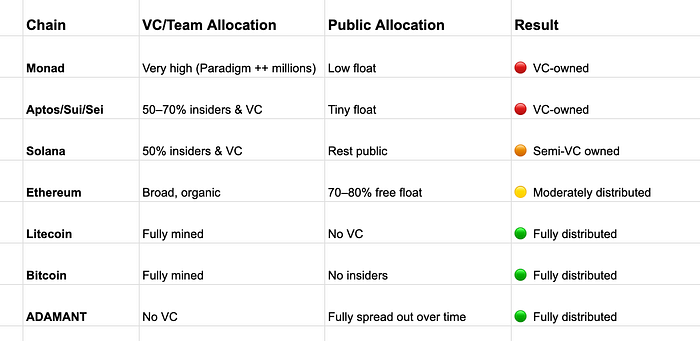
VC allocation = future sell pressure + control.
High TPS + high VC allocation = two layers of centralization at once.
“False decentralization”: The most dangerous type of blockchain
Many modern chains market themselves as:
- “Web-scale decentralization”
- “High TPS without sacrificing security”
- “Democratized validator sets”
- “Next-gen supernodes”
But in reality:
If only 0.01% of users can run a node, it is not a decentralized system — it is a CDN with a token.
And here’s the painful truth:
It is better to have an honestly centralized system (like Tron) than a chain that pretends to be decentralized but isn’t.
Why?
- Honest centralization = predictable governance
- Hidden centralization = attack surface
- Honest centralization = reliable performance
- Hidden centralization = false security assumptions, catastrophic failures
- A chain that lies about decentralization is more dangerous than one that admits it.
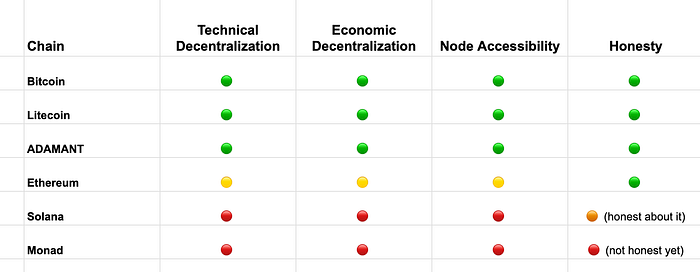
Conclusion: TPS is the new scam metric
Projects will keep promising thousands TPS and “your chain, but faster”. But the conclusion is brutally simple:
The more TPS a chain targets, the fewer humans can run it.
And the fewer humans can run it, the less decentralized — and less secure — it is.
Real decentralization is not glamorous.
It is not fast.
It is not sexy.
It is not VC-friendly.
It is inexpensive, accessible, boring, resilient, censorship-resistant.
And that’s why systems like Bitcoin, Litecoin, and ADAMANT survive cycles.