
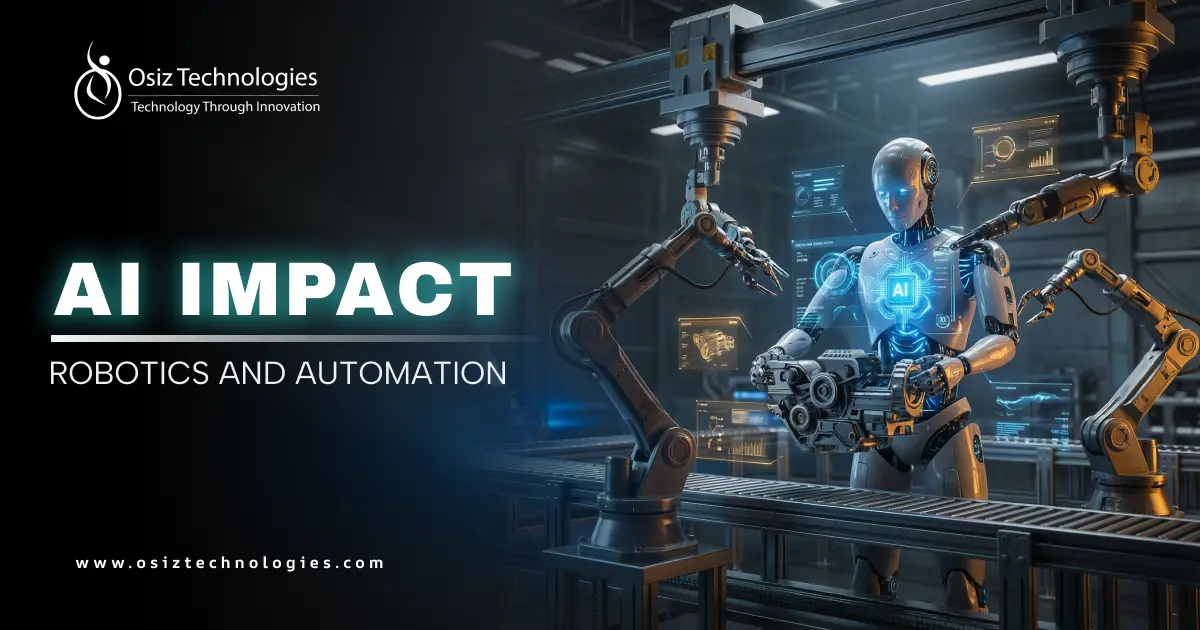
The convergence of artificial intelligence and robotics is reshaping how machines perceive, reason, and operate within physical environments. AI-powered robotic systems now move beyond task-based automation to deliver adaptability, precision, and autonomous decision-making. By integrating advanced learning models, real-world applications, and robust operational frameworks, AI in robotics is redefining intelligent automation and enabling organizations to build scalable, efficient, and resilient systems across industries
Understanding AI in Robotics
AI in robotics involves embedding artificial intelligence software and algorithms into physical robots, allowing them to sense their surroundings, learn from experience, make informed decisions, and carry out tasks independently. At its core, AI acts as the "brain" that enables a robot's "body" to go beyond fixed, repetitive tasks and respond effectively to changing, real-life environments.
How AI Powers Physical Automation
Perception and Environment Awareness
Enables AI in robotics to interpret visual, spatial, and sensory data, allowing accurate understanding of dynamic environments through computer vision and sensor fusion. This capability supports safer navigation and task execution in complex physical spaces.
Autonomous Decision-Making
Machine learning models analyze incoming data to determine optimal actions without predefined rules, improving responsiveness and flexibility. Robots can adjust operations based on changing conditions, workloads, or obstacles.
Motion Planning and Control
AI optimizes movement paths by calculating efficient trajectories while avoiding collisions and minimizing energy use. This results in smoother, faster, and more precise robotic actions. Such control capabilities naturally extend into collaborative and industrial environments.
Predictive Maintenance
AI monitors robotic components to predict wear, failures, and maintenance needs before breakdowns occur. This reduces downtime and increases equipment lifespan. Predictive insights enhance operational continuity in automated facilities.
Human-Robot Collaboration
Intelligent systems allow robots to safely work alongside humans by recognizing gestures, proximity, and intent. This collaboration improves productivity without compromising safety. It creates an easy bridge between automation and human expertise.
Key Technologies Behind AI-Driven Robotics
Machine Learning and Deep Learning
Learning models enable robots to improve performance over time by analyzing patterns and outcomes. This adaptability is essential for handling unstructured and evolving tasks. It forms the core intelligence behind autonomous robots AI.
Computer Vision Systems
Vision technologies enable robots to identify objects, interpret their surroundings, and make spatial judgments. Accurate perception is essential for precise operations in various automation scenarios and forms the basis for physical interaction.
Edge AI and Embedded Systems
Edge AI lets robots operate reliably without constant reliance on the cloud, making it ideal for essential automation applications. Running intelligence directly on the device lowers latency and enables real-time performance.
Sensor Fusion Technologies
Combining data from cameras, LiDAR, force sensors, and IoT devices enhances situational awareness. This multi-sensory intelligence improves decision accuracy. It directly impacts navigation and manipulation tasks.
Robotic Operating Systems with AI Integration
Sophisticated robotic platforms smoothly integrate hardware, software, and AI algorithms, facilitating scalable implementation and ongoing improvement, serving as the core foundation for intelligent automation.
AI in Industrial & Manufacturing Robotics
Smart Assembly and Quality Control
Industrial robotics AI enables automated assembly lines to detect defects, adapt precision, and maintain consistent quality. Vision-based inspection reduces human error and waste. This intelligence supports scalable manufacturing efficiency.
Adaptive Production Lines
AI-driven robots dynamically adjust to product variations and production demands without reprogramming. This flexibility supports mass customization. It enhances competitiveness in modern manufacturing environments.
Predictive Operations Optimization
Data-driven insights optimize throughput, energy consumption, and machine utilization. Robotics automation with AI continuously refines industrial performance. This creates resilient and cost-efficient operations.
AI in Warehousing & Logistics Automation
Autonomous Picking and Sorting
Warehouse automation AI enables robots to identify, pick, and sort items with high accuracy and speed. Vision and learning models adapt to diverse inventory types. This accelerates order fulfillment processes.
Intelligent Inventory Management
AI analyzes demand patterns to optimize inventory levels and movement. Robots autonomously reconfigure storage arrangements for greater efficiency, reducing delays and cutting operational costs.
Fleet Coordination and Navigation
Autonomous robots use artificial intelligence to plan routes dynamically and assign tasks in real time, minimizing congestion and improving efficiency for smooth large-scale warehouse management.
AI in Healthcare & Service Robotics
Robotic-Assisted Surgery and Care
AI robotics in healthcare supports precision procedures and patient assistance with enhanced accuracy and consistency. Intelligent systems assist clinicians without replacing expertise. This improves outcomes and safety.
Service and Hospitality Automation
AI-powered service robots manage reception, delivery, and customer interactions efficiently. Context awareness improves user experience. This expands automation into human-centric environments.
Rehabilitation and Therapy Robotics
Robots adapt therapy plans in real time based on patient progress and individual feedback, ensuring personalized care. Artificial intelligence designs optimized recovery pathways, enhancing treatment effectiveness.
AI in Agriculture, Drones & Autonomous Vehicles
Precision Agriculture Robotics
AI-powered machines assess soil conditions, crop types, and weather patterns to enhance planting and harvesting strategies, leading to higher yields and greater environmental sustainability.
Autonomous Drones and Monitoring
Drones apply artificial intelligence for inspecting infrastructure, conducting land surveys, and monitoring agricultural fields. Real-time data analysis supports quick responses, thereby extending automation to vast outdoor settings.
Self-Driving and Mobile Robotics
Autonomous vehicles use artificial intelligence to navigate, avoid obstacles, and optimize routes. By constantly learning from real-world experiences, these systems drive progress in transportation automation.
Benefits of AI in Robotics & Physical Automation
Increased Operational Efficiency
AI minimizes the need for human involvement and enhances the speed of task completion, boosting overall efficiency.
Enhanced Accuracy and Consistency
Learning-based control reduces errors and inconsistencies, enabling robots to sustain accuracy in both repetitive and intricate tasks, thereby guaranteeing dependable results.
Improved Safety Standards
AI facilitates instant identity management of hazards and timely responses, while robots work safely with humans, lowering overall workplace dangers.
Scalability and Flexibility
AI-driven systems swiftly adjust to new tasks and environments, aligning with changing business demands and ensuring automation stays ahead of the curve.
Data-Driven Continuous Improvement
Robots improve their performance by analyzing operational data over time, enabling more informed decisions that support sustained efficiency.
Future of AI in Robotics & Automation
The future of AI in robotics centers on greater autonomy, collaboration, and integration across physical and digital systems. As robots gain improved reasoning and contextual awareness, intelligent automation will expand across industries. Businesses will adopt adaptive systems that learn continuously instead of relying on fixed instructions. Ethical design, safety, and transparency will guide responsible deployment. As an AI development company, Osiz provides scalable robotics intelligence to help enterprises build resilient and adaptable automation systems.
Listen To The Article

Founder & CEO Osiz Technologies
Mr. Thangapandi, the CEO of Osiz, has a proven track record of conceptualizing and architecting 100+ user-centric and scalable solutions for startups and enterprises. He brings a deep understanding of both technical and user experience aspects. The CEO, being an early adopter of new technology, said, "I believe in the transformative power of AI to revolutionize industries and improve lives. My goal is to integrate AI in ways that not only enhance operational efficiency but also drive sustainable development and innovation." Proving his commitment, Mr. Thangapandi has built a dedicated team of AI experts proficient in coming up with innovative AI solutions and have successfully completed several AI projects across diverse sectors.
Recent Blogs




No 22,Astalakshmi Nagar, Thanakankullam, (Opp Seetha lakshmi Mill gate Bus stop) Thirunagar, Madurai - 625 006.
(Corporate Office)


Canada Office address, 1150, Rue Patrick, Laval, Quebec - H7Y 2C4, Canada.
(Sales Office)


Halloween
Offers

 Artificial Intelligence
- AI Development
- AI Predictive Analytics Services
- AI SaaS Development
- RAG Development
- AI Assistant Development
- ChatGPT Development
- Data Analytics Services
- AI Copilot Development
- Adaptive AI Development
- Machine Learning Development
- NLP
- AI Consulting Services
- AI Software Builder
- AI Token Development
- AI Integration Services
- Enterprise AI Solution
- AI As a Service
- AI Marketing Tools
- AI Video Generator
- Computer Vision Services
- Explore AI
- Dataset
- Machine Learning in Healthcare
- Machine Learning in Retail
- Hire AI Engineers
- Hire Prompt Engineers
- Hire ChatGPT Developers
- Hire Stable Diffusion Developers
- Hire Action Transformer Developers
- Blockchain
- Blockchain Development
- Private Blockchain Development
- Smart Contract Development
- Custom Blockchain Development
- Solana Blockchain Development
- Polygon Blockchain Development
- Public Blockchain Development
- DAO Blockchain Development
- Binance Smart Chain (BSC) Blockchain Development
- DApp Development
- Solana DApp Development
- White Label Blockchain Solutions
- Custom Blockchain On Avalanche
- Custom Blockchain On Polygon
- Blockchain Game Development
- Blockchain Consulting Services
- Blockchain Explorer Development
- Ethereum Blockchain Development
- TRON Blockchain Development
- Prediction Market Platform Development Company
Layer 1 & 2 Solutions- Layer-1 Blockchain Development
- Cross Chain Bridge Development
- Data Availability Layer Development
- Ethereum Layer 2 Scaling Solutions
- Cross-L2 DEX Solution
- Layer 2 Token Development
- Layer 2 Token Marketing
- Layer 2 Cryptocurrency Development
- Layer 2 Solutions For Blockchain Games
- Layer 2 Solutions For Web3 Gaming
- Layer 2 Blockchain Solutions
- Rollups As A Service
- Optimistic Rollups Development
- ZK Tech Development
- Bitcoin Layer 2 Solutions
Crypto Exchange- Cryptocurrency Exchange Development
- White Label Crypto Exchange
- Decentralized Exchange Development
- P2P Exchange Development
- Crypto Derivatives Exchange Development
- Centralized Exchange Development
- Crypto Exchange Clone Script
- Cryptocurrency Exchange App Development
- OTC Exchange Development
- Exchange Listing Services
- Binance Like Exchange Development
- Bitstamp Like Exchange Development
- Crypto Exchange Script
CryptoCrypto WalletToken Standards- Token Development
- AI Token Development
- RWA Tokenization Development
- Coinremitter Clone Script
- Asset Tokenization
- Real Estate Tokenization
- Tokenization Platform Development
- Crypto ETF Development
- Solona Token Development
- Semi-Fungible Token Development
- BEP20 Token Development
- Ethereum Token Development
- ERC1400 Token Development
- ERC998 Token Development
- ERC 721 Token Development
- ERC20 Token Development
- Defi Token Development
- ERC1155 Token Development
- BEP721 Token Development
- Utility Token Development
- ERC 777 Token Development
- ERC 827 Token Development
- Social Token Development
- Metaverse Token Development
- Tron Token Development
- ERC404 Token Development
- Governance Token
- Shibarium Token
- polygon Token
- BRC-20
- TRC20 Token Development
- TRC10 Token Development
- Soulbound Token Development
- NFT Token Development
Trading BotsClone- Crypto Exchange Clone Script
- Binance Clone Script
- Metamask Clone Script
- Coinbase Clone Script
- Kucoin Clone Script
- Paxful Clone Script
- Remitano Clone Script
- Wazirx Clone Script
- ByBit Clone Script
- Bitfinex Clone Script
- MEXC Clone Script
- Bitget Clone Script
- Cointool App Clone Script
- Trust Wallet Clone App
- Coinmarketcap Clone Script
- Changelly Clone Script
- BingX Clone Script
CybersecurityApp SecurityDigital Forensics & Incident ResponseAudit & ConsultingEducation & TrainingSolutionsWeb 3DeFi- Decentralized Finance (DeFi) Development
- DeFi Lending/ Borrowing Platform Development
- DeFi Staking Platform Development
- DeFi Token Development
- DeFi Wallet Development
- DeFi Smart Contract Development
- DeFi DApp Development
- Decentralized Exchange Development
- DeFi Insurance Development
- DeFi Crypto Synthetic Assets Development
Game Development- Game Development
- Android Game Development
- IOS Game Development
- Metaverse Game Development
- VR Game Development
- AI Game Development
- Unity 3D Game Development
- Unreal Engine Game Development
- Mobile Game Development
- Blockchain Game Development
- NFT Game Development
- Play to Earn Game Development
- Move to Earn Game Development
- Casino Game Development
- Slot Game Development
- Poker Game Development
- AAA Game Development
- AR Game Development
- Social Network Game Development
- Gamification Services
- Decentralized Sports Betting Platform
- Sports Betting Dapp Development
- Blockchain Casino Game Development
- Game Asset Creation
- Baccarat Game Development
- Rollbit Clone Script
- Fortnite Clone Script
- Slot Game Development
- Tap to Earn Game Development
- Slot Game Development
Metaverse Platforms- Metaverse Game Development
- Metaverse Event Platform Development
- Metaverse Virtual Mall Development
- Metaverse NFT Marketplace Development
- Metaverse Token Development
- Metaverse Virtual Land Development
- Metaverse Avatar Development
- Metaverse 3d Space Development
- Metaverse Real Estate Development
- Metaverse Social Media Platform Development
- Top 10 Metaverse Development Company
- Metaverse Business Ideas
- Metaverse Launchpad Development
- Metaverse App Development
- Metaverse Casino Game Development
NFT SolutionsNFT Platforms- NFT Minting Development
- NFT Token Development
- NFT Exchange Platform Development
- NFT Launchpad Development
- NFT Fashion Marketplace Development
- NFT Art Marketplace Development
- NFT Music Marketplace Development
- Carbon Credits NFT Marketplace Development
- Binance NFT Marketplace Development
- Polygon NFT Marketplace Development
- Solana NFT Marketplace Development
- Influencers NFT Marketplace Development
- NFT Ticketing Marketplace Development
- DeFi NFT Marketplace Development
- NFT Fantasy Sports Platform Development
- NFT Storage Development
- NFT Lending Platform Development
- Top10 NFT Business Ideas
NFT Game ClonesSustainabilityServiceNow - Blog
- Contact Us
- Works