
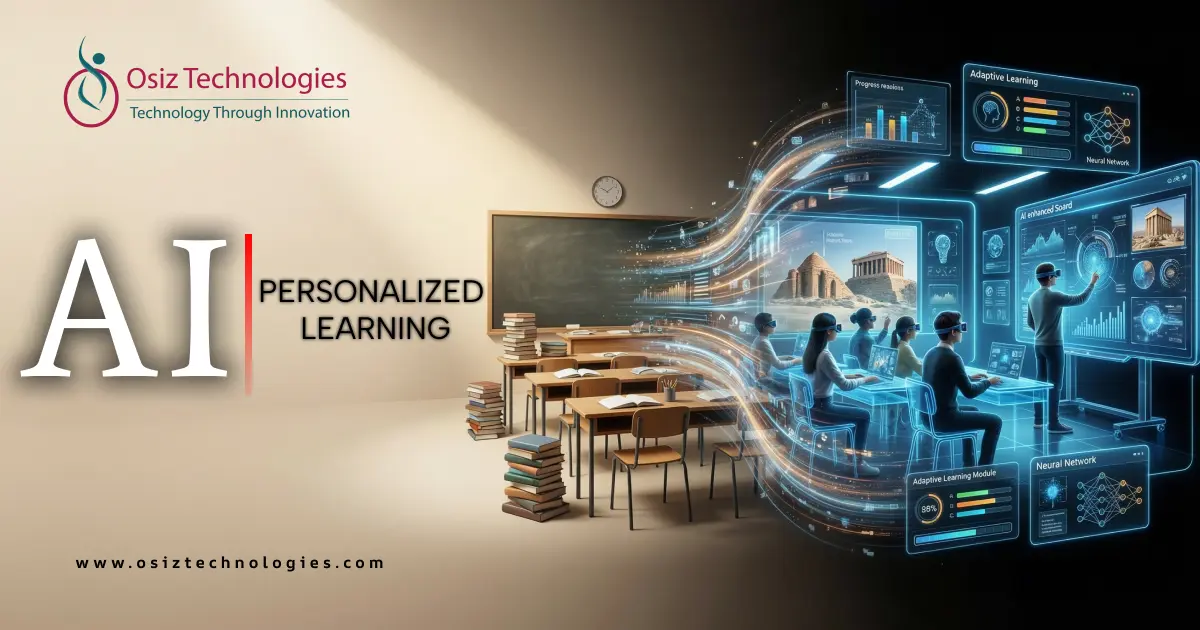
Education is entering a transformative phase where learning is no longer one-size-fits-all, and AI in education is redefining how knowledge is delivered, absorbed, and measured. Learners today expect flexibility, relevance, and guidance that aligns with their pace and goals, while institutions seek scalable ways to improve outcomes. This shift points toward a future powered by personalized learning with AI, where instruction adapts intelligently and continuously to individual needs.
Understanding AI in Education
AI in Education (AIEd) utilizes artificial intelligence to improve teaching and learning through personalized experiences, automated functions such as grading, intelligent tutoring systems, and data-driven feedback that benefit students, teachers, and school leaders. This makes education more responsive, efficient, and inclusive. It uses AI to simulate human cognitive abilities such as understanding, reasoning, and making decisions within educational environments.
What Is Personalized Learning?
Personalized learning is an approach that tailors instruction to meet each student's unique needs, abilities, pace, interests, and goals, moving away from one-size-fits-all teaching toward customized experiences often enhanced by technology that adapts content and feedback to deepen understanding and engagement. It promotes student independence, allowing learners to have a say in their learning journey, which increases motivation and leads to better outcomes focusing not just on content mastery but also on cultivating essential skills.
Key AI Technologies Used in Education
Machine Learning & Deep Learning
Machine learning can look at how people learn and what they do to spot trends that help improve teaching methods. Deep learning enables forecasting of future learning needs for students.
Natural Language Processing (NLP)
Natural Language Processing (NLP) lets computers understand what people say and write. This helps create lessons, tests, and explanations that people can easily use. It makes learning feel natural and allows students to connect with smart online teachers.
Chatbots & Virtual Tutors
Online tutors can instantly help students by answering questions and guiding them through school topics. These systems always offer help whenever it's needed. They make learning more interesting and support teachers in their work.
Learning Analytics
AI takes learning data and turns it into useful advice for teachers and schools. The advice points out what's going on with student interest, understanding, and results. This helps with planning lessons and knowing when to step in and help.
Higher Education Shifts Toward Personalized Learning
Universities are changing to focus more on each student instead of using a standard method for everyone. With new technology and information, schools can now change their content and speed to fit what each student needs. Students can then learn in a way that fits their goals, which makes them more interested and helps them do better in class. Personal learning helps all kinds of students because it fits how they learn best.
To make learning more personal, schools are modernizing education with AI, improving what they teach, how they teach, and how they test students. Teachers are becoming more like coaches, using information to see where students need help and guiding them to succeed. Schools that use personal learning see more students graduate. These changes in universities get students ready for jobs and learning throughout their lives.
How AI Enables Personalization
Advanced Learning Data Analytics
AI aggregates and analyzes learner interactions to build detailed learning profiles. These profiles reveal strengths, weaknesses, and preferences. Insights guide personalized instructional strategies.
Adaptive Content Delivery Systems
Adaptive AI platforms dynamically adjust content difficulty and format based on learner progress. This ensures learners remain challenged without feeling overwhelmed. Such systems maintain continuous engagement.
Personalized Feedback & Recommendation Engine
AI-driven engines deliver targeted feedback and resource recommendations aligned with learner needs. This guidance supports self-directed improvement. It strengthens learning outcomes over time.
Predictive Analytics for Early Intervention
Predictive analytics uses student data to identify potential disengagement or academic struggles before they become severe. These early warnings enable educators to intervene promptly with targeted support strategies.
Dynamic Curriculum Optimization
AI refines curriculum by aligning learning objectives with real-time performance data. Content evolves to meet learner demands and institutional goals. This ensures relevance and effectiveness.
Intelligent Tutoring Systems (ITS)
An Intelligent Tutoring System (ITS) is an AI-driven software that delivers individualized, one-on-one teaching by adjusting to a student's learning pace, knowledge level, and specific needs. It offers instant feedback, targeted hints, and personalized learning routes to enhance comprehension and mastery of difficult topics. By combining artificial intelligence, cognitive science, and educational psychology, ITSs create dynamic, responsive learning environments that provide immediate, customized support something traditional education often fails to deliver thereby expanding access to high-quality learning experiences.
The Mechanics of Intelligent Tutoring Systems
Learner Modeling
ITS creates in-depth user profiles that evolve as users interact with the system, enabling personalized learning experiences.
Content Selection and Sequencing
The AI picks what to teach based on if the user is ready and what they want to learn. The lessons are put in order to make things easy to understand, helping users learn faster.
Real-Time Assessment
The system sees how users answer questions and know what they understand. They get feedback right away that makes sense for what they're doing, which helps them learn better.
Adaptive Feedback Generation
ITS gives custom help and tips that go with the user's mistakes. Feedback changes to match the user, helping them really get it.
Continuous Improvement Loop
How well users learn goes back into the system to make future teaching better. The profiles get better each time someone uses the system, keeping it helpful over time.
Benefits of AI-Driven Personalized Education
Improved Learning Outcomes
When learning is geared to each student's needs, they grasp ideas quicker. Teaching that fits the student leads to better grades.
Enhanced Learner Engagement
Experiences that change to fit the student keep them wanting to learn. Content that matters to them gets their attention, and keeps it.
Scalable Individual Attention
AI in education makes it easier to give personalized help to each student without extra work for teachers. Schools can back students from all backgrounds, balancing top-quality teaching.
Data-Informed Instruction
Teachers gain insights for improving their classes, drawing from proven methods rather than assumptions.
Lifelong Learning Enablement
Systems that change to fit the student back ongoing skills growth, even outside of school. Students change as their targets change.
Conclusion
The growing integration of AI in education is enabling learning systems that adjust and grow based on individual learners. AI-powered platforms tailor content to match students' needs, institutional objectives, and future job market requirements. Using data analytics, these systems support ongoing refinement and more efficient knowledge transfer. Educational institutions that adopt such technologies see improved learning results and greater long-term value. Osiz as a AI development company offers scalable and secure AI solutions to help organizations create smart, customized learning environments.
Listen To The Article

Founder & CEO Osiz Technologies
Mr. Thangapandi, the CEO of Osiz, has a proven track record of conceptualizing and architecting 100+ user-centric and scalable solutions for startups and enterprises. He brings a deep understanding of both technical and user experience aspects. The CEO, being an early adopter of new technology, said, "I believe in the transformative power of AI to revolutionize industries and improve lives. My goal is to integrate AI in ways that not only enhance operational efficiency but also drive sustainable development and innovation." Proving his commitment, Mr. Thangapandi has built a dedicated team of AI experts proficient in coming up with innovative AI solutions and have successfully completed several AI projects across diverse sectors.
Recent Blogs




No 22,Astalakshmi Nagar, Thanakankullam, (Opp Seetha lakshmi Mill gate Bus stop) Thirunagar, Madurai - 625 006.
(Corporate Office)


Canada Office address, 1150, Rue Patrick, Laval, Quebec - H7Y 2C4, Canada.
(Sales Office)


Halloween
Offers

 Artificial Intelligence
- AI Development
- AI Predictive Analytics Services
- AI SaaS Development
- RAG Development
- AI Assistant Development
- ChatGPT Development
- Data Analytics Services
- AI Copilot Development
- Adaptive AI Development
- Machine Learning Development
- NLP
- AI Consulting Services
- AI Software Builder
- AI Token Development
- AI Integration Services
- Enterprise AI Solution
- AI As a Service
- AI Marketing Tools
- AI Video Generator
- Computer Vision Services
- Explore AI
- Dataset
- Machine Learning in Healthcare
- Machine Learning in Retail
- Hire AI Engineers
- Hire Prompt Engineers
- Hire ChatGPT Developers
- Hire Stable Diffusion Developers
- Hire Action Transformer Developers
- Blockchain
- Blockchain Development
- Private Blockchain Development
- Smart Contract Development
- Custom Blockchain Development
- Solana Blockchain Development
- Polygon Blockchain Development
- Public Blockchain Development
- DAO Blockchain Development
- Binance Smart Chain (BSC) Blockchain Development
- DApp Development
- Solana DApp Development
- White Label Blockchain Solutions
- Custom Blockchain On Avalanche
- Custom Blockchain On Polygon
- Blockchain Game Development
- Blockchain Consulting Services
- Blockchain Explorer Development
- Ethereum Blockchain Development
- TRON Blockchain Development
- Prediction Market Platform Development Company
Layer 1 & 2 Solutions- Layer-1 Blockchain Development
- Cross Chain Bridge Development
- Data Availability Layer Development
- Ethereum Layer 2 Scaling Solutions
- Cross-L2 DEX Solution
- Layer 2 Token Development
- Layer 2 Token Marketing
- Layer 2 Cryptocurrency Development
- Layer 2 Solutions For Blockchain Games
- Layer 2 Solutions For Web3 Gaming
- Layer 2 Blockchain Solutions
- Rollups As A Service
- Optimistic Rollups Development
- ZK Tech Development
- Bitcoin Layer 2 Solutions
Crypto Exchange- Cryptocurrency Exchange Development
- White Label Crypto Exchange
- Decentralized Exchange Development
- P2P Exchange Development
- Crypto Derivatives Exchange Development
- Centralized Exchange Development
- Crypto Exchange Clone Script
- Cryptocurrency Exchange App Development
- OTC Exchange Development
- Exchange Listing Services
- Binance Like Exchange Development
- Bitstamp Like Exchange Development
- Crypto Exchange Script
CryptoCrypto WalletToken Standards- Token Development
- AI Token Development
- RWA Tokenization Development
- Coinremitter Clone Script
- Asset Tokenization
- Real Estate Tokenization
- Tokenization Platform Development
- Crypto ETF Development
- Solona Token Development
- Semi-Fungible Token Development
- BEP20 Token Development
- Ethereum Token Development
- ERC1400 Token Development
- ERC998 Token Development
- ERC 721 Token Development
- ERC20 Token Development
- Defi Token Development
- ERC1155 Token Development
- BEP721 Token Development
- Utility Token Development
- ERC 777 Token Development
- ERC 827 Token Development
- Social Token Development
- Metaverse Token Development
- Tron Token Development
- ERC404 Token Development
- Governance Token
- Shibarium Token
- polygon Token
- BRC-20
- TRC20 Token Development
- TRC10 Token Development
- Soulbound Token Development
- NFT Token Development
Trading BotsClone- Crypto Exchange Clone Script
- Binance Clone Script
- Metamask Clone Script
- Coinbase Clone Script
- Kucoin Clone Script
- Paxful Clone Script
- Remitano Clone Script
- Wazirx Clone Script
- ByBit Clone Script
- Bitfinex Clone Script
- MEXC Clone Script
- Bitget Clone Script
- Cointool App Clone Script
- Trust Wallet Clone App
- Coinmarketcap Clone Script
- Changelly Clone Script
- BingX Clone Script
CybersecurityApp SecurityDigital Forensics & Incident ResponseAudit & ConsultingEducation & TrainingSolutionsWeb 3DeFi- Decentralized Finance (DeFi) Development
- DeFi Lending/ Borrowing Platform Development
- DeFi Staking Platform Development
- DeFi Token Development
- DeFi Wallet Development
- DeFi Smart Contract Development
- DeFi DApp Development
- Decentralized Exchange Development
- DeFi Insurance Development
- DeFi Crypto Synthetic Assets Development
Game Development- Game Development
- Android Game Development
- IOS Game Development
- Metaverse Game Development
- VR Game Development
- AI Game Development
- Unity 3D Game Development
- Unreal Engine Game Development
- Mobile Game Development
- Blockchain Game Development
- NFT Game Development
- Play to Earn Game Development
- Move to Earn Game Development
- Casino Game Development
- Slot Game Development
- Poker Game Development
- AAA Game Development
- AR Game Development
- Social Network Game Development
- Gamification Services
- Decentralized Sports Betting Platform
- Sports Betting Dapp Development
- Blockchain Casino Game Development
- Game Asset Creation
- Baccarat Game Development
- Rollbit Clone Script
- Fortnite Clone Script
- Slot Game Development
- Tap to Earn Game Development
- Slot Game Development
Metaverse Platforms- Metaverse Game Development
- Metaverse Event Platform Development
- Metaverse Virtual Mall Development
- Metaverse NFT Marketplace Development
- Metaverse Token Development
- Metaverse Virtual Land Development
- Metaverse Avatar Development
- Metaverse 3d Space Development
- Metaverse Real Estate Development
- Metaverse Social Media Platform Development
- Top 10 Metaverse Development Company
- Metaverse Business Ideas
- Metaverse Launchpad Development
- Metaverse App Development
- Metaverse Casino Game Development
NFT SolutionsNFT Platforms- NFT Minting Development
- NFT Token Development
- NFT Exchange Platform Development
- NFT Launchpad Development
- NFT Fashion Marketplace Development
- NFT Art Marketplace Development
- NFT Music Marketplace Development
- Carbon Credits NFT Marketplace Development
- Binance NFT Marketplace Development
- Polygon NFT Marketplace Development
- Solana NFT Marketplace Development
- Influencers NFT Marketplace Development
- NFT Ticketing Marketplace Development
- DeFi NFT Marketplace Development
- NFT Fantasy Sports Platform Development
- NFT Storage Development
- NFT Lending Platform Development
- Top10 NFT Business Ideas
NFT Game ClonesSustainabilityServiceNow - Blog
- Contact Us
- Works