
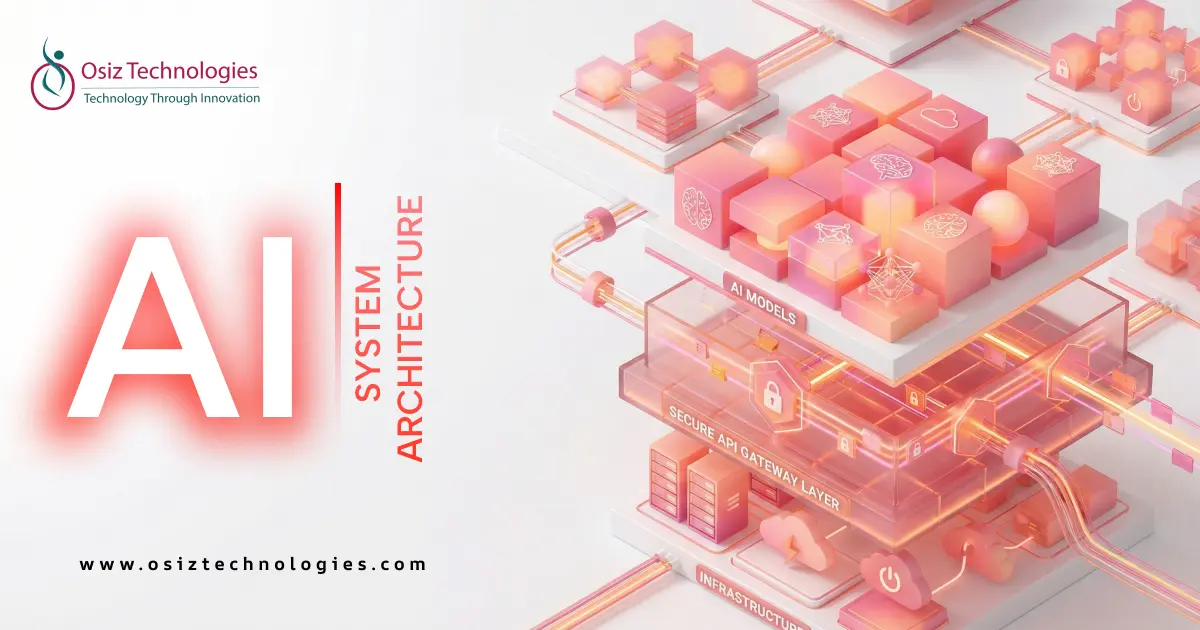
Today’s technology depends on organized frameworks within artificial intelligence to turn unprocessed information into practical understanding, also shaping responsive user interactions. Beginning with purposeful design methods in AI-driven products, companies build adaptable infrastructures meeting wide-ranging business and personal demands alongside improved workflow results.
What Is an AI System Architecture?
An AI System Architecture is the core, end-to-end structure that outlines the design, elements, and workflows of an artificial intelligence system. It acts as a comprehensive blueprint, illustrating how data pipelines, machine learning models, infrastructure, and human involvement integrate to collect data, produce predictions, and deliver smart, actionable outcomes.
Understanding AI System Architecture
Beginning with structure, AI System Architecture defines how components connect across a full workflow, guiding information from the entry point toward useful results. Data moves step by step through linked stages, shaped by intentional layout rather than random setup. Found within are processing engines dedicated to models, systems handling background tasks, interfaces allowing external connections, along with screens where users engage.
Functionality remains stable when each segment performs as intended, supported by clear divisions of labor. Clarity in design supports long-term growth, easier updates, and fewer breakdowns during expansion. Builders gain precision in crafting enterprise-grade applications because insight into framework behavior removes guesswork.
A modern AI system splits duties into parts like data handling, model math, server work, interface links, and how users interact. Because functions are apart, changes happen without breaking other pieces. Layers grow when needed, respond faster, yet stay clean inside. Design choices here shape how easily machine learning tools join company systems. Structure matters most when updates arrive often.
A solid structure for an AI system allows each part to begin with data collection, then processing, and finally output function together without conflict. When demand increases, operations remain fast, responsive, and stable due to carefully aligned layers. Every successful artificial intelligence product is built on deliberate design, not random guesswork. This clarity ensures that results match the objectives defined by both users and stakeholders.
Data Layer - The Foundation of AI Systems
Beneath each artificial intelligence setup lies a framework handling information flow, gathering inputs from diverse origins both organized and free-form. Instead of relying on chance, automated workflows prepare material carefully, delivering uniformity so learning systems build decisions on dependable foundations. Storage methods adapt depending on needs: relational setups, flexible databases, or remote servers scale according to how much arrives, how fast it moves, and its format type.
This process starts with cleaning raw data, scaling values to a consistent range, and transforming features to prepare the data for algorithmic analysis. With this solid foundation, artificial intelligence systems achieve greater accuracy and improved predictive capabilities.
Still further, rules around access, privacy, and safety take shape within the data tier, upholding both organizational policies and confidence among users. Transparency emerges through careful handling of metadata along with clear records showing how information moves during development cycles.
Model Layer - The AI Brain
Within the structure, intelligence emerges through algorithms, neural frameworks, and forecasting systems designed for artificial intelligence creation. From information supplied by storage components, interpretations such as forecasts, groupings, or suggestions are formed. Smooth integration across broader operational sequences depends on carefully structured software design.
Training models follows repeated adjustments, refinement of settings, then confirmation through testing so Enterprise AI systems reach required precision and speed. Because frameworks exist for building Machine Learning platforms, updates happen automatically, changes are tracked carefully, and behavior stays under observation. From here, decision-making capability flows into system operations alongside interface functions, unseen but essential.
Here, explanation methods sit alongside mechanisms for monitoring mistakes and choosing models each shaped by organizational aims and regulatory needs. Deployment flows built for scale make shifting between settings manageable without reworking core logic. What emerges feeds into system operations and connects outward through interface points.
Backend Logic & Processing Layer
Computations begin where the backend logic takes shape, linking data adjustments with output flows inside AI development cycles. When response times stay minimal, systems reveal resilience under load - especially evident during live or grouped task handling. Structure matters most when growth is expected; well-planned back-ends allow steady links to external interfaces without disruption. A section divides into two parts. Following this, a second segment appears separately. Each portion stays distinct within the structure
This level handles company procedures, inquiries from users, because of triggers initiated by model results, preserving steady operations within software. Because workflows change often, organized frameworks for AI adapt through prioritized task queues alongside an efficient allocation of computing assets. Interactions stay stable during background computations due to consistent coordination linking stored information, analytical engines, and also interface layers.
The third division is divided into three separate sections that follow sequentially without overlapping. Each section contains unique elements not shared with the others. When security measures are triggered, system logs record every action, and errors are managed via backend mechanisms to maintain data accuracy and adherence to Enterprise AI solutions. While design enhancements aim to boost efficiency, computational requirements increase steadily even under high load, irrespective of interface performance.
API & Integration Layer
Beginning with communication between systems, the API layer provides model functions along with underlying services to apps and outside platforms using uniform entry points. Rather than isolated operations, data outcomes like forecasts or insights become reachable instantly through these interfaces. Despite complexity behind the scenes, consistent design supports smooth interaction among parts of an artificial intelligence setup while handling growth efficiently.
Where integration frameworks manage authentication, they also control versioning alongside directing requests - each step supports steady performance within AI product workflows. Because these systems regulate access, external tools gain entry to artificial intelligence functions while integrity remains intact. Starting with API structures, connections form between hidden analytical layers and interfaces people interact with, which results in adaptable design growth.
Despite its simplicity, the API layer enables tracking, rate control, and record keeping to meet operational clarity and regulatory needs. A standardized approach to building Machine Learning platforms maintains steady data movement, proper response to failures, and connections to outside analysis systems. What lies beneath the surface the structure of the API shapes how well a system grows, performs, and feels during use.
Frontend & User Experience Layer
Through web, mobile, or desktop platforms, insight delivery happens via artificial intelligence at the interface level. With a focus on responsiveness, interaction paths adapt smoothly during use. Outputs from models appear instantly, shaped into visual forms users recognize quickly. Designed around people, function becomes clear, and action follows naturally when systems behave predictably. Clarity emerges where complexity once lived quietly beneath surfaces meant for human hands.
Despite relying on backend systems, front-ends retrieve predictive outputs through secure API pathways. Instead of static displays, interfaces adapt using real-time data streams. Visual tools shape insights into structured dashboards, periodic summaries, or triggered notifications. Efficiency emerges when responsiveness aligns with intuitive navigation patterns across devices.
Even though it is simple, the front-end layer converts complex model outputs into actionable insights for business decisions or user engagement.With thoughtful design, AI software achieves consistent enhancements, fast response times, and smooth interaction. User engagement with AI tools tends to increase when interfaces are thoughtfully crafted.
Monitoring, Scaling & Security
Above all, observing how models perform includes checking their accuracy alongside system stability and human engagement during development cycles. When irregularities appear such as breakdowns or slowdowns notifications activate while visual summaries highlight concerns without delay. Resilience in large-scale environments grows stronger when systems consistently report status updates through automated observation tools.
When demand rises, systems adjust capacity automatically so processing speed stays consistent across scalable artificial intelligence platforms. Rather than slow down, performance holds steady through smart distribution of tasks and data storage methods. Efficiency improves when work spreads across multiple servers instead of relying on a unit. Frameworks built for expansion manage surges without disruption during peak usage periods.
Throughout AI in architecture, protection of data, model outputs, and user exchanges depends on structured safeguards. Where role-specific permissions apply, encryption methods support them - risk reduces without weakening performance. System reliability continues when oversight matches regulatory demands. Trust develops when consistency and safety are present together. Compliance is achieved naturally through built-in safeguards, not through extra procedures.
Deployment & Infrastructure
Deployment means packaging models, APIs, and frontend components into stable environments for production use in AI Product Development pipelines. Infrastructure needs include containerization, orchestration, and cloud provisioning for the best performance. Deployment makes sure that AI capabilities reach end-users and systems reliably.
Infrastructure design provides high availability, fault tolerance, and redundancy across Enterprise AI solutions. Scalable Machine Learning Platform Development guarantees that compute-heavy tasks are distributed well and managed under different workloads. Deployment pipelines create reproducible, manageable, and strong AI systems.
The deployment layer incorporates monitoring, logging, and automated updates to maintain seamless AI software operations. Robust infrastructure enables rapid modifications, version management, and system recovery during failures. A production-ready deployment ensures the continuous delivery of scalable AI solutions to end-users.
Conclusion
Build reliable AI products that actually work and scale; you need to get the architecture right from the start. Osiz, a leading AI development company, specializes in creating end-to-end AI Product Development pipelines that integrate data layers, model layers, backend logic, APIs, and user-facing interfaces. Our team knows the ins and outs of AI model development, machine learning platforms, and enterprise-level systems, so you get solutions that are secure, scalable, and won’t turn into a maintenance nightmare. With strong architecture, it’s easy for businesses to update their products and stay on top of shifting market demands.
Listen To The Article

Founder & CEO Osiz Technologies
Mr. Thangapandi, the CEO of Osiz, has a proven track record of conceptualizing and architecting 100+ user-centric and scalable solutions for startups and enterprises. He brings a deep understanding of both technical and user experience aspects. The CEO, being an early adopter of new technology, said, "I believe in the transformative power of AI to revolutionize industries and improve lives. My goal is to integrate AI in ways that not only enhance operational efficiency but also drive sustainable development and innovation." Proving his commitment, Mr. Thangapandi has built a dedicated team of AI experts proficient in coming up with innovative AI solutions and have successfully completed several AI projects across diverse sectors.
Recent Blogs




No 22,Astalakshmi Nagar, Thanakankullam, (Opp Seetha lakshmi Mill gate Bus stop) Thirunagar, Madurai - 625 006.
(Corporate Office)


Canada Office address, 1150, Rue Patrick, Laval, Quebec - H7Y 2C4, Canada.
(Sales Office)


Halloween
Offers

 Artificial Intelligence
- AI Development
- AI Predictive Analytics Services
- AI SaaS Development
- RAG Development
- AI Assistant Development
- ChatGPT Development
- Data Analytics Services
- AI Copilot Development
- Adaptive AI Development
- Machine Learning Development
- NLP
- AI Consulting Services
- AI Software Builder
- AI Token Development
- AI Integration Services
- Enterprise AI Solution
- AI As a Service
- AI Marketing Tools
- AI Video Generator
- Computer Vision Services
- Explore AI
- Dataset
- Machine Learning in Healthcare
- Machine Learning in Retail
- Hire AI Engineers
- Hire Prompt Engineers
- Hire ChatGPT Developers
- Hire Stable Diffusion Developers
- Hire Action Transformer Developers
- Blockchain
- Blockchain Development
- Private Blockchain Development
- Smart Contract Development
- Custom Blockchain Development
- Solana Blockchain Development
- Polygon Blockchain Development
- Public Blockchain Development
- DAO Blockchain Development
- Binance Smart Chain (BSC) Blockchain Development
- DApp Development
- Solana DApp Development
- White Label Blockchain Solutions
- Custom Blockchain On Avalanche
- Custom Blockchain On Polygon
- Blockchain Game Development
- Blockchain Consulting Services
- Blockchain Explorer Development
- Ethereum Blockchain Development
- TRON Blockchain Development
- Prediction Market Platform Development Company
Layer 1 & 2 Solutions- Layer-1 Blockchain Development
- Cross Chain Bridge Development
- Data Availability Layer Development
- Ethereum Layer 2 Scaling Solutions
- Cross-L2 DEX Solution
- Layer 2 Token Development
- Layer 2 Token Marketing
- Layer 2 Cryptocurrency Development
- Layer 2 Solutions For Blockchain Games
- Layer 2 Solutions For Web3 Gaming
- Layer 2 Blockchain Solutions
- Rollups As A Service
- Optimistic Rollups Development
- ZK Tech Development
- Bitcoin Layer 2 Solutions
Crypto Exchange- Cryptocurrency Exchange Development
- White Label Crypto Exchange
- Decentralized Exchange Development
- P2P Exchange Development
- Crypto Derivatives Exchange Development
- Centralized Exchange Development
- Crypto Exchange Clone Script
- Cryptocurrency Exchange App Development
- OTC Exchange Development
- Exchange Listing Services
- Binance Like Exchange Development
- Bitstamp Like Exchange Development
- Crypto Exchange Script
CryptoCrypto WalletToken Standards- Token Development
- AI Token Development
- RWA Tokenization Development
- Coinremitter Clone Script
- Asset Tokenization
- Real Estate Tokenization
- Tokenization Platform Development
- Crypto ETF Development
- Solona Token Development
- Semi-Fungible Token Development
- BEP20 Token Development
- Ethereum Token Development
- ERC1400 Token Development
- ERC998 Token Development
- ERC 721 Token Development
- ERC20 Token Development
- Defi Token Development
- ERC1155 Token Development
- BEP721 Token Development
- Utility Token Development
- ERC 777 Token Development
- ERC 827 Token Development
- Social Token Development
- Metaverse Token Development
- Tron Token Development
- ERC404 Token Development
- Governance Token
- Shibarium Token
- polygon Token
- BRC-20
- TRC20 Token Development
- TRC10 Token Development
- Soulbound Token Development
- NFT Token Development
Trading BotsClone- Crypto Exchange Clone Script
- Binance Clone Script
- Metamask Clone Script
- Coinbase Clone Script
- Kucoin Clone Script
- Paxful Clone Script
- Remitano Clone Script
- Wazirx Clone Script
- ByBit Clone Script
- Bitfinex Clone Script
- MEXC Clone Script
- Bitget Clone Script
- Cointool App Clone Script
- Trust Wallet Clone App
- Coinmarketcap Clone Script
- Changelly Clone Script
- BingX Clone Script
CybersecurityApp SecurityDigital Forensics & Incident ResponseAudit & ConsultingEducation & TrainingSolutionsWeb 3DeFi- Decentralized Finance (DeFi) Development
- DeFi Lending/ Borrowing Platform Development
- DeFi Staking Platform Development
- DeFi Token Development
- DeFi Wallet Development
- DeFi Smart Contract Development
- DeFi DApp Development
- Decentralized Exchange Development
- DeFi Insurance Development
- DeFi Crypto Synthetic Assets Development
Game Development- Game Development
- Android Game Development
- IOS Game Development
- Metaverse Game Development
- VR Game Development
- AI Game Development
- Unity 3D Game Development
- Unreal Engine Game Development
- Mobile Game Development
- Blockchain Game Development
- NFT Game Development
- Play to Earn Game Development
- Move to Earn Game Development
- Casino Game Development
- Slot Game Development
- Poker Game Development
- AAA Game Development
- AR Game Development
- Social Network Game Development
- Gamification Services
- Decentralized Sports Betting Platform
- Sports Betting Dapp Development
- Blockchain Casino Game Development
- Game Asset Creation
- Baccarat Game Development
- Rollbit Clone Script
- Fortnite Clone Script
- Slot Game Development
- Tap to Earn Game Development
- Slot Game Development
Metaverse Platforms- Metaverse Game Development
- Metaverse Event Platform Development
- Metaverse Virtual Mall Development
- Metaverse NFT Marketplace Development
- Metaverse Token Development
- Metaverse Virtual Land Development
- Metaverse Avatar Development
- Metaverse 3d Space Development
- Metaverse Real Estate Development
- Metaverse Social Media Platform Development
- Top 10 Metaverse Development Company
- Metaverse Business Ideas
- Metaverse Launchpad Development
- Metaverse App Development
- Metaverse Casino Game Development
NFT SolutionsNFT Platforms- NFT Minting Development
- NFT Token Development
- NFT Exchange Platform Development
- NFT Launchpad Development
- NFT Fashion Marketplace Development
- NFT Art Marketplace Development
- NFT Music Marketplace Development
- Carbon Credits NFT Marketplace Development
- Binance NFT Marketplace Development
- Polygon NFT Marketplace Development
- Solana NFT Marketplace Development
- Influencers NFT Marketplace Development
- NFT Ticketing Marketplace Development
- DeFi NFT Marketplace Development
- NFT Fantasy Sports Platform Development
- NFT Storage Development
- NFT Lending Platform Development
- Top10 NFT Business Ideas
NFT Game ClonesSustainabilityServiceNow - Blog
- Contact Us
- Works