
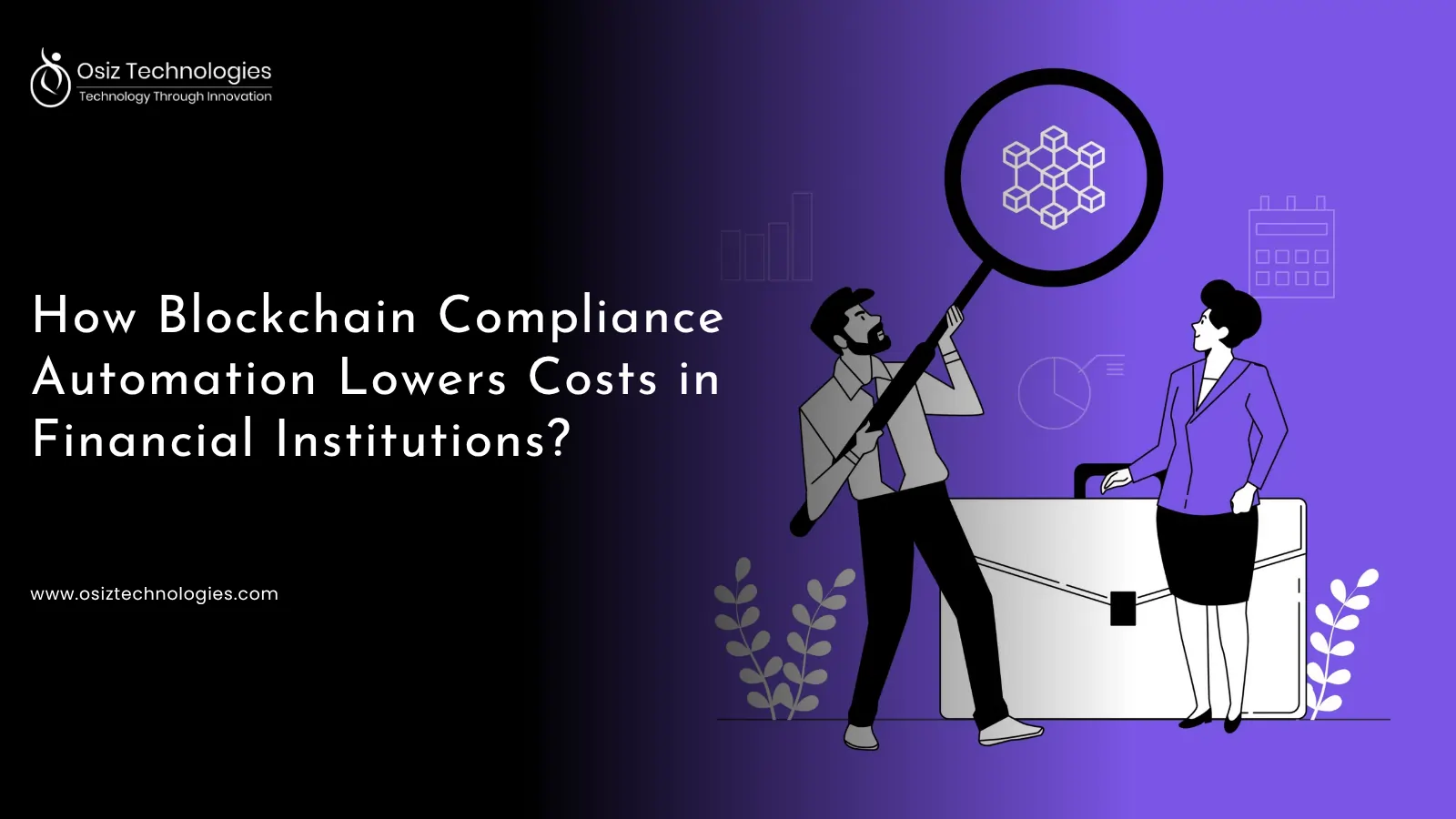
Rising financial regulations are driving demand for Blockchain Compliance Automation to streamline operations and reduce compliance risks. As blockchain adoption grows in financial institutions, organizations are implementing efficient compliance systems aligned with regulatory and performance goals.
Understanding Compliance in Financial Institutions
Compliance within financial institutions guarantees strict following of laws, regulations, and ethical guidelines to stop fraud, money laundering, and market manipulation essential for ensuring system stability, safeguarding consumers, and avoiding heavy fines. Key elements encompass Anti-Money Laundering (AML), Know Your Customer (KYC), risk management, and data privacy.
How Blockchain Compliance Automation Lowers Costs in Financial Institutions?
Reduced Manual Processing Costs
By implementing Blockchain Compliance Automation financial institutions eliminate repetitive manual tasks involved in compliance verification and reporting which significantly reduces operational expenses while automation ensures faster processing and fewer human errors within Automated Compliance Systems that improve accuracy and efficiency while this streamlined approach allows institutions to allocate resources more effectively.
Enhanced Data Transparency and Accuracy
Using Blockchain Audit Solutions ensures that all compliance data is recorded in an immutable ledger providing real-time transparency and accuracy across financial operations while this reduces discrepancies and minimizes the need for costly reconciliations within Blockchain for Banking Compliance frameworks that enhance trust and reliability while improved data consistency supports faster regulatory approvals.
Efficient KYC and Identity Verification
Through Blockchain Identity Management institutions can automate identity verification processes reducing onboarding time and associated compliance costs while KYC Automation Blockchain systems eliminate duplication and ensure consistent data validation across platforms while this leads to faster customer acquisition and reduced operational overhead while paving the way for streamlined AML monitoring systems.
Real-Time AML Monitoring and Risk Detection
With AML Compliance Blockchain financial institutions gain real-time monitoring capabilities that detect suspicious activities instantly reducing the cost of fraud investigations and regulatory penalties while these systems operate continuously within Smart Compliance Systems that enhance security and compliance efficiency while proactive risk detection minimizes financial losses while leading to improved reporting and audit readiness.
Simplified Regulatory Reporting
Automated reporting through Regulatory Compliance Blockchain solutions reduces the time and cost associated with preparing and submitting compliance reports while these systems generate accurate reports directly from blockchain data ensuring consistency and reliability within Blockchain Compliance Solutions frameworks while this eliminates the need for extensive manual intervention while enabling faster response to regulatory requirements.
Strengthened Security and Fraud Prevention
Integrating Blockchain Security in Finance ensures that compliance data is protected against unauthorized access and tampering reducing the cost of data breaches and fraud incidents while secure decentralized systems enhance trust within Blockchain in Financial Institutions by maintaining data integrity and confidentiality while improved security reduces financial risks while completing the cycle of cost-efficient compliance management.
Practical Use Cases of Blockchain Compliance Automation in Cost-Effective Banking
Automated KYC Verification
Blockchain makes it possible to verify customer identities once and reuse that data securely across multiple systems. This removes the need for repeating the same KYC process again and again.
AML Transaction Monitoring
Transactions recorded on a blockchain can be tracked in real time, making it easier to monitor financial activity. Banks can detect odd patterns swiftly without depending on several systems, lowering monitoring expenses and enhancing compliance effectiveness.
Cross-Border Payment Compliance
International transactions typically require multiple verification steps and involve various third parties, but blockchain streamlines the process by performing compliance checks within one unified system.
Regulatory Reporting Automation
Blockchain keeps a clear and permanent record of all transactions, which makes reporting much easier. Banks can produce reports directly from the system, eliminating the need for manual tasks and thereby reducing both labor effort and audit-related expenses.
Fraud Detection and Risk Management
Since blockchain records cannot be changed, it becomes easier to track and identify suspicious activities. Banks can detect odd activities early, act promptly to prevent problems from escalating, thereby minimizing financial losses and reducing the demand for extensive risk.
Smart Contract-Based Compliance
Smart contracts automatically enforce rules during transactions, ensuring that all actions follow compliance requirements. This minimizes the requirement for manual reviews and approvals, helping banks ensure consistency and reduce operational expenses.
Why Financial Institutions Should Adopt Blockchain Automation?
Improved Operational Efficiency
Adopting Blockchain Compliance Automation enables financial institutions to streamline processes and reduce delays associated with traditional compliance systems while Automated Compliance Systems enhance workflow efficiency and minimize bottlenecks across operations while improved efficiency leads to faster decision-making and better resource utilization.
Scalable Compliance Infrastructure
With Blockchain Compliance Solutions institutions can build scalable compliance frameworks that adapt to increasing transaction volumes and regulatory complexities while Blockchain in Financial Institutions supports flexible system upgrades without disrupting operations while scalability ensures long-term sustainability while leading to enhanced transparency benefits.
Greater Transparency and Trust
Using Blockchain for Banking Compliance ensures transparent record-keeping that builds trust among regulators and stakeholders while immutable ledgers provide verifiable data within Blockchain Audit Solutions that enhance accountability and credibility while increased trust improves regulatory relationships while transitioning into cost optimization advantages.
Significant Cost Reduction
Implementing Blockchain Cost Reduction Finance strategies helps institutions lower operational and compliance costs by eliminating redundancies and improving process efficiency while automation reduces dependency on manual resources within Financial Compliance Automation frameworks that deliver measurable savings.
Enhanced Security and Data Integrity
Leveraging Blockchain in Finance ensures robust protection of sensitive compliance data while decentralized systems prevent unauthorized modifications within Regulatory Compliance Blockchain environments that maintain data integrity while secure systems reduce risks and liabilities while paving the way for improved customer experience.
Faster Customer Onboarding
Through Digital Identity KYC Blockchain integration institutions can accelerate onboarding processes while maintaining compliance with regulatory standards while KYC Automation Blockchain ensures seamless identity verification that enhances user experience while faster onboarding improves customer satisfaction while completing the adoption advantages cycle.
Conclusion
The adoption of Blockchain Compliance Automation is transforming how financial institutions manage regulatory requirements by reducing costs improving efficiency and enhancing transparency across operations while as a leading blockchain development company Osiz delivers advanced Blockchain Compliance Solutions that align with evolving industry standards and operational goals while by integrating Smart Compliance Systems and secure automation frameworks institutions can achieve scalable and cost-effective compliance management while this approach ensures long-term growth resilience and a competitive edge in the financial ecosystem.
Listen To The Article

Founder & CEO Osiz Technologies
Mr.Thangapandi, the founder and CEO of Osiz, is a pioneering figure in the field of blockchain technology. His deep understanding of both blockchain technology and user experience has led to the creation of innovative and successful blockchain solutions for businesses and startups, solidifying Osiz's reputation as a reliable service provider in the industry. Because of his unwavering quest for innovation, Mr.Thanga Pandi is well-positioned to be a thought leader and early adopter in the rapidly changing blockchain space. He keeps Osiz at the forefront of this exciting industry with his forward-thinking approach.
Recent Blogs





No 22,Astalakshmi Nagar, Thanakankullam, (Opp Seetha lakshmi Mill gate Bus stop) Thirunagar, Madurai - 625 006.
(Corporate Office)


Canada Office address, 1150, Rue Patrick, Laval, Quebec - H7Y 2C4, Canada.
(Sales Office)


Meydan Grandstand, 6th floor, Meydan Road, Nad Al Sheba, Dubai, U.A.E.
(Sales Office)


Halloween
Offers

 Artificial Intelligence
- AI Development
- AI Predictive Analytics Services
- AI SaaS Development
- RAG Development
- AI Assistant Development
- ChatGPT Development
- Data Analytics Services
- AI Copilot Development
- Adaptive AI Development
- Machine Learning Development
- NLP
- AI Consulting Services
- AI Software Builder
- AI Token Development
- AI Integration Services
- Enterprise AI Solution
- AI As a Service
- AI Marketing Tools
- AI Video Generator
- Computer Vision Services
- Explore AI
- Dataset
- Machine Learning in Healthcare
- Machine Learning in Retail
- Hire AI Engineers
- Hire Prompt Engineers
- Hire ChatGPT Developers
- Hire Stable Diffusion Developers
- Hire Action Transformer Developers
- Blockchain
- Blockchain Development
- Private Blockchain Development
- Smart Contract Development
- Custom Blockchain Development
- Solana Blockchain Development
- Polygon Blockchain Development
- Public Blockchain Development
- DAO Blockchain Development
- Binance Smart Chain (BSC) Blockchain Development
- DApp Development
- Solana DApp Development
- White Label Blockchain Solutions
- Custom Blockchain On Avalanche
- Custom Blockchain On Polygon
- Blockchain Game Development
- Blockchain Consulting Services
- Blockchain Explorer Development
- Ethereum Blockchain Development
- TRON Blockchain Development
- Prediction Market Platform Development Company
Layer 1 & 2 Solutions- Layer-1 Blockchain Development
- Cross Chain Bridge Development
- Data Availability Layer Development
- Ethereum Layer 2 Scaling Solutions
- Cross-L2 DEX Solution
- Layer 2 Token Development
- Layer 2 Token Marketing
- Layer 2 Cryptocurrency Development
- Layer 2 Solutions For Blockchain Games
- Layer 2 Solutions For Web3 Gaming
- Layer 2 Blockchain Solutions
- Rollups As A Service
- Optimistic Rollups Development
- ZK Tech Development
- Bitcoin Layer 2 Solutions
Crypto Exchange- Cryptocurrency Exchange Development
- White Label Crypto Exchange
- Decentralized Exchange Development
- P2P Exchange Development
- Crypto Derivatives Exchange Development
- Centralized Exchange Development
- Crypto Exchange Clone Script
- Cryptocurrency Exchange App Development
- OTC Exchange Development
- Exchange Listing Services
- Binance Like Exchange Development
- Bitstamp Like Exchange Development
- Crypto Exchange Script
CryptoCrypto WalletToken Standards- Token Development
- AI Token Development
- RWA Tokenization Development
- Coinremitter Clone Script
- Asset Tokenization
- Real Estate Tokenization
- Tokenization Platform Development
- Crypto ETF Development
- Solona Token Development
- Semi-Fungible Token Development
- BEP20 Token Development
- Ethereum Token Development
- ERC1400 Token Development
- ERC998 Token Development
- ERC 721 Token Development
- ERC20 Token Development
- Defi Token Development
- ERC1155 Token Development
- BEP721 Token Development
- Utility Token Development
- ERC 777 Token Development
- ERC 827 Token Development
- Social Token Development
- Metaverse Token Development
- Tron Token Development
- ERC404 Token Development
- Governance Token
- Shibarium Token
- polygon Token
- BRC-20
- TRC20 Token Development
- TRC10 Token Development
- Soulbound Token Development
- NFT Token Development
Trading BotsClone- Crypto Exchange Clone Script
- Binance Clone Script
- Metamask Clone Script
- Coinbase Clone Script
- Kucoin Clone Script
- Paxful Clone Script
- Remitano Clone Script
- Wazirx Clone Script
- ByBit Clone Script
- Bitfinex Clone Script
- MEXC Clone Script
- Bitget Clone Script
- Cointool App Clone Script
- Trust Wallet Clone App
- Coinmarketcap Clone Script
- Changelly Clone Script
- BingX Clone Script
CybersecurityApp SecurityDigital Forensics & Incident ResponseAudit & ConsultingEducation & TrainingSolutionsWeb 3DeFi- Decentralized Finance (DeFi) Development
- DeFi Lending/ Borrowing Platform Development
- DeFi Staking Platform Development
- DeFi Token Development
- DeFi Wallet Development
- DeFi Smart Contract Development
- DeFi DApp Development
- Decentralized Exchange Development
- DeFi Insurance Development
- DeFi Crypto Synthetic Assets Development
Game Development- Game Development
- Android Game Development
- IOS Game Development
- Metaverse Game Development
- VR Game Development
- AI Game Development
- Unity 3D Game Development
- Unreal Engine Game Development
- Mobile Game Development
- Blockchain Game Development
- NFT Game Development
- Play to Earn Game Development
- Move to Earn Game Development
- Casino Game Development
- Slot Game Development
- Poker Game Development
- AAA Game Development
- AR Game Development
- Social Network Game Development
- Gamification Services
- Decentralized Sports Betting Platform
- Sports Betting Dapp Development
- Blockchain Casino Game Development
- Game Asset Creation
- Baccarat Game Development
- Rollbit Clone Script
- Fortnite Clone Script
- Slot Game Development
- Tap to Earn Game Development
- Slot Game Development
Metaverse Platforms- Metaverse Game Development
- Metaverse Event Platform Development
- Metaverse Virtual Mall Development
- Metaverse NFT Marketplace Development
- Metaverse Token Development
- Metaverse Virtual Land Development
- Metaverse Avatar Development
- Metaverse 3d Space Development
- Metaverse Real Estate Development
- Metaverse Social Media Platform Development
- Top 10 Metaverse Development Company
- Metaverse Business Ideas
- Metaverse Launchpad Development
- Metaverse App Development
- Metaverse Casino Game Development
NFT SolutionsNFT Platforms- NFT Minting Development
- NFT Token Development
- NFT Exchange Platform Development
- NFT Launchpad Development
- NFT Fashion Marketplace Development
- NFT Art Marketplace Development
- NFT Music Marketplace Development
- Carbon Credits NFT Marketplace Development
- Binance NFT Marketplace Development
- Polygon NFT Marketplace Development
- Solana NFT Marketplace Development
- Influencers NFT Marketplace Development
- NFT Ticketing Marketplace Development
- DeFi NFT Marketplace Development
- NFT Fantasy Sports Platform Development
- NFT Storage Development
- NFT Lending Platform Development
- Top10 NFT Business Ideas
NFT Game ClonesSustainabilityServiceNow - Blog
- Contact Us
- Works