
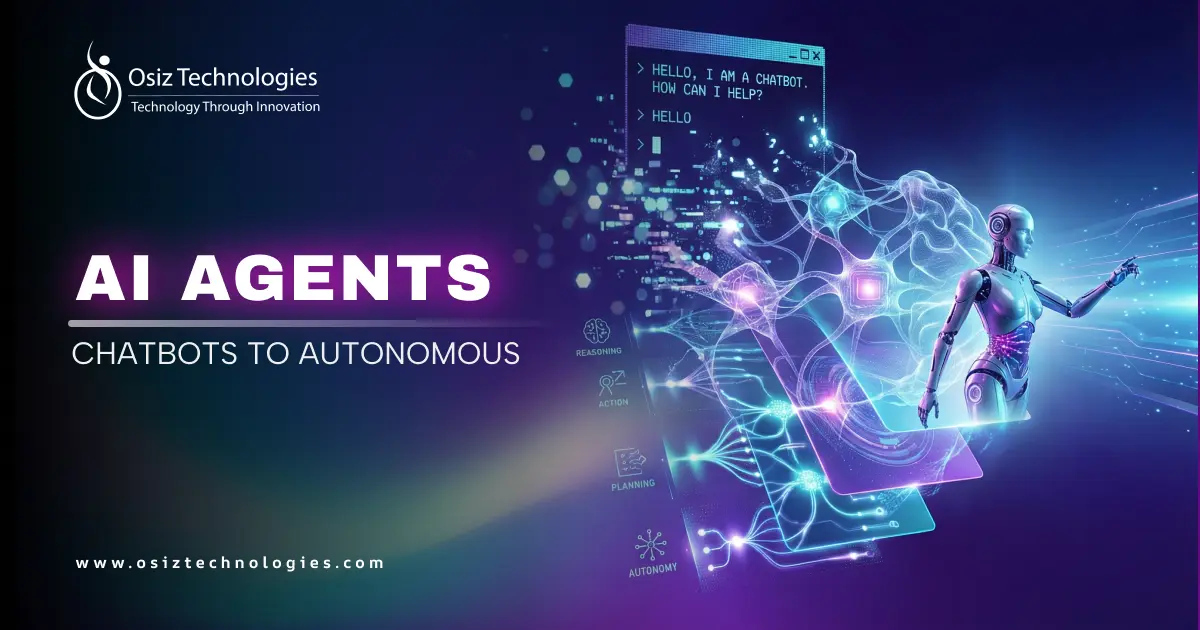
AI is doing more than simple tasks. It's building smart online experiences that guess user needs and act fast. Companies are using AI business automation to simplify work, boost productivity, and offer personalized customer service.
Chatbots: Early Stage AI Assistants
Step 1: Rule-Based Chatbots
Early AI assistants relied on predefined rules and keywords to respond to queries, offering limited functionality and enforcing rigid interaction patterns. They worked well for basic questions and customer help but couldn't handle complicated requests. Even though they had limits, these chatbots started Generative AI helpers and smart online experiences.
Step 2: AI-Enhanced Chatbots
With machine learning and natural language understanding, chatbots could better understand what people meant and get better over time. They gave more precise help, handled longer talks, and learned from past chats. This change connected simple rule-based systems and dynamic AI agents, getting firms ready for more advanced automation.
Step 3: Conversational AI Platforms
Today's AI chatbots and AI platforms allow deeper chats by connecting to CRM systems, knowledge bases, and business apps. They offer suggestions, customized experiences, and help with making choices. Even though conversational AI improved efficiency, people still needed to watch over it, which showed that we need independent systems that can act and learn alone.
Limitations of Traditional Chatbots
Restricted Context Awareness
Typical chatbots can't remember details from earlier in a conversation, so they can't give good answers all the time. They mess up when things get complicated. Because of this, more companies are using smarter AI that can understand what's going on.
Lack of Proactive Decision-Making
Normal chatbots just react to what people say. They don't look at trends or make processes better without someone telling them to. But new AI systems can make their own choices to reach goals.
Scalability Constraints
Deploying chatbots across various locations requires significant effort, and they are difficult to modify as the company expands or circumstances evolve. AI services fix this by learning on their own and working in many places.
Limited Integration Capabilities
AI chat agents don't link up with important systems like ERP or CRM. So, they can't help much with big business tasks or smart choices. AI that uses machine learning can connect to more systems and do more things.
Inability to Learn Independently
Most chatbots need to be retrained to get better. They can't keep learning on their own. Better AI can learn from conversations and data all the time. This helps it make better choices and work faster.
Autonomous AI Agents
Autonomous AI Agents are intelligent software systems capable of sensing their environment, making independent decisions, and taking actions to fulfill goals with little to no human oversight. Unlike basic scripts, they plan ahead, adapt dynamically, and learn from experience to handle intricate, multi-stage tasks. By leveraging AI technologies such as natural language processing and machine learning, these agents understand context, generate their own tasks, and pursue objectives independently, functioning as proactive, self-driven digital entities rather than passive tools.
Real-World Use Cases Across Sectors
1. Autonomous Clinical Decision Support in Healthcare
AI systems can check patient info like vital signs, records, images, and lab results.The system identifies early warning signals and recommends interventions before a physician needs to intervene. As patients' conditions change, the system adjusts accordingly, enhancing treatment outcomes and easing the burden on doctors.
2. Self-Optimizing Fraud Detection in Financial Services
Finance companies use AI to find fraud as it happens. The AI learns what's normal for transactions and user actions and spots when something is different. The system changes how it finds fraud as criminals change their methods, so it lowers false alarms while keeping things safe. This helps financial platforms run without needing people to adjust the rules.
3. Predictive and Autonomous Manufacturing Operations
In factories, AI can run production lines by guessing when machines will fail, changing settings, and planning maintenance on its own. Quality systems using cameras find problems and fix tolerances right away. This means less downtime, more products made, and smoother operations.
4. Autonomous Cybersecurity and IT Self-Healing Systems
AI can find security threats, keep them away from other parts of the system, and put defenses in place without anyone having to do it. For IT, these systems can find what's causing problems, move work around, and get services back up and running automatically. Learning from each event makes the system stronger and faster at fixing problems.
5. Intelligent Supply Chain Orchestration
AI systems can guess what demand will be, manage inventory, change logistics, and adjust supplier plans when things get disrupted. They use market info, weather data, and world events to keep things running smoothly. This helps companies react faster than supply chains that depend on people.
Roadmap for Businesses to Adopt Autonomous AI
Step 1: Assess Automation Opportunities
Look for workflows where AI can make things faster, cut down on manual work, and help with better choices. Pay special attention to tasks that repeat, follow rules, or involve lots of data.
Step 2: Evaluate Data Infrastructure
Make sure you have a good system for gathering, storing, and handling data. Solid data processes and clean data are musts for correct predictions and independent actions.
Step 3: Pilot Autonomous AI Agents
Test agents on a small scale to observe their performance, adaptability, and judgment quality, and assess whether they scale and integrate effectively.
Step 4: Integrate with Enterprise Systems
Connect agents to ERP, CRM, and stats platforms for easy running. Business AI makes sure agents act smart across all parts of the company.
Step 5: Continuous Learning and Optimization
Configure machine learning so agents learn from their actions, outcomes, and human input, leading to continuous enhancements in speed and accuracy.
Step 6: Scale Across Operations
Spread AI use to all workflows, units, and avenues. Deployment that can grow supports smooth digital interactions.
Step 7: Monitor Governance and Compliance
Create guidelines for moral AI use, following rules, and cutting risks. Constant watching makes sure business automation is done well and responsibly at scale.
The Next Big AI Leap
Switching from basic AI chatbots to self-ruling AI shows a move to machines that can think and act on their own. These help change automation and customer help by creating smart online experiences that guess what users want and make things easier to run. More firms are using AI helpers and self-running tools to grow and make better choices. Working with an AI development company like Osiz can help firms create and use self-ruling tools with safe setup and constant learning. As more firms use self-ruling AI, they see better work and smarter tasks that go past normal automation.
Listen To The Article

Founder & CEO Osiz Technologies
Mr. Thangapandi, the CEO of Osiz, has a proven track record of conceptualizing and architecting 100+ user-centric and scalable solutions for startups and enterprises. He brings a deep understanding of both technical and user experience aspects. The CEO, being an early adopter of new technology, said, "I believe in the transformative power of AI to revolutionize industries and improve lives. My goal is to integrate AI in ways that not only enhance operational efficiency but also drive sustainable development and innovation." Proving his commitment, Mr. Thangapandi has built a dedicated team of AI experts proficient in coming up with innovative AI solutions and have successfully completed several AI projects across diverse sectors.
Recent Blogs



No 22,Astalakshmi Nagar, Thanakankullam, (Opp Seetha lakshmi Mill gate Bus stop) Thirunagar, Madurai - 625 006.
(Corporate Office)


Canada Office address, 1150, Rue Patrick, Laval, Quebec - H7Y 2C4, Canada.
(Sales Office)


Meydan Grandstand, 6th floor, Meydan Road, Nad Al Sheba, Dubai, U.A.E.
(Sales Office)


Halloween
Offers

 Artificial Intelligence
- AI Development
- AI Predictive Analytics Services
- AI SaaS Development
- RAG Development
- AI Assistant Development
- ChatGPT Development
- Data Analytics Services
- AI Copilot Development
- Adaptive AI Development
- Machine Learning Development
- NLP
- AI Consulting Services
- AI Software Builder
- AI Token Development
- AI Integration Services
- AI Agent Bots
- Enterprise AI Solution
- AI As a Service
- AI Marketing Tools
- AI Video Generator
- Computer Vision Services
- Explore AI
- Dataset
- Machine Learning in Healthcare
- Machine Learning in Retail
- Hire AI Engineers
- Hire Prompt Engineers
- Hire ChatGPT Developers
- Hire Stable Diffusion Developers
- Hire Action Transformer Developers
- Blockchain
- Blockchain Development
- Private Blockchain Development
- Smart Contract Development
- Custom Blockchain Development
- Solana Blockchain Development
- Polygon Blockchain Development
- Public Blockchain Development
- DAO Blockchain Development
- Binance Smart Chain (BSC) Blockchain Development
- DApp Development
- Solana DApp Development
- White Label Blockchain Solutions
- Custom Blockchain On Avalanche
- Custom Blockchain On Polygon
- Blockchain Game Development
- Blockchain Consulting Services
- Blockchain Explorer Development
- Ethereum Blockchain Development
- TRON Blockchain Development
- Prediction Market Platform Development Company
Layer 1 & 2 Solutions- Layer-1 Blockchain Development
- Cross Chain Bridge Development
- Data Availability Layer Development
- Ethereum Layer 2 Scaling Solutions
- Cross-L2 DEX Solution
- Layer 2 Token Development
- Layer 2 Token Marketing
- Layer 2 Cryptocurrency Development
- Layer 2 Solutions For Blockchain Games
- Layer 2 Solutions For Web3 Gaming
- Layer 2 Blockchain Solutions
- Rollups As A Service
- Optimistic Rollups Development
- ZK Tech Development
- Bitcoin Layer 2 Solutions
Crypto Exchange- Cryptocurrency Exchange Development
- White Label Crypto Exchange
- Decentralized Exchange Development
- P2P Exchange Development
- Crypto Derivatives Exchange Development
- Centralized Exchange Development
- Crypto Exchange Clone Script
- Cryptocurrency Exchange App Development
- OTC Exchange Development
- Exchange Listing Services
- Binance Like Exchange Development
- Bitstamp Like Exchange Development
- Crypto Exchange Script
CryptoCrypto WalletToken Standards- Token Development
- AI Token Development
- RWA Tokenization Development
- Coinremitter Clone Script
- Asset Tokenization
- Real Estate Tokenization
- Tokenization Platform Development
- Crypto ETF Development
- Solona Token Development
- Semi-Fungible Token Development
- BEP20 Token Development
- Ethereum Token Development
- ERC1400 Token Development
- ERC998 Token Development
- ERC 721 Token Development
- ERC20 Token Development
- Defi Token Development
- ERC1155 Token Development
- BEP721 Token Development
- Utility Token Development
- ERC 777 Token Development
- ERC 827 Token Development
- Social Token Development
- Metaverse Token Development
- Tron Token Development
- ERC404 Token Development
- Governance Token
- Shibarium Token
- polygon Token
- BRC-20
- TRC20 Token Development
- TRC10 Token Development
- Soulbound Token Development
- NFT Token Development
Trading BotsClone- Crypto Exchange Clone Script
- Binance Clone Script
- Metamask Clone Script
- Coinbase Clone Script
- Kucoin Clone Script
- Paxful Clone Script
- Remitano Clone Script
- Wazirx Clone Script
- ByBit Clone Script
- Bitfinex Clone Script
- MEXC Clone Script
- Bitget Clone Script
- Cointool App Clone Script
- Trust Wallet Clone App
- Coinmarketcap Clone Script
- Changelly Clone Script
- BingX Clone Script
CybersecurityApp SecurityDigital Forensics & Incident ResponseAudit & ConsultingEducation & TrainingSolutionsWeb 3DeFi- Decentralized Finance (DeFi) Development
- DeFi Lending/ Borrowing Platform Development
- DeFi Staking Platform Development
- DeFi Token Development
- DeFi Wallet Development
- DeFi Smart Contract Development
- DeFi DApp Development
- Decentralized Exchange Development
- DeFi Insurance Development
- DeFi Crypto Synthetic Assets Development
Game Development- Game Development
- Android Game Development
- IOS Game Development
- Metaverse Game Development
- VR Game Development
- AI Game Development
- Unity 3D Game Development
- Unreal Engine Game Development
- Mobile Game Development
- Blockchain Game Development
- NFT Game Development
- Play to Earn Game Development
- Move to Earn Game Development
- Casino Game Development
- Slot Game Development
- Poker Game Development
- AAA Game Development
- AR Game Development
- Social Network Game Development
- Gamification Services
- Decentralized Sports Betting Platform
- Sports Betting Dapp Development
- Blockchain Casino Game Development
- Game Asset Creation
- Baccarat Game Development
- Rollbit Clone Script
- Fortnite Clone Script
- Slot Game Development
- Tap to Earn Game Development
- Slot Game Development
Metaverse Platforms- Metaverse Game Development
- Metaverse Event Platform Development
- Metaverse Virtual Mall Development
- Metaverse NFT Marketplace Development
- Metaverse Token Development
- Metaverse Virtual Land Development
- Metaverse Avatar Development
- Metaverse 3d Space Development
- Metaverse Real Estate Development
- Metaverse Social Media Platform Development
- Top 10 Metaverse Development Company
- Metaverse Business Ideas
- Metaverse Launchpad Development
- Metaverse App Development
- Metaverse Casino Game Development
NFT SolutionsNFT Platforms- NFT Minting Development
- NFT Token Development
- NFT Exchange Platform Development
- NFT Launchpad Development
- NFT Fashion Marketplace Development
- NFT Art Marketplace Development
- NFT Music Marketplace Development
- Carbon Credits NFT Marketplace Development
- Binance NFT Marketplace Development
- Polygon NFT Marketplace Development
- Solana NFT Marketplace Development
- Influencers NFT Marketplace Development
- NFT Ticketing Marketplace Development
- DeFi NFT Marketplace Development
- NFT Fantasy Sports Platform Development
- NFT Storage Development
- NFT Lending Platform Development
- Top10 NFT Business Ideas
NFT Game ClonesSustainabilityServiceNow - Blog
- Contact Us
- Works