
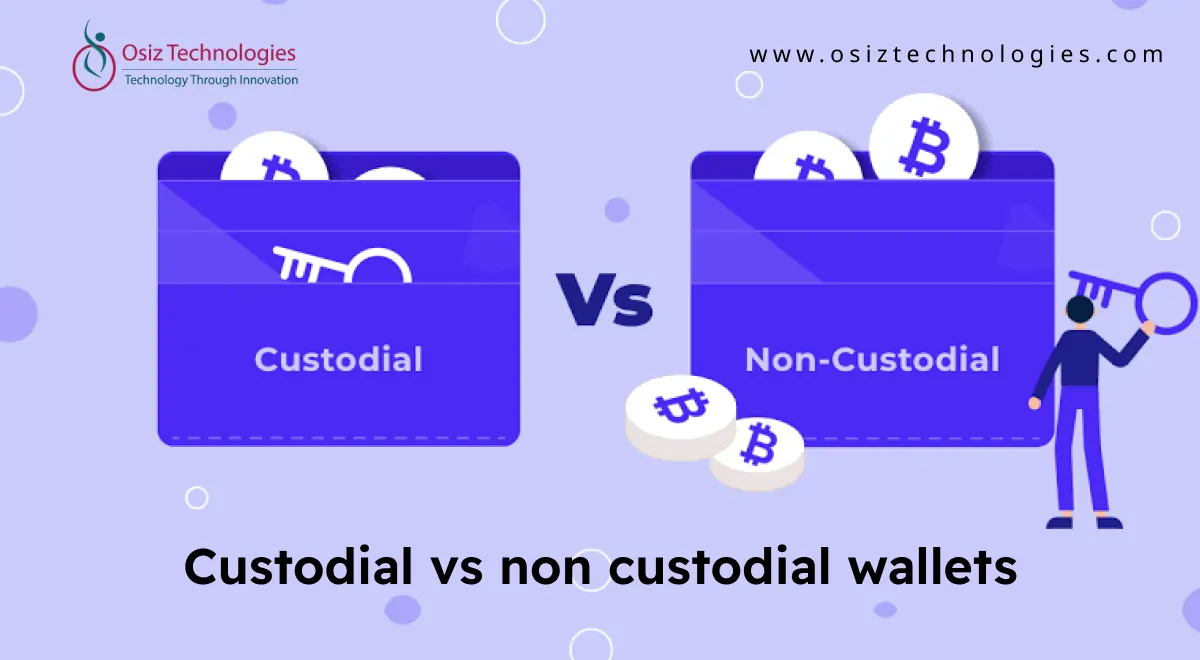
As more people use crypto, picking the correct storage is a key choice for all digital asset users. Custodial and non-custodial wallets are two different ways to handle security, access, and control. Knowing how each works will guide users to select a wallet that fits their trading style, risk level, and what they want in the long run.
What Is a Custodial Wallet?
A custodial wallet is a type of cryptocurrency wallet in which a third party, like a cryptocurrency exchange, stores and manages your private keys. As a result, that third party controls your funds and is responsible for their security, offering a convenient solution for users who prefer to trust the provider with security and a simple login process instead of handling keys personally.
How it Works?
When someone signs up on a custodial platform, we create and keep their private keys safe. They just need to remember their login info. We handle wallet backups, security, and recovery.
User sends or gets crypto; the system authorizes and signs the blockchain transactions. This makes sending simple and quick, so users don't have to mess with the blockchain directly.
Custodial service uses security measures such as multi-signature authorization, cold storage, and fraud checks to keep user funds safe.
Pros
Simple to Use
Custodial wallets are easy for beginners since they handle private keys and security automatically. Users can send, store, and receive cryptocurrency without needing any technical knowledge.
Easy Account Recovery
If access is lost, the provider can assist in recovering the account via verification, making custodial wallets a safer option for those concerned about forgetting passwords or losing private keys.
Cons
Limited Control over Funds
When using a platform that stores your private keys, you lose direct control over your cryptocurrency. Your assets are subject to the platform's policies, security measures, and operational stability.
Platform Breach or Shutdown Risks
If the service is hacked or stops letting people take out money, you might not be able to get to your assets. Users deal with risks tied to how secure the provider is and how stable they are financially.
What Is a Non-Custodial Wallet?
A non-custodial wallet puts complete control and responsibility for your private keys in your hands, giving you full authority over your crypto assets. Unlike custodial wallets where exchanges or third parties manage your keys, you remain in full control of your transactions and funds. No external party can freeze or interfere with your activities, but this also means you must securely store your private keys and seed phrase; if you lose them, you’ll permanently lose access to your assets.
How it Works?
A non-custodial wallet makes a private key and recovery phrase right on your device. You’re in complete control from the start since these keys stay on your device.
When sending crypto, the wallet uses your private key to approve the transaction instantly, proving it's you without ever revealing the key to anyone else.
After approval, the wallet sends the transaction to the blockchain network for confirmation. The network checks the approval, confirms the transaction, and then saves it on the ledger.
Pros
Full Control of Assets
Hold your own private keys to own your cryptocurrency fully; no one can freeze or access your funds.
Higher Security & Privacy
Keys remain with you, reducing the risk of hacks or data breaches. You gain enhanced privacy and greater control over your personal information.
Cons
No Recovery if Keys Are Lost
If you lose your seed phrase or private key, you will not be able to get your access back. There is no way to recover your funds if this happens.
More Responsibility for Users
You need to ensure your device is secure, handle your own backups, and watch out for phishing attempts. This can be a lot to handle if you're just starting.
Custodial vs Non-Custodial: Head-to-Head Comparison
1. Control
Custodial Wallet
Keep the keys; this means you're placing trust in us to handle your money. It reduces your burden, but you still don't have full ownership of your assets.
Non-Custodial Wallet
Hold onto your own keys; this gives you full control. You own everything outright, free from dependence on anyone else's permission.
2. Security
Custodial Wallet
Security keeps you safe, and while having robust systems, breaches are still possible. Benefit from our advanced protection, but you remain at risk if our platform is compromised.
Non-Custodial Wallet
Security lies in your hands, guarding you against central attacks. However, if you lose your keys or compromise your security, you might lose everything.
3. Privacy
Custodial Wallet
Most custodial services require KYC verification, meaning personal data must be shared. This reduces anonymity but increases regulatory compliance.
Non-Custodial Wallet
No personal information is required, allowing transactions to remain private. The absence of KYC provides strong anonymity and user independence.
4. Ease of Use
Custodial Wallet
Designed for beginners with simple interfaces and customer support. Users don’t need technical knowledge to manage or recover funds.
Non-Custodial Wallet
Requires more understanding of private keys and backups, which may challenge new users. The experience offers more control but demands responsibility.
5. Recovery Options
Custodial Wallet
Platforms offer password resets, account recovery, and customer support if access is lost. This safety net makes it beginner-friendly.
Non-Custodial Wallet
Recovery depends solely on seed phrase backup—losing it means permanent loss of funds. The system prioritizes autonomy over assisted recovery.
Real-World Examples
Custodial wallets
Coinbase: It's simple to use, mainly if you are just getting started with crypto.
Binance: A good pick for both trading and keeping crypto, with custodial wallet choices.
WazirX: It is well-liked in India and provides custodial wallets with crypto trading and staking.
Non-custodial wallets
MetaMask: It's a browser wallet that lets you handle your Ethereum private keys.
Trust Wallet: A great mobile wallet that supports many cryptos, putting you in control.
Ledger: A hardware wallet gives great security by storing your private keys offline.
Conclusion
It's vital to get how crypto wallets do their thing in today's world of digital money. Custodial and non-custodial wallets each serve different needs, whether it's simple access or total control over your private keys. Working with a solid crypto exchange development company like Osiz - means folks and businesses can create digital or blockchain wallets that are safe, can grow, and are easy to use. These can be made just for what they need, making sure money is kept safe and transactions are smooth in the growing crypto game.
Listen To The Article

Founder & CEO Osiz Technologies
Mr. Thangapandi, the CEO of Osiz, has a proven track record of conceptualizing and architecting 100+ user-centric and scalable solutions for startups and enterprises. He brings a deep understanding of both technical and user experience aspects. The CEO, being an early adopter of new technology, said, \"I believe in the transformative power of AI to revolutionize industries and improve lives. My goal is to integrate AI in ways that not only enhance operational efficiency but also drive sustainable development and innovation.\" Proving his commitment, Mr. Thangapandi has built a dedicated team of AI experts proficient in coming up with innovative AI solutions and have successfully completed several AI projects across diverse sectors.
Recent Blogs





No 22,Astalakshmi Nagar, Thanakankullam, (Opp Seetha lakshmi Mill gate Bus stop) Thirunagar, Madurai - 625 006.
(Corporate Office)


Canada Office address, 1150, Rue Patrick, Laval, Quebec - H7Y 2C4, Canada.
(Sales Office)


Halloween
Offers

 Artificial Intelligence
- AI Development
- AI Predictive Analytics Services
- AI SaaS Development
- RAG Development
- AI Assistant Development
- ChatGPT Development
- Data Analytics Services
- AI Copilot Development
- Adaptive AI Development
- Machine Learning Development
- NLP
- AI Consulting Services
- AI Software Builder
- AI Token Development
- AI Integration Services
- Enterprise AI Solution
- AI As a Service
- AI Marketing Tools
- AI Video Generator
- Computer Vision Services
- Explore AI
- Dataset
- Machine Learning in Healthcare
- Machine Learning in Retail
- Hire AI Engineers
- Hire Prompt Engineers
- Hire ChatGPT Developers
- Hire Stable Diffusion Developers
- Hire Action Transformer Developers
- Blockchain
- Blockchain Development
- Private Blockchain Development
- Smart Contract Development
- Custom Blockchain Development
- Solana Blockchain Development
- Polygon Blockchain Development
- Public Blockchain Development
- DAO Blockchain Development
- Binance Smart Chain (BSC) Blockchain Development
- DApp Development
- Solana DApp Development
- White Label Blockchain Solutions
- Custom Blockchain On Avalanche
- Custom Blockchain On Polygon
- Blockchain Game Development
- Blockchain Consulting Services
- Blockchain Explorer Development
- Ethereum Blockchain Development
- TRON Blockchain Development
- Prediction Market Platform Development Company
Layer 1 & 2 Solutions- Layer-1 Blockchain Development
- Cross Chain Bridge Development
- Data Availability Layer Development
- Ethereum Layer 2 Scaling Solutions
- Cross-L2 DEX Solution
- Layer 2 Token Development
- Layer 2 Token Marketing
- Layer 2 Cryptocurrency Development
- Layer 2 Solutions For Blockchain Games
- Layer 2 Solutions For Web3 Gaming
- Layer 2 Blockchain Solutions
- Rollups As A Service
- Optimistic Rollups Development
- ZK Tech Development
- Bitcoin Layer 2 Solutions
Crypto Exchange- Cryptocurrency Exchange Development
- White Label Crypto Exchange
- Decentralized Exchange Development
- P2P Exchange Development
- Crypto Derivatives Exchange Development
- Centralized Exchange Development
- Crypto Exchange Clone Script
- Cryptocurrency Exchange App Development
- OTC Exchange Development
- Exchange Listing Services
- Binance Like Exchange Development
- Bitstamp Like Exchange Development
- Crypto Exchange Script
CryptoCrypto WalletToken Standards- Token Development
- AI Token Development
- RWA Tokenization Development
- Coinremitter Clone Script
- Asset Tokenization
- Real Estate Tokenization
- Tokenization Platform Development
- Crypto ETF Development
- Solona Token Development
- Semi-Fungible Token Development
- BEP20 Token Development
- Ethereum Token Development
- ERC1400 Token Development
- ERC998 Token Development
- ERC 721 Token Development
- ERC20 Token Development
- Defi Token Development
- ERC1155 Token Development
- BEP721 Token Development
- Utility Token Development
- ERC 777 Token Development
- ERC 827 Token Development
- Social Token Development
- Metaverse Token Development
- Tron Token Development
- ERC404 Token Development
- Governance Token
- Shibarium Token
- polygon Token
- BRC-20
- TRC20 Token Development
- TRC10 Token Development
- Soulbound Token Development
- NFT Token Development
Trading BotsClone- Crypto Exchange Clone Script
- Binance Clone Script
- Metamask Clone Script
- Coinbase Clone Script
- Kucoin Clone Script
- Paxful Clone Script
- Remitano Clone Script
- Wazirx Clone Script
- ByBit Clone Script
- Bitfinex Clone Script
- MEXC Clone Script
- Bitget Clone Script
- Cointool App Clone Script
- Trust Wallet Clone App
- Coinmarketcap Clone Script
- Changelly Clone Script
- BingX Clone Script
CybersecurityApp SecurityDigital Forensics & Incident ResponseAudit & ConsultingEducation & TrainingSolutionsWeb 3DeFi- Decentralized Finance (DeFi) Development
- DeFi Lending/ Borrowing Platform Development
- DeFi Staking Platform Development
- DeFi Token Development
- DeFi Wallet Development
- DeFi Smart Contract Development
- DeFi DApp Development
- Decentralized Exchange Development
- DeFi Insurance Development
- DeFi Crypto Synthetic Assets Development
Game Development- Game Development
- Android Game Development
- IOS Game Development
- Metaverse Game Development
- VR Game Development
- AI Game Development
- Unity 3D Game Development
- Unreal Engine Game Development
- Mobile Game Development
- Blockchain Game Development
- NFT Game Development
- Play to Earn Game Development
- Move to Earn Game Development
- Casino Game Development
- Slot Game Development
- Poker Game Development
- AAA Game Development
- AR Game Development
- Social Network Game Development
- Gamification Services
- Decentralized Sports Betting Platform
- Sports Betting Dapp Development
- Blockchain Casino Game Development
- Game Asset Creation
- Baccarat Game Development
- Rollbit Clone Script
- Fortnite Clone Script
- Slot Game Development
- Tap to Earn Game Development
- Slot Game Development
Metaverse Platforms- Metaverse Game Development
- Metaverse Event Platform Development
- Metaverse Virtual Mall Development
- Metaverse NFT Marketplace Development
- Metaverse Token Development
- Metaverse Virtual Land Development
- Metaverse Avatar Development
- Metaverse 3d Space Development
- Metaverse Real Estate Development
- Metaverse Social Media Platform Development
- Top 10 Metaverse Development Company
- Metaverse Business Ideas
- Metaverse Launchpad Development
- Metaverse App Development
- Metaverse Casino Game Development
NFT SolutionsNFT Platforms- NFT Minting Development
- NFT Token Development
- NFT Exchange Platform Development
- NFT Launchpad Development
- NFT Fashion Marketplace Development
- NFT Art Marketplace Development
- NFT Music Marketplace Development
- Carbon Credits NFT Marketplace Development
- Binance NFT Marketplace Development
- Polygon NFT Marketplace Development
- Solana NFT Marketplace Development
- Influencers NFT Marketplace Development
- NFT Ticketing Marketplace Development
- DeFi NFT Marketplace Development
- NFT Fantasy Sports Platform Development
- NFT Storage Development
- NFT Lending Platform Development
- Top10 NFT Business Ideas
NFT Game ClonesSustainabilityServiceNow - Blog
- Contact Us
- Works