
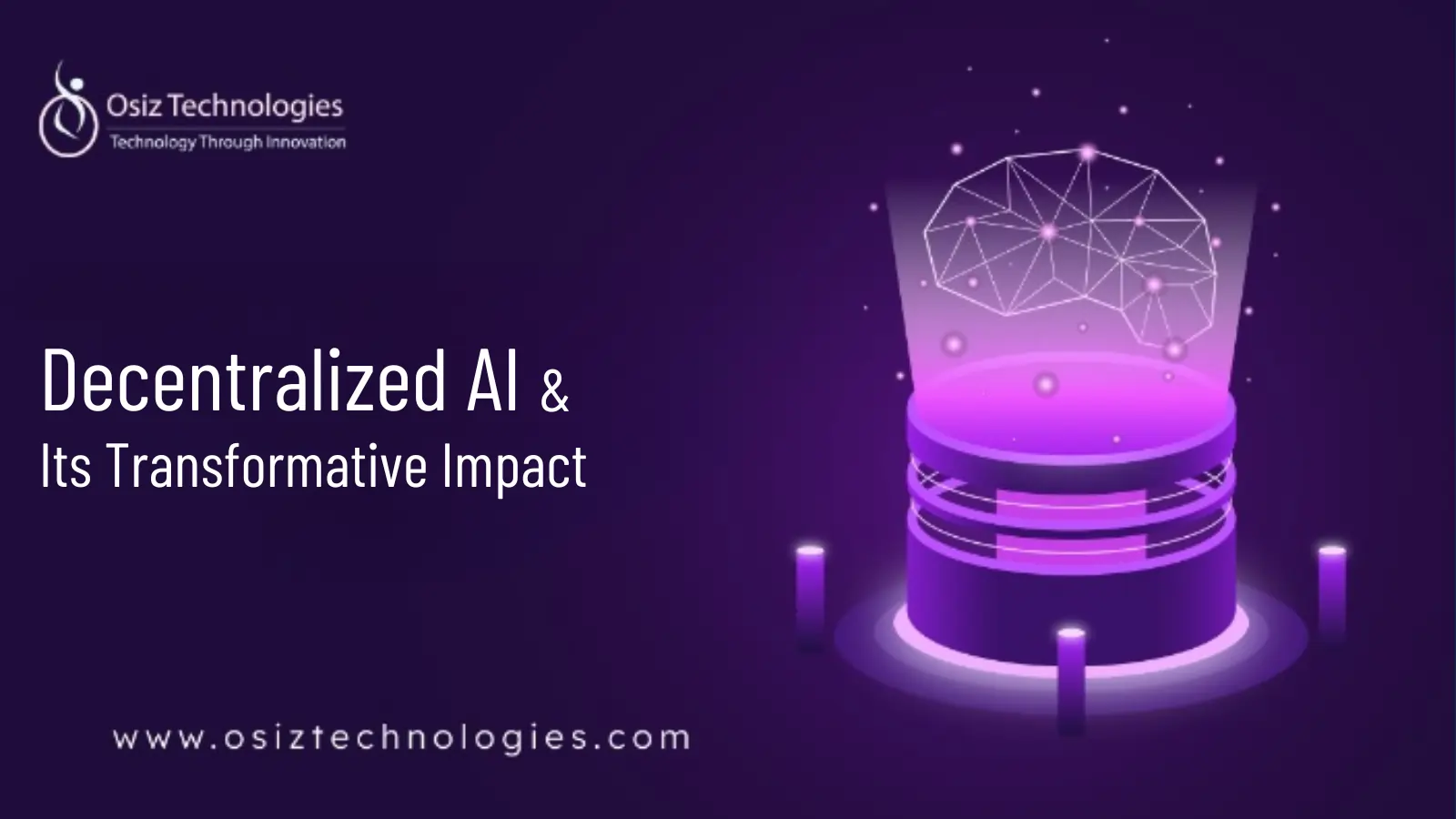
With change moving fast in artificial intelligence, 2026 emerges as a turning point for decentralized models and shared smart systems across sectors; firms now look for tools balancing speed, safety, and discretion. Progress here alters the way companies automate tasks, placing self-governance, openness, and teamwork at the core of digital progress.
What Is Decentralized AI?
Decentralized AI (DeAI) spreads AI's control, computation, and data across a network of interconnected devices (nodes), rather than relying on a single central entity. By leveraging technologies such as blockchain and federated learning, it improves data privacy, security, and user autonomy, supporting collaborative AI advancement and transparent processes through token-based rewards for contributors. This model redistributes influence from large tech corporations to individuals, empowering users to own their data while enabling AI to gain valuable insights from a distributed network.
Key Components of Decentralized AI
Distributed Data Systems
At its core, decentralized artificial intelligence relies on networks where information resides across many points. Each node handles storage and computation independently, yet contributes knowledge gained during processing. Collaboration emerges through shared understanding rather than direct data exchange.
Federated Learning Frameworks
Learning across separate devices happens without moving private information due to shared improvements rather than original records. Because only adjustments travel, exposure from leaks drops significantly. Systems built on distributed principles support reliable training setups within large organizations.
Blockchain AI Integration
A single update within an artificial intelligence system can find its place on a distributed ledger, ensuring no alteration occurs without detection. Where changes are logged, confidence among participants grows; traceable records show exactly what happened and when. Governance gains structure because decisions around model behavior leave permanent markers.
Edge AI Systems
Computation moves nearer to where data originates within Edge AI frameworks, which cuts down delays plus eases network load, which allows instant analysis without centralized control. Decisions happen independently through connected devices and scattered processing points under such setups.
Neural Networks Combine Models
With decentralized AI, learning emerges across separate points, linked through advanced network structures. Insights combine without central control, allowing systems to adapt continuously as information changes. Accuracy stays high because models merge results in structured ways.
How Decentralized AI Works?
Step 1: Local Data Processing
Information stays within local devices during processing, enabling artificial intelligence tasks while protecting personal details from being sent to a main hub. Through edge computing units or scattered points, calculations occur independently at each location. With such structure, trustworthy and streamlined learning across separate systems begins to take shape.
Step 2: Model Training at the Node Level
Training begins at individual nodes, where neural networks learn from local data using methods tied to machine learning and generative artificial intelligence. Collaboration across nodes allows shared knowledge growth while keeping raw information contained within its original environment.
Step 3: Federated Model Aggregation
Through federated learning, model updates move across the network each node contributes without revealing original data. Insights from every participant merge into a unified version of the system. Improved precision emerges as patterns strengthen over multiple sources. The collective structure gains stability simply by diverse input.
Step 4: Blockchain Validation
With blockchain technology, every update, transaction, and contribution by nodes gets logged securely. Because records are time-stamped and distributed, changes cannot be made without detection. Trust emerges naturally when data flows through such transparent systems. Reliability takes shape where decentralization meets cryptographic verification.
Step 5: Continuous Learning and Deployment
With each update, decentralized AI models adjust to fresh inputs and shifting network environments. Across edge devices and scattered nodes, learning continues without pause. Performance stays uniform because setup happens automatically. Resilience grows where systems work together, shaped by constant refinement.
Business Benefits of Decentralized AI
Enhanced Data Privacy and Security
With privacy-aware artificial intelligence plus processing data locally, distributed systems limit vulnerability to digital attacks while aligning with international rules. Insights become accessible to organizations even as confidential details remain protected.
Scalability Across Nodes and Regions
Few systems manage expansion like distributed artificial intelligence does when applied across regions or teams. Performance remains robust due to a design that eliminates single points of failure, and increasing data volumes encounter fewer challenges within these systems.
Cost Efficiency in AI Operations
Fewer clouds mean fewer fees, and reality shapes how modern networks handle information flow. Processing happens closer to source points instead of distant hubs. Edge-based intelligence adjusts usage patterns without constant oversight.
Robustness and Fault Tolerance
When tasks spread over many systems, artificial intelligence without central control resists breakdowns naturally. Learning models keep operating smoothly during disruptions through collaborative refinements, and stability ensures reliable outcomes.
Enhanced Model Accuracy and Insights
When multiple data sources combine via federated learning, model performance increases without centralizing information. Insights emerge more clearly as separate systems contribute knowledge over time.
Practical Guide to Implementing Decentralized AI
Step 1: Assess Data Sources and Nodes
Starting from scattered data sources, selection of edge units proceeds alongside node eligibility checks. Where information integrity matters, scrutiny follows privacy demands as well as signal stability. With these factors weighed, placement of artificial intelligence functions becomes more precise.
Step 2: Select the Federated Learning Framework
Federated systems use proven methods for training and combining machine learning models, where each device or node trains a local model on its own data. These local updates are then shared through carefully designed coordination protocols to update a central global model. The design prioritizes computational efficiency, and data remains on the device.
Step 3: Integrate Blockchain for Security
Updates to models, activity of nodes, together with transaction records can be stored using blockchain combined with artificial intelligence tools. Trust across multiple locations may emerge when agreement protocols are properly set up. Operations involving artificial intelligence gain transparency plus security through incorporation of blockchain technology.
Step 4: Deploy Edge AI Systems
Beginning at the periphery, configure AI agent frameworks to manage live information streams while running models locally. Compatibility must exist across scattered computing units along with standardized communication rules. When intelligence operates closer to data sources, choices happen faster because delays shrink.
Step 5: Monitor, Evaluate, and Iterate
Performance of the model requires ongoing observation, alongside attention to security and how resources are used. Updates regularly occur, adjustments made as needed, ensuring operations remain efficient. Evaluation relies on specific measures; accuracy appears first, then stability under stress, followed by the ability to scale.
Use Cases Across Industries
Healthcare and Medical Research
Across hospitals, artificial intelligence uses distributed systems to build models without transferring personal health details. Medical studies gain new possibilities under strict privacy rules like HIPAA. Patient information stays within each facility thanks to federated approaches. Innovation moves faster when clinics adopt these separate yet connected frameworks.
Finance and Banking
Fraud patterns shift quickly; decentralized artificial intelligence tracks them instantly, avoiding centralized databases. Across banks, credit assessments improve when information stays local yet insights travel. Risk evaluation adapts continuously, powered by distributed learning networks.
Supply Chain and Logistics
From varied inputs, decentralized artificial intelligence refines stock control, predicts needs more accurately, while shaping delivery paths, all without revealing private details. Resilience grows when processing happens locally, supported by shared learning across systems. Efficiency emerges quietly through distributed analysis.
Energy and Smart Grids
With edge AI, energy suppliers track usage patterns without sharing sensitive information. Instead of central processing, decisions occur locally through distributed learning networks. These setups adjust in real time, maintaining stability even under fluctuating demand. Efficiency gains appear not only in power delivery but also in upkeep forecasting.
Retail and E-Commerce
When decentralized systems process information locally, personalization emerges alongside accurate forecasts; privacy remains intact throughout. Collaboration between stores becomes possible because data never leaves its origin; instead, patterns travel securely through federated networks.
Future Outlook Beyond 2026
Beyond 2026, decentralized artificial intelligence begins reshaping enterprise strategy through distributed systems where computation shifts closer to data sources. Security strengthens when blockchain principles anchor the architecture, ensuring integrity while supporting autonomy. Osiz, as a leading AI development company, focuses on delivering advanced AI solutions that combine edge intelligence, decentralized machine learning, and privacy-preserving frameworks to help organizations leverage the full potential of neural networks, machine learning concepts, and AI automation. As neural networks evolve, emphasis grows on clarity; machines must show how conclusions form, not just deliver outcomes.
Listen To The Article

Founder & CEO Osiz Technologies
Mr. Thangapandi, the CEO of Osiz, has a proven track record of conceptualizing and architecting 100+ user-centric and scalable solutions for startups and enterprises. He brings a deep understanding of both technical and user experience aspects. The CEO, being an early adopter of new technology, said, "I believe in the transformative power of AI to revolutionize industries and improve lives. My goal is to integrate AI in ways that not only enhance operational efficiency but also drive sustainable development and innovation." Proving his commitment, Mr. Thangapandi has built a dedicated team of AI experts proficient in coming up with innovative AI solutions and have successfully completed several AI projects across diverse sectors.
Recent Blogs



No 22,Astalakshmi Nagar, Thanakankullam, (Opp Seetha lakshmi Mill gate Bus stop) Thirunagar, Madurai - 625 006.
(Corporate Office)


Canada Office address, 1150, Rue Patrick, Laval, Quebec - H7Y 2C4, Canada.
(Sales Office)


Explore Our
AI Portfolio

 Artificial Intelligence
- AI Development
- AI Predictive Analytics Services
- AI SaaS Development
- RAG Development
- AI Assistant Development
- ChatGPT Development
- Data Analytics Services
- AI Copilot Development
- Adaptive AI Development
- Machine Learning Development
- NLP
- AI Consulting Services
- AI Software Builder
- AI Token Development
- AI Integration Services
- Enterprise AI Solution
- AI As a Service
- AI Marketing Tools
- AI Video Generator
- Computer Vision Services
- Explore AI
- Dataset
- Machine Learning in Healthcare
- Machine Learning in Retail
- Hire AI Engineers
- Hire Prompt Engineers
- Hire ChatGPT Developers
- Hire Stable Diffusion Developers
- Hire Action Transformer Developers
- Blockchain
- Blockchain Development
- Private Blockchain Development
- Smart Contract Development
- Custom Blockchain Development
- Solana Blockchain Development
- Polygon Blockchain Development
- Public Blockchain Development
- DAO Blockchain Development
- Binance Smart Chain (BSC) Blockchain Development
- DApp Development
- Solana DApp Development
- White Label Blockchain Solutions
- Custom Blockchain On Avalanche
- Custom Blockchain On Polygon
- Blockchain Game Development
- Blockchain Consulting Services
- Blockchain Explorer Development
- Ethereum Blockchain Development
- TRON Blockchain Development
- Prediction Market Platform Development Company
Layer 1 & 2 Solutions- Layer-1 Blockchain Development
- Cross Chain Bridge Development
- Data Availability Layer Development
- Ethereum Layer 2 Scaling Solutions
- Cross-L2 DEX Solution
- Layer 2 Token Development
- Layer 2 Token Marketing
- Layer 2 Cryptocurrency Development
- Layer 2 Solutions For Blockchain Games
- Layer 2 Solutions For Web3 Gaming
- Layer 2 Blockchain Solutions
- Rollups As A Service
- Optimistic Rollups Development
- ZK Tech Development
- Bitcoin Layer 2 Solutions
Crypto Exchange- Cryptocurrency Exchange Development
- White Label Crypto Exchange
- Decentralized Exchange Development
- P2P Exchange Development
- Crypto Derivatives Exchange Development
- Centralized Exchange Development
- Crypto Exchange Clone Script
- Cryptocurrency Exchange App Development
- OTC Exchange Development
- Exchange Listing Services
- Binance Like Exchange Development
- Bitstamp Like Exchange Development
- Crypto Exchange Script
CryptoCrypto WalletToken Standards- Token Development
- AI Token Development
- RWA Tokenization Development
- Coinremitter Clone Script
- Asset Tokenization
- Real Estate Tokenization
- Tokenization Platform Development
- Crypto ETF Development
- Solona Token Development
- Semi-Fungible Token Development
- BEP20 Token Development
- Ethereum Token Development
- ERC1400 Token Development
- ERC998 Token Development
- ERC 721 Token Development
- ERC20 Token Development
- Defi Token Development
- ERC1155 Token Development
- BEP721 Token Development
- Utility Token Development
- ERC 777 Token Development
- ERC 827 Token Development
- Social Token Development
- Metaverse Token Development
- Tron Token Development
- ERC404 Token Development
- Governance Token
- Shibarium Token
- polygon Token
- BRC-20
- TRC20 Token Development
- TRC10 Token Development
- Soulbound Token Development
- NFT Token Development
Trading BotsClone- Crypto Exchange Clone Script
- Binance Clone Script
- Metamask Clone Script
- Coinbase Clone Script
- Kucoin Clone Script
- Paxful Clone Script
- Remitano Clone Script
- Wazirx Clone Script
- ByBit Clone Script
- Bitfinex Clone Script
- MEXC Clone Script
- Bitget Clone Script
- Cointool App Clone Script
- Trust Wallet Clone App
- Coinmarketcap Clone Script
- Changelly Clone Script
- BingX Clone Script
CybersecurityApp SecurityDigital Forensics & Incident ResponseAudit & ConsultingEducation & TrainingSolutionsWeb 3DeFi- Decentralized Finance (DeFi) Development
- DeFi Lending/ Borrowing Platform Development
- DeFi Staking Platform Development
- DeFi Token Development
- DeFi Wallet Development
- DeFi Smart Contract Development
- DeFi DApp Development
- Decentralized Exchange Development
- DeFi Insurance Development
- DeFi Crypto Synthetic Assets Development
Game Development- Game Development
- Android Game Development
- IOS Game Development
- Metaverse Game Development
- VR Game Development
- AI Game Development
- Unity 3D Game Development
- Unreal Engine Game Development
- Mobile Game Development
- Blockchain Game Development
- NFT Game Development
- Play to Earn Game Development
- Move to Earn Game Development
- Casino Game Development
- Slot Game Development
- Poker Game Development
- AAA Game Development
- AR Game Development
- Social Network Game Development
- Gamification Services
- Decentralized Sports Betting Platform
- Sports Betting Dapp Development
- Blockchain Casino Game Development
- Game Asset Creation
- Baccarat Game Development
- Rollbit Clone Script
- Fortnite Clone Script
- Slot Game Development
- Tap to Earn Game Development
- Slot Game Development
Metaverse Platforms- Metaverse Game Development
- Metaverse Event Platform Development
- Metaverse Virtual Mall Development
- Metaverse NFT Marketplace Development
- Metaverse Token Development
- Metaverse Virtual Land Development
- Metaverse Avatar Development
- Metaverse 3d Space Development
- Metaverse Real Estate Development
- Metaverse Social Media Platform Development
- Top 10 Metaverse Development Company
- Metaverse Business Ideas
- Metaverse Launchpad Development
- Metaverse App Development
- Metaverse Casino Game Development
NFT SolutionsNFT Platforms- NFT Minting Development
- NFT Token Development
- NFT Exchange Platform Development
- NFT Launchpad Development
- NFT Fashion Marketplace Development
- NFT Art Marketplace Development
- NFT Music Marketplace Development
- Carbon Credits NFT Marketplace Development
- Binance NFT Marketplace Development
- Polygon NFT Marketplace Development
- Solana NFT Marketplace Development
- Influencers NFT Marketplace Development
- NFT Ticketing Marketplace Development
- DeFi NFT Marketplace Development
- NFT Fantasy Sports Platform Development
- NFT Storage Development
- NFT Lending Platform Development
- Top10 NFT Business Ideas
NFT Game ClonesSustainabilityServiceNow - Blog
- Contact Us
- Works