
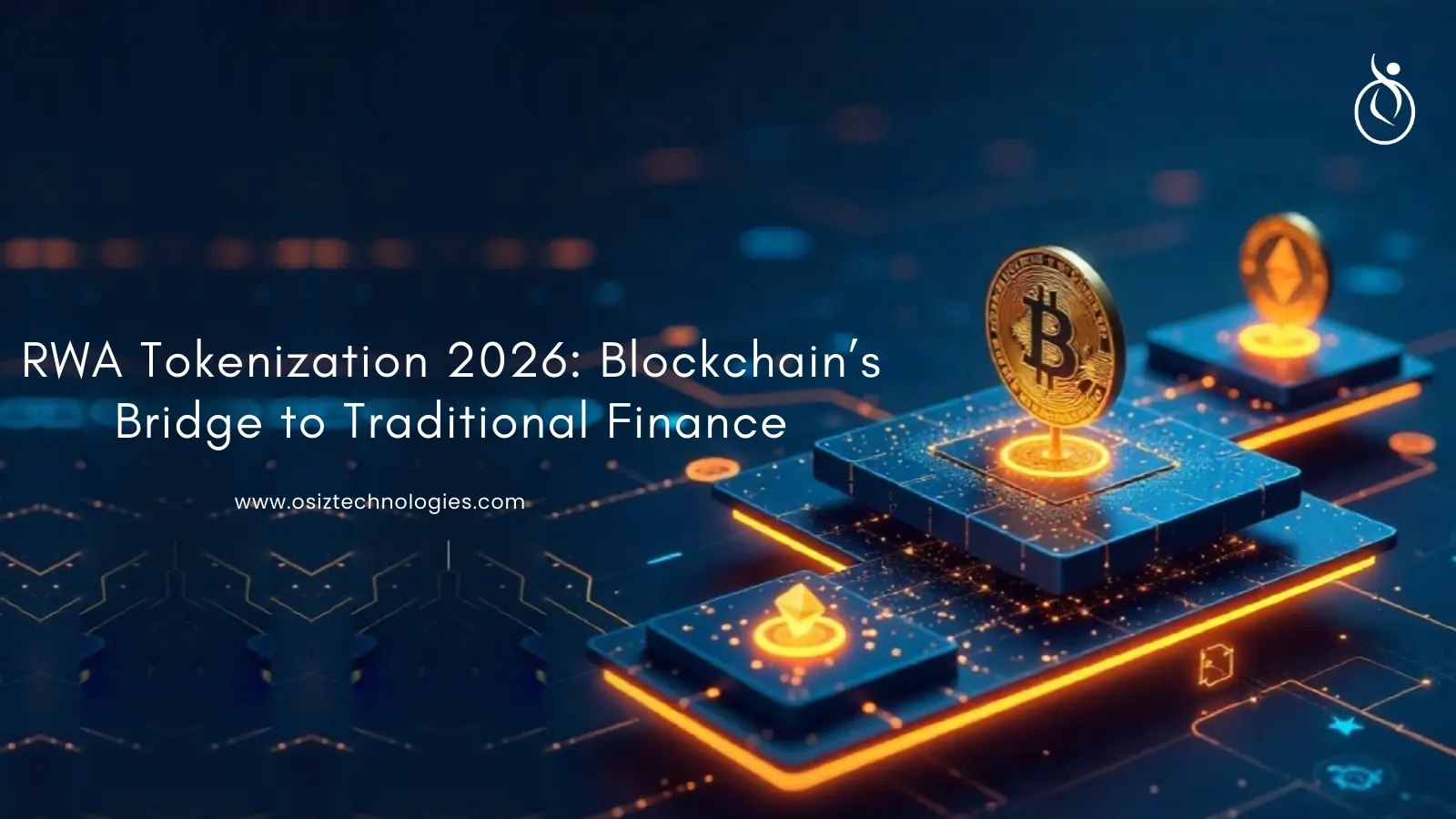
By 2026, the real-world asset (RWA) market will grow as old banking meets new decentralized systems. More investors want to digitize real-world assets to make them liquid, open, and efficient. Blockchain technology is enabling this by transferring traditional finance onto the blockchain, creating a secure, programmable, and worldwide financial system.
Blockchain in RWA Tokenization
Blockchain-based tokenization of Real-World Assets (RWA) involves converting physical or traditional financial assets such as real estate, art, stocks, or bonds into secure, digital tokens on a blockchain. These tokens enable fractional ownership, smoother trading, and greater liquidity by leveraging a transparent, decentralized ledger. This process transforms valuable tangible assets into programmable digital forms governed by smart contracts, automating transactions and connecting traditional finance (TradFi) with decentralized finance (DeFi).
Why Blockchain is Bringing Traditional Finance On-Chain in 2026?
1. Real-Time Settlement and Instant Liquidity
Blockchain technology allows for trades to settle right away, which gets rid of the usual delays in traditional finance. This fast clearing boosts how well capital is used, lowers risks between parties, and frees up cash for both big institutions and individual investors.
2. Programmable Finance and Smart Contract Innovation
Smart contracts enable financial instruments such as bonds and loans to operate autonomously, streamlining tasks like interest payments and asset management by reducing the need for manual intervention and minimizing delays.
3. Interoperability Across Financial Networks
New blockchain systems make it easy for different financial setups to work together, like banks and payment networks. This lets institutions use blockchain without messing up their current systems, mixing both on-chain and off-chain activities.
4. Enhanced Risk Management with Predictive Analytics
When blockchain teams up with AI, prediction tools can detect unusual behavior, identify fraud, and automatically adjust assets, offering a significant advantage in risk management over traditional finance methods.
5. Tokenization of Illiquid and Alternative Assets
Assets such as property can be turned into tokens, letting more people own pieces of them. This turns markets into ones that are easy to get into and trade, opening up investments while keeping things legal.
6. Decentralized Identity and Permissioned Access
Blockchain identity management verifies users privately and safely. Institutions can give specific access to services while sticking to rules. This makes getting started simpler and cuts down on fraud.
7. Cross-Border Payments and FX Optimization
Finance using blockchain allows for quick international transfers with low fees, skipping old-school middlemen. When combined with programmable contracts, it also lowers currency risks and makes global money movement smoother for companies.
Benefits of Bringing Traditional Finance On-Chain
Operational Automation
Smart contracts handle settlements, interest, and asset management automatically. This cuts down on mistakes, speeds things up, and keeps operations consistent.
Capital Efficiency Optimization
On-chain insights enable real-time monitoring of capital and collateral, allowing financial institutions to reallocate assets rapidly and reduce idle capital.
Reduced Counterparty Risk
Atomic transactions make sure assets and payments happen at the same time. This cuts out the need for middlemen and avoids settlement issues.
Interoperability with DeFi Ecosystems
Tokenized assets can work with DeFi lending and more. This makes combined financial setups that mix institutional security with DeFi advancements.
Programmable Financial Instruments
Blockchain lets you program financial products with rules. Bonds, funds, and derivatives can change based on the market.
Current Blockchain Bottlenecks in Real-World Asset Tokenization
Regulatory Fragmentation
Because tokenized assets have different rules in different places, following the rules can be hard. Groups must deal with many rules to make sure they're doing things legally. These regulatory differences make it take longer for people to start using blockchain for regular money stuff, and they also make things riskier.
Technology Scalability
Big transaction amounts and complex asset setups can put a strain on blockchain networks. If the system can't grow to handle the load, things might slow down, cost more, or get jammed up. This would make it harder to integrate real-world assets with blockchain. The network needs to get better at handling big company demands without any problems.
Legal and Custodial Issues
Who owns what, how to enforce the law, and who's in charge of keeping things safe are still tricky questions for tokenized assets. If the legal rules aren't clear, then splitting ownership and representing assets digitally becomes risky. We have to sort these things out before we can fully put traditional finance on the blockchain.
Market Standardization
Not having standard rules for making tokens, figuring out their worth, and making them work together makes it harder for people to use them. Investors and big institutions might be unsure Without clear standards to ensure compatibility and reliability, establishing strong guidelines is essential for transforming finance across markets through blockchain.
Integration Complexity
Connecting old systems with blockchain takes work, like moving data, changing how things are done, and lining up security. If it's not easy to connect everything, companies might waste time while they try to see how blockchain can bring traditional finance on-chain. Good solutions should make it easier to go from old to new systems.
How Blockchain Will Continue Transforming Traditional Finance [2026 Perspective]
On-Chain Regulatory Infrastructure
Expect regulators to start using blockchain for keeping a closer watch and getting reports. This means they can supervise in real-time, do audits automatically, and check if things follow the rules right away.
Institutional-Grade Custody and Asset Control
Better tech for managing keys will make it safer for banks to hold assets on the blockchain. Big institutions can control their digital assets themselves, without needing a middleman. This builds confidence and gets more companies involved.
Unified Financial Ledgers
Blockchain can serve as a central ledger for financial activities such as trading, settlement, accounting, and reporting, eliminating the need for time-consuming data reconciliation between different entities and systems.
Dynamic Collateral Management
Assets on the blockchain let you see their value in real-time and change collateral automatically. Margin amounts can change instantly with the market. This lowers the risk of things being sold off and keeps things steady when the market jumps around.
Tokenized Credit and On-Chain Lending
Normal credit things like business loans will go on the blockchain. This makes it easier to see the risks, get loans faster, and get money to more people. It's an upgrade to how lending works worldwide.
Tokenized Credit and On-Chain Lending
New tech will allow transactions to be private but still checkable. Institutions can keep financial data safe while still following the rules. This fixes a big problem that was stopping companies from using blockchain.
Conclusion
Looking ahead to 2026, merging tokenized assets and blockchain tech will reshape traditional finance. Getting RWA blockchain working with fractional ownership and smart contracts can speed up, clarify, and globalize financial tools. Sure, there are issues, but blockchain development company such as Osiz help organizations handle rules and tech questions. Moving from old-fashioned finance to a fully online system is gaining speed. Companies that plan can use blockchain finance for better results, security, and ideas. The future of finance is not just digital; it's transparent and worldwide with tokens.
Listen To The Article

Founder & CEO Osiz Technologies
Mr.Thangapandi, the founder and CEO of Osiz, is a pioneering figure in the field of blockchain technology. His deep understanding of both blockchain technology and user experience has led to the creation of innovative and successful blockchain solutions for businesses and startups, solidifying Osiz's reputation as a reliable service provider in the industry. Because of his unwavering quest for innovation, Mr.Thanga Pandi is well-positioned to be a thought leader and early adopter in the rapidly changing blockchain space. He keeps Osiz at the forefront of this exciting industry with his forward-thinking approach.
Recent Blogs



No 22,Astalakshmi Nagar, Thanakankullam, (Opp Seetha lakshmi Mill gate Bus stop) Thirunagar, Madurai - 625 006.
(Corporate Office)


Canada Office address, 1150, Rue Patrick, Laval, Quebec - H7Y 2C4, Canada.
(Sales Office)


Halloween
Offers

 Artificial Intelligence
- AI Development
- AI Predictive Analytics Services
- AI SaaS Development
- RAG Development
- AI Assistant Development
- ChatGPT Development
- Data Analytics Services
- AI Copilot Development
- Adaptive AI Development
- Machine Learning Development
- NLP
- AI Consulting Services
- AI Software Builder
- AI Token Development
- AI Integration Services
- Enterprise AI Solution
- AI As a Service
- AI Marketing Tools
- AI Video Generator
- Computer Vision Services
- Explore AI
- Dataset
- Machine Learning in Healthcare
- Machine Learning in Retail
- Hire AI Engineers
- Hire Prompt Engineers
- Hire ChatGPT Developers
- Hire Stable Diffusion Developers
- Hire Action Transformer Developers
- Blockchain
- Blockchain Development
- Private Blockchain Development
- Smart Contract Development
- Custom Blockchain Development
- Solana Blockchain Development
- Polygon Blockchain Development
- Public Blockchain Development
- DAO Blockchain Development
- Binance Smart Chain (BSC) Blockchain Development
- DApp Development
- Solana DApp Development
- White Label Blockchain Solutions
- Custom Blockchain On Avalanche
- Custom Blockchain On Polygon
- Blockchain Game Development
- Blockchain Consulting Services
- Blockchain Explorer Development
- Ethereum Blockchain Development
- TRON Blockchain Development
- Prediction Market Platform Development Company
Layer 1 & 2 Solutions- Layer-1 Blockchain Development
- Cross Chain Bridge Development
- Data Availability Layer Development
- Ethereum Layer 2 Scaling Solutions
- Cross-L2 DEX Solution
- Layer 2 Token Development
- Layer 2 Token Marketing
- Layer 2 Cryptocurrency Development
- Layer 2 Solutions For Blockchain Games
- Layer 2 Solutions For Web3 Gaming
- Layer 2 Blockchain Solutions
- Rollups As A Service
- Optimistic Rollups Development
- ZK Tech Development
- Bitcoin Layer 2 Solutions
Crypto Exchange- Cryptocurrency Exchange Development
- White Label Crypto Exchange
- Decentralized Exchange Development
- P2P Exchange Development
- Crypto Derivatives Exchange Development
- Centralized Exchange Development
- Crypto Exchange Clone Script
- Cryptocurrency Exchange App Development
- OTC Exchange Development
- Exchange Listing Services
- Binance Like Exchange Development
- Bitstamp Like Exchange Development
- Crypto Exchange Script
CryptoCrypto WalletToken Standards- Token Development
- AI Token Development
- RWA Tokenization Development
- Coinremitter Clone Script
- Asset Tokenization
- Real Estate Tokenization
- Tokenization Platform Development
- Crypto ETF Development
- Solona Token Development
- Semi-Fungible Token Development
- BEP20 Token Development
- Ethereum Token Development
- ERC1400 Token Development
- ERC998 Token Development
- ERC 721 Token Development
- ERC20 Token Development
- Defi Token Development
- ERC1155 Token Development
- BEP721 Token Development
- Utility Token Development
- ERC 777 Token Development
- ERC 827 Token Development
- Social Token Development
- Metaverse Token Development
- Tron Token Development
- ERC404 Token Development
- Governance Token
- Shibarium Token
- polygon Token
- BRC-20
- TRC20 Token Development
- TRC10 Token Development
- Soulbound Token Development
- NFT Token Development
Trading BotsClone- Crypto Exchange Clone Script
- Binance Clone Script
- Metamask Clone Script
- Coinbase Clone Script
- Kucoin Clone Script
- Paxful Clone Script
- Remitano Clone Script
- Wazirx Clone Script
- ByBit Clone Script
- Bitfinex Clone Script
- MEXC Clone Script
- Bitget Clone Script
- Cointool App Clone Script
- Trust Wallet Clone App
- Coinmarketcap Clone Script
- Changelly Clone Script
- BingX Clone Script
CybersecurityApp SecurityDigital Forensics & Incident ResponseAudit & ConsultingEducation & TrainingSolutionsWeb 3DeFi- Decentralized Finance (DeFi) Development
- DeFi Lending/ Borrowing Platform Development
- DeFi Staking Platform Development
- DeFi Token Development
- DeFi Wallet Development
- DeFi Smart Contract Development
- DeFi DApp Development
- Decentralized Exchange Development
- DeFi Insurance Development
- DeFi Crypto Synthetic Assets Development
Game Development- Game Development
- Android Game Development
- IOS Game Development
- Metaverse Game Development
- VR Game Development
- AI Game Development
- Unity 3D Game Development
- Unreal Engine Game Development
- Mobile Game Development
- Blockchain Game Development
- NFT Game Development
- Play to Earn Game Development
- Move to Earn Game Development
- Casino Game Development
- Slot Game Development
- Poker Game Development
- AAA Game Development
- AR Game Development
- Social Network Game Development
- Gamification Services
- Decentralized Sports Betting Platform
- Sports Betting Dapp Development
- Blockchain Casino Game Development
- Game Asset Creation
- Baccarat Game Development
- Rollbit Clone Script
- Fortnite Clone Script
- Slot Game Development
- Tap to Earn Game Development
- Slot Game Development
Metaverse Platforms- Metaverse Game Development
- Metaverse Event Platform Development
- Metaverse Virtual Mall Development
- Metaverse NFT Marketplace Development
- Metaverse Token Development
- Metaverse Virtual Land Development
- Metaverse Avatar Development
- Metaverse 3d Space Development
- Metaverse Real Estate Development
- Metaverse Social Media Platform Development
- Top 10 Metaverse Development Company
- Metaverse Business Ideas
- Metaverse Launchpad Development
- Metaverse App Development
- Metaverse Casino Game Development
NFT SolutionsNFT Platforms- NFT Minting Development
- NFT Token Development
- NFT Exchange Platform Development
- NFT Launchpad Development
- NFT Fashion Marketplace Development
- NFT Art Marketplace Development
- NFT Music Marketplace Development
- Carbon Credits NFT Marketplace Development
- Binance NFT Marketplace Development
- Polygon NFT Marketplace Development
- Solana NFT Marketplace Development
- Influencers NFT Marketplace Development
- NFT Ticketing Marketplace Development
- DeFi NFT Marketplace Development
- NFT Fantasy Sports Platform Development
- NFT Storage Development
- NFT Lending Platform Development
- Top10 NFT Business Ideas
NFT Game ClonesSustainabilityServiceNow - Blog
- Contact Us
- Works