
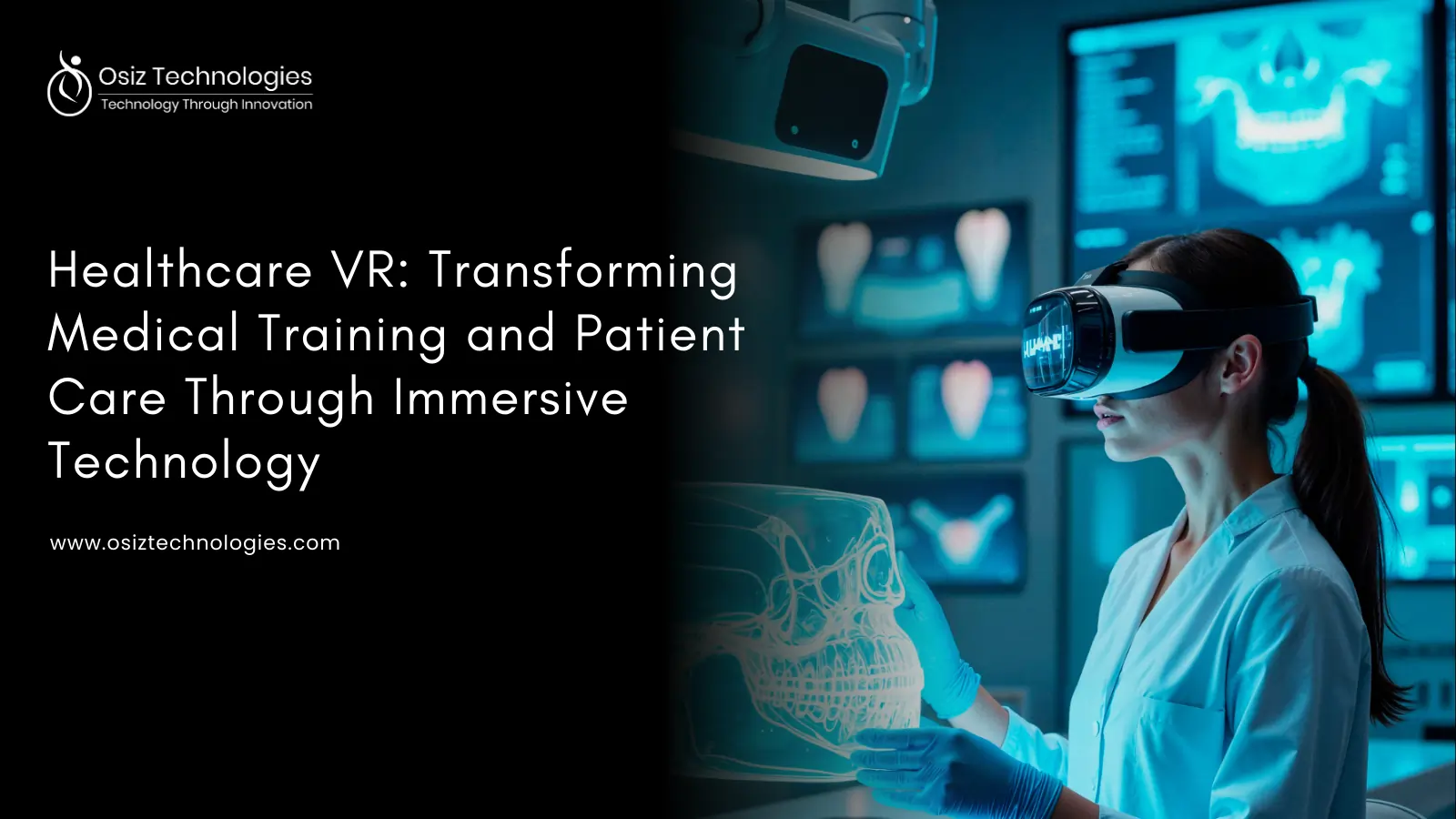
Healthcare is changing with new tech, and VR development is leading the way, making learning and treatment more real. Doctors can train, run simulations, and care for patients in virtual settings that improve accuracy and speed. Osiz offers full VR services for healthcare that fit what medical places need and where patient care is headed.
What Is Healthcare VR?
Healthcare-focused virtual reality employs immersive, computer-generated 3D environments and sensory feedback devices such as goggles and gloves to deliver realistic simulations for medical training, patient therapy, and education. This enables doctors to rehearse intricate surgeries without risk, and allows patients to explore medical conditions or receive treatment for pain and phobias in a safe, controlled environment, enhancing both learning and healing through greater engagement.
Our Healthcare VR Development Services
VR Medical Training
VR Medical Training lets healthcare workers rehearse surgeries, processes, and emergency responses in virtual settings. This lowers mistakes and speeds up learning, while building confidence. This training sets the stage for VR therapy options that focus on patients.
VR Therapy Solutions
VR Therapy Options use simulations to handle pain, rehab, and mental health care. Patients are in safe spaces that help them heal and stay involved. These therapies move easily into simulation-based learning and research tools.
Medical Simulation VR
Medical Simulation VR gives real-life situations for rehearsing steps, talking to patients, and practicing diagnoses. This makes sure doctors are ready for hard cases. Simulation VR supports creating general Healthcare VR Apps.
Healthcare VR App Development
Healthcare VR App development makes apps for hospitals, clinics, and training sites. These apps mix VR simulations, learning pieces, and ways to get patients involved. Apps allow rolling out VR options in a way that is secure and works well.
Integration with Healthcare Systems
When VR options work with patient records, management setups, and hospital jobs, it makes things easy to use. This expands how well things work, following rules, and keeping care consistent while backing training and therapy times.
How Healthcare VR Works?
Step 1: Requirement Analysis
We start by learning what your medical center wants to achieve in training and patient care. Getting this right means our VR solutions will solve real problems, which then guides our content creation and simulation design.
Step 2: VR Environment Design
We create 3D models of anatomy, clinics, and tools for realistic simulations. We focus on lighting, textures, and spatial detail to ensure the training and therapy feel real, which then leads us to add interactive features.
Step 3: Interactive Scenario Implementation
We integrate medical procedures, patient engagements, and therapeutic exercises into the virtual reality environment. Real-time feedback ensures the simulation feels authentic, enabling effective testing and improvement.
Step 4: Testing and Validation
We test the VR solutions thoroughly for performance, ease of use, and correctness. This step confirms they are safe, work well, and are reliable for training and patient care, preparing them for use.
Step 5: Deployment and Maintenance
We roll out the VR apps to medical centers with secure access and ongoing support. Regular maintenance and updates keep them running smoothly and adaptable, completing the process and bringing the tech's impact to healthcare.
Key Features of Healthcare VR Solutions
Immersive surgical simulations
Surgical simulations offer hands-on, interactive training in realistic virtual environments. Medical virtual reality reduces risks and enhances precision, improving overall training outcomes.
Patient therapy modules
Therapy modules offer VR experiences to help manage pain, aid rehab, and improve mental health. Patients can participate safely, and results are tracked. This fits well with other ways to help patients.
Anatomical visualization
Anatomical visualization gives you interactive 3D models to study, diagnose, and plan procedures. Medical staff can gain a better spatial understanding, which helps make simulations more accurate.
Emergency response training
Emergency response scenarios prep your team for tough situations in a safe, virtual space. People can practice procedures and make decisions without risking real-world harm. This training can be used to see how well people perform.
Interactive clinical environments
VR lets clinicians check out hospital layouts, equipment, and how patients move through the space. This improves understanding and readiness, and can help with workflow and patient care.
Healthcare VR Use Cases
Surgical planning and rehearsal
Surgeons can practice hard procedures in VR before working on people. Medical Simulation VR makes things more exact and drops operation risks.
Physical rehabilitation
Patients do VR rehabilitation for faster healing and involvement. VR Therapy Solutions watch progress and change challenges for each person. Rehab uses help make better treatment plans.
Mental health therapy
VR settings help people handle stress, worry, and fears. Hands-on treatments make results and involvement better. Therapy sections link to clinical programs and result numbers.
Patient engagement and education
VR helps patients get conditions, processes, and treatment choices in a hands-on way. Better understanding grows loyalty and happiness.
Benefits of Healthcare VR for Medical Institutions
Enhanced clinical training
Virtual reality offers hands-on practice for medical skills and procedures, enhancing staff confidence and competence. This improved training results in safer patient outcomes and a more resilient healthcare environment.
Reduced operational costs
Simulations cut down on wasted supplies, repeat attempts, and travel costs. Healthcare VR Services are a cheaper option than old-school training. Saved money can go back into caring for patients.
Improved patient outcomes
Interactive therapy and learning tools help patients understand their health, stick to treatment, and get better. VR improves results in both physical and mental health, which helps the hospital look better too.
Increased accessibility
VR makes it possible to train people and reach patients anywhere, expanding healthcare beyond local areas. Virtual Reality for Medical Institutions makes sure everyone can get involved, making training and care work better.
Innovation and competitive advantage
Virtual reality demonstrates that hospitals are innovative and patient-centered. Emerging technologies attract top talent and open doors to strategic partnerships, while fresh ideas support sustainable growth.
Technology Stack We Use
Unity and Unreal Engine
These two are the engines behind realistic and interactive VR environments. They are very important for Healthcare VR App Development and immersive experiences.
WebXR and WebVR
These allow VR access through browsers. This cuts down on device issues and makes things easier to grow. They are great for patient education and remote training.
Three.js and A-Frame
These allow interactive 3D content for web platforms and VR apps. They make medical VR solutions more responsive and keep users interested.
Oculus and HTC Vive
These VR headsets offer immersive experiences for training, therapy, and patient engagement. Their quality makes things feel real and work well.
Cloud and server setup
Safe cloud and server setups host VR apps and handle real-time data and user interactions. This setup makes sure things are accessible, scalable, and reliable.
Why Choose Osiz for Healthcare VR Services?
Osiz is a top VR development company that offers advanced Healthcare VR Development and Services for medical centers. We are skilled in Medical VR solutions like VR Medical Training, VR Treatment Solutions and Healthcare VR App Development. We build experiences that improve learning, patient involvement, and how well things run.
Osiz makes sure every solution is accurate, easy to use and trustworthy. Our staff mixes healthcare knowledge with VR skills to provide platforms that grow and adapt. Centers will gain from better training results, patient happiness, and new ideas through Osiz options.
Listen To The Article

Founder & CEO Osiz Technologies
Osiz Technologies' CEO, Mr. Thangapandi celebrated a major milestone, signifying the company's progression into its next phase. With a strong team of over 300+ employees, Osiz has established itself as a globally recognized leader in the IT industry, known for its outstanding performance.
CEO, Mr. Thangapandi is thrilled to share the exciting progress of our VR Development Company. Our team’s dedication and innovation have propelled us to the forefront of the virtual reality industry, delivering groundbreaking applications across education, healthcare, and entertainment. We continue to push the boundaries of what's possible, creating immersive experiences that transform how we learn, work, and play!
Recent Blogs




No 22,Astalakshmi Nagar, Thanakankullam, (Opp Seetha lakshmi Mill gate Bus stop) Thirunagar, Madurai - 625 006.
(Corporate Office)


Canada Office address, 1150, Rue Patrick, Laval, Quebec - H7Y 2C4, Canada.
(Sales Office)


Halloween
Offers

 Artificial Intelligence
- AI Development
- AI Predictive Analytics Services
- AI SaaS Development
- RAG Development
- AI Assistant Development
- ChatGPT Development
- Data Analytics Services
- AI Copilot Development
- Adaptive AI Development
- Machine Learning Development
- NLP
- AI Consulting Services
- AI Software Builder
- AI Token Development
- AI Integration Services
- Enterprise AI Solution
- AI As a Service
- AI Marketing Tools
- AI Video Generator
- Computer Vision Services
- Explore AI
- Dataset
- Machine Learning in Healthcare
- Machine Learning in Retail
- Hire AI Engineers
- Hire Prompt Engineers
- Hire ChatGPT Developers
- Hire Stable Diffusion Developers
- Hire Action Transformer Developers
- Blockchain
- Blockchain Development
- Private Blockchain Development
- Smart Contract Development
- Custom Blockchain Development
- Solana Blockchain Development
- Polygon Blockchain Development
- Public Blockchain Development
- DAO Blockchain Development
- Binance Smart Chain (BSC) Blockchain Development
- DApp Development
- Solana DApp Development
- White Label Blockchain Solutions
- Custom Blockchain On Avalanche
- Custom Blockchain On Polygon
- Blockchain Game Development
- Blockchain Consulting Services
- Blockchain Explorer Development
- Ethereum Blockchain Development
- TRON Blockchain Development
- Prediction Market Platform Development Company
Layer 1 & 2 Solutions- Layer-1 Blockchain Development
- Cross Chain Bridge Development
- Data Availability Layer Development
- Ethereum Layer 2 Scaling Solutions
- Cross-L2 DEX Solution
- Layer 2 Token Development
- Layer 2 Token Marketing
- Layer 2 Cryptocurrency Development
- Layer 2 Solutions For Blockchain Games
- Layer 2 Solutions For Web3 Gaming
- Layer 2 Blockchain Solutions
- Rollups As A Service
- Optimistic Rollups Development
- ZK Tech Development
- Bitcoin Layer 2 Solutions
Crypto Exchange- Cryptocurrency Exchange Development
- White Label Crypto Exchange
- Decentralized Exchange Development
- P2P Exchange Development
- Crypto Derivatives Exchange Development
- Centralized Exchange Development
- Crypto Exchange Clone Script
- Cryptocurrency Exchange App Development
- OTC Exchange Development
- Exchange Listing Services
- Binance Like Exchange Development
- Bitstamp Like Exchange Development
- Crypto Exchange Script
CryptoCrypto WalletToken Standards- Token Development
- AI Token Development
- RWA Tokenization Development
- Coinremitter Clone Script
- Asset Tokenization
- Real Estate Tokenization
- Tokenization Platform Development
- Crypto ETF Development
- Solona Token Development
- Semi-Fungible Token Development
- BEP20 Token Development
- Ethereum Token Development
- ERC1400 Token Development
- ERC998 Token Development
- ERC 721 Token Development
- ERC20 Token Development
- Defi Token Development
- ERC1155 Token Development
- BEP721 Token Development
- Utility Token Development
- ERC 777 Token Development
- ERC 827 Token Development
- Social Token Development
- Metaverse Token Development
- Tron Token Development
- ERC404 Token Development
- Governance Token
- Shibarium Token
- polygon Token
- BRC-20
- TRC20 Token Development
- TRC10 Token Development
- Soulbound Token Development
- NFT Token Development
Trading BotsClone- Crypto Exchange Clone Script
- Binance Clone Script
- Metamask Clone Script
- Coinbase Clone Script
- Kucoin Clone Script
- Paxful Clone Script
- Remitano Clone Script
- Wazirx Clone Script
- ByBit Clone Script
- Bitfinex Clone Script
- MEXC Clone Script
- Bitget Clone Script
- Cointool App Clone Script
- Trust Wallet Clone App
- Coinmarketcap Clone Script
- Changelly Clone Script
- BingX Clone Script
CybersecurityApp SecurityDigital Forensics & Incident ResponseAudit & ConsultingEducation & TrainingSolutionsWeb 3DeFi- Decentralized Finance (DeFi) Development
- DeFi Lending/ Borrowing Platform Development
- DeFi Staking Platform Development
- DeFi Token Development
- DeFi Wallet Development
- DeFi Smart Contract Development
- DeFi DApp Development
- Decentralized Exchange Development
- DeFi Insurance Development
- DeFi Crypto Synthetic Assets Development
Game Development- Game Development
- Android Game Development
- IOS Game Development
- Metaverse Game Development
- VR Game Development
- AI Game Development
- Unity 3D Game Development
- Unreal Engine Game Development
- Mobile Game Development
- Blockchain Game Development
- NFT Game Development
- Play to Earn Game Development
- Move to Earn Game Development
- Casino Game Development
- Slot Game Development
- Poker Game Development
- AAA Game Development
- AR Game Development
- Social Network Game Development
- Gamification Services
- Decentralized Sports Betting Platform
- Sports Betting Dapp Development
- Blockchain Casino Game Development
- Game Asset Creation
- Baccarat Game Development
- Rollbit Clone Script
- Fortnite Clone Script
- Slot Game Development
- Tap to Earn Game Development
- Slot Game Development
Metaverse Platforms- Metaverse Game Development
- Metaverse Event Platform Development
- Metaverse Virtual Mall Development
- Metaverse NFT Marketplace Development
- Metaverse Token Development
- Metaverse Virtual Land Development
- Metaverse Avatar Development
- Metaverse 3d Space Development
- Metaverse Real Estate Development
- Metaverse Social Media Platform Development
- Top 10 Metaverse Development Company
- Metaverse Business Ideas
- Metaverse Launchpad Development
- Metaverse App Development
- Metaverse Casino Game Development
NFT SolutionsNFT Platforms- NFT Minting Development
- NFT Token Development
- NFT Exchange Platform Development
- NFT Launchpad Development
- NFT Fashion Marketplace Development
- NFT Art Marketplace Development
- NFT Music Marketplace Development
- Carbon Credits NFT Marketplace Development
- Binance NFT Marketplace Development
- Polygon NFT Marketplace Development
- Solana NFT Marketplace Development
- Influencers NFT Marketplace Development
- NFT Ticketing Marketplace Development
- DeFi NFT Marketplace Development
- NFT Fantasy Sports Platform Development
- NFT Storage Development
- NFT Lending Platform Development
- Top10 NFT Business Ideas
NFT Game ClonesSustainabilityServiceNow - Blog
- Contact Us
- Works