Who Counts as a Writer When AI Writes and Nobody Reads
Falling literacy, AI that writes everything, and the question nobody's asking: who's still reading? An essay on what makes someone a writer.
Everyone Is a Writer Now, and Nobody Is
Or, as literally every other essay on this subject is called: On Writing.
There are many, many essays, stories, and books "on writing" from great writers. This is by no means that. I do not know how to make someone a great writer. I don't even know if that's possible. I believe that some folks are just built different and come out of the womb with the ability to write a damn good story. I do think that storytelling is a gift, but one that usually comes with experiences. I'll admit I'm biased toward storytellers who have had to survive something. That's a taste and not a rule - plenty of writers who never wanted for anything have written circles around me - but there's something about living a full, robust life full of doing hard things that makes your stories hit different. But even more confusing to this essay is the fact that we all know people who are great sages of oral storytelling, yet cannot write a lick for readership. Do they need the physical audience? Or what...no idea, but I wouldn't call them writers. Entertainers, maybe. Maybe one day I'll write a whole spiel on storytelling. But that also isn't what this is.
I've been thinking a lot about what makes someone a "writer" over the past few months. This coincides with the dramatic increase in time I've been spending with a cousin deep in the throes of writer's block...which is deeply unfortunate for her publisher and her self-esteem. Watching her struggle with the title of "writer" has been incredibly eye opening for my own self-awareness. For example, I do not consider myself to be a "writer." I don't say that because I don't write. I'm writing 10–12 hours a day at this point in my life. However, I feel like a writer is given that title by their readers. Which, now that I've typed it out, sounds an awful lot like the first thing they teach you in Contracts your first year of law school. Writing is the offer. Reading is the acceptance. No acceptance, no contract. I'm going to need that one later because you know I love a good legal addition to the story.
Basically, does someone seek out your writing? Then you probably are a writer. Does someone tell you explicitly that they enjoy your writing? Then you're probably a writer. Maybe I'm being too humble, but I just don't consider myself to be a writer (as a professional title). Do I write? Yes. But in my book that doesn't make me a writer. There are many actual writers in my extended family. People pay them good money to write amazing stories of people and worlds that bring joy to readers. If not joy, some kind of emotion. Who can do that? Is it only good writers? What about bad writers? Or an LLM?
I will spare you the high school writing template of "The dictionary says a writer is..." because every time I see that in the writing of someone who thinks themselves to be a writer a little part of me dies. (Do better. Please. Unless it's something that truly needs a definition you are better than that.) And spoiler alert...I might not even answer the question of what makes a good writer by the end of this essay. I honestly have no idea where this is going at the moment.
Seriously though. Work with me here...this essay might get ranty and go all kinds of places so I'm asking that you keep an open mind and think about what writing means to you as we go on this journey (imagine this was said in Marianne Williamson voice) together.
Is it any easier to ask who isn't a writer? Must you be paid for your writing? Operate at a certain echelon of publishing? What about all the Substacks begging us for attention and subscribers? Are those written by writers? At what level does writing make a writer? A memo at work? A post on X?
Is it how much you write? What is it?
Do you have to make your readers feel something? Or learn something? Is that something only humans can do? Can only humans teach?
I firmly believe that "good writing" is based on the readers' belief and taste. There are writers that most of the world says are amazing that you could not pay me to read at this point in my life. I have done my English prerequisites back in college and I don't plan on returning to the Jane Austen oeuvre anytime soon unless someone makes a version of Pride and Prejudice with the early 2000s era Louis Garrel. And there are people who I don't even think are "good" writers per se that I enjoy reading for some reason, whether it be their humor or stories just land different with me due to my own life experiences. Do you have to enjoy someone's writing for them to be a writer? What about academic writing?
Is all good writing only written by "writers"? Which further leads to the existential crisis for me of asking...If I'm not a writer is all my writing bad? Am I just putting yuck out into the world? (If so, I am sincerely sorry. Please ignore the yuck.)
I kinda write into a void. When I started my first newsletter in 2021, I was writing to educate. It was meant to solely be educational. Then, at a certain point, I found that people were using it within a bit of an echo chamber - which isn't what it was meant to be. After I stopped writing it, I did miss writing, mostly because I felt like all my rants were being lost on my poor family. Unfortunately, they can only listen to me yap about my Ingmar Bergman's Persona is based on Balzac's Seraphita conspiracy 10 times before my face becomes immensely punchable to them. I'd like to keep familial harmony in check so writing is serving multiple purposes.
And yes, one day I will write a whole dang essay on how CLEARLY Ingmar Bergman was influenced by Balzac's story Seraphita when he made Persona (AKA the best Bergman film ever.)
Clearly, I just don't write for other people. If people want to read what I'm writing, amazing! But if I'm just writing for me and my thought process that's okay too. It's my "creative outlet." I don't have sponsors for my work and I don't charge a fee to read my stuff. I know a lot of people do, which is fine, but if I'm pushing for a reason to write it's because I'm writing for people to learn. The areas I write about tend to be exceptionally gatekept and I don't want to add to that problem. Or on the alternate should we gatekeep works to only those we have judged as able to understand or act on our work? Is all writing for all people? Now we are asking the deep questions...
Which brings me to the most gatekept writing I actually do. Most of what I've been writing recently has been law review articles. I'm literally being paid to research and write at the moment. Which...is great, but law review articles are a different kind of writing. It's academic. It's rote. At this point what gets accepted by good-to-great law reviews is essentially templatized. You know how to write what you need to write to communicate what needs to be communicated. There's no personality. Definitely no cursing which puts an enormous strain on my personality showing up...but anyways, in law review articles there isn't supposed to be a personality per se. You are meant to make an outstanding legal argument. You are writing to catch citations at a later date. It's a little more personable than writing an amicus brief or a ruling in the judicial branch, but not by much. So, what I'm saying is that it's a sterile, automatic-type of writing. I firmly believe that any good lawyer should be able to write a solid law review article. Now all that being said, the question follows...does that mean lawyers are now writers?
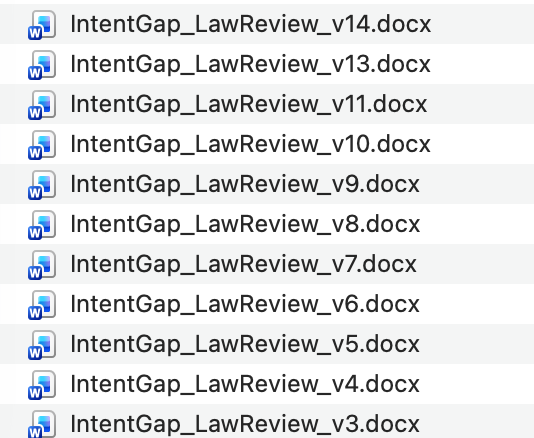
I looked and my law review articles have, on average, 30 versions that I worked through. (I won't lie, my poor laptop storage situation is dire at the moment.) These are 50- to 100-page articles. Sooooo they're not "light" reading by any stretch of the imagination. Nor were they a weekend or two of work. Think long ass months of arguing legal standards in your head and then typing them out, thinking that each word would make Thurgood Marshall reimagine his best arguements. I know that sounds super thrilling to everyone. These articles are longer than some books I have read. Is this length because I am a good writer or because I need a good editor...who's to say!
When I was in law school I didn't do law review because I had a full-time job and was already placed in the job I would have after graduation. I didn't want to do hours of free work, nor did I want to spend my life in the law library chasing down errant bluebook citations. And well, times they do change, and the joke's on me...because I spent 10 hours last week on bluebook citations. Though, now I am paid for it. At that time writing didn't make sense for where I wanted my career to go and now it is the centerpiece. Would I go back in time and do law review? No. (Though honestly that is more because I also didn't really like the people who were serving on law review. Also, not gonna lie...I was kinda a brat still in law school. So, if I was the mature version of myself...maybe I would have done law review.)
It's so hard to leave that academic style of writing behind for me after I finish an article. Coming back to writing like a person after months of law review work is like trying to talk normally after a root canal - everything is numb and you sound ridiculous. I sit down to write something with a little life in it and out comes "this Article proceeds in four Parts." My own voice gets lost somewhere in the muck and mire of legal word salad, buried under passive constructions and defensive hedging and eighty-seven footnotes whose only real job is to prove I know what I am talking about. (It's truly the most pick me of pick me behaviors.) It takes weeks to find my actual voice again, and I am never entirely sure I got all of it back. To be fair there's probably even a bit still here in this essay. I also just don't have that many opportunities to just write to write. I'm not a diarist unless I think it's important for others to hear (for better or worse). When I write I'm hoping people learn something...anything. (Please for the love of G-d learn something.) Therefore, I'm usually trying to infuse some of my own -isms and humor into pieces, but at the same time I know that sarcasm and deadpan aren't exactly easy to see in words no matter how many italics I use. Just pretend you notice them all and give me a lil' chuckle here and there.
And yet I'd defend the academic style of law review writing to anybody who asked. Law is a profession everyone assumes is stuck in the mud, and mostly they're right. But the mud is the point. Law moves through its written and oral traditions or it doesn't move at all. Somebody writes something down. Somebody else reads it and disagrees in writing. A judge reads that and cites it in a dissent. Twenty years later the dissent is a majority and the law is different than it was. It's a chain of people accepting each other's offers across decades, in public, on the record. An article I publish this year or next might sit untouched until 2041 and then show up in a footnote that changes something real. Slow. Unglamorous. Still almost entirely personality-free. And one of the only kinds of writing where you can actually watch that happen with a citation attached. The sterility has a purpose. It just costs me my voice for a few months at a time.
That's one end of the spectrum. Writing so slow and so traceable that you can watch a single sentence get picked up across forty years of footnotes. Now let me go to the other end, where none of that machinery exists and the same thing happens in about four seconds.
AI has changed so much for creative fields, writing included, maybe even to the greatest extent. Is AI a writer? Can something trained on a human writing style be a writer? Do you need a soul to write? Is writing a prompt an academic or creative feat?
One of my cousins was paid a pretty penny by an AI lab so that they could train their models on his writing. By all measurements he is a great writer. (Alas, I don't believe that writing is determined by genetics.)
That transaction matters more than people give it credit for. He made an offer, a lab accepted it, and - this is the part everyone skips - they paid him for it. That's not charity. That's not goodwill or a nice gesture. That's consideration. It's what you owe somebody whose work you're building on. I spend my working life somewhere near this question, so let me just say what I think responsible AI development looks like on the writing side: train on good writing, and pay the people who wrote it. Both halves. Not one. Training on good writing and not paying for it isn't a deal, it's a taking. And paying a fortune for slop doesn't help anybody either.
And the quality half isn't sentimental, it's infrastructural. A model trained on careful, well-edited, structurally sound prose produces careful, well-edited, structurally sound prose. Hundreds of millions of people read that output every single day. For a lot of them it might be the most competent writing they'll see all week. So it's either a literacy intervention at a scale no school district could dream of, or it's a slop machine pointed at people who are already struggling to read. Depends what went in. Depends who got paid. But most important for those great writers is that someone got paid.
I'm glad AI was trained on good writing. If it wasn't the bad AI slop would be all we are left with. The downward literacy spiral would be even worse because nobody would want to read that crap.
Honestly, with the literacy rate we currently have (especially here in the United States) does it matter who a writer is? If humans aren't even reading whatever is being put out into the universe whether by AI or actual human, does it matter who's writing it?
And whether you like it or not, the literacy numbers are genuinely bad. In 2023, 28% of American adults - roughly 59 million people - scored at or below Level 1 in literacy, which means a short simple text is fine but multi-step instructions start coming apart in your hands. In 2017 it was 19%. On the 2024 Nation's Report Card, about 40% of fourth graders came in below NAEP Basic in reading, the largest share since 2002. Not below proficient. Below basic. And here's the part I actually think matters more than we know: even the people who can read have stopped. Daily reading for pleasure in this country fell by more than 40% between 2003 and 2023, with the steepest drops among people with less income, less education, and rural addresses.
Reading, supposedly the most democratic thing a person can do, is quietly turning back into a class marker. Gutenberg is rolling in his grave.
Without literacy there are no writers. AI isn't killing the writer - illiteracy is. Lack of reading and reading comprehension is.
Why is this happening? The usual suspects are all in the room. Phones. The pandemic. The collapse of sustained attention. Reading curricula that taught a generation to guess at words from the pictures. The plain fact that most people are exhausted and a screen asks less of you than a paragraph does. But notice what isn't on that list. Not one of them is something a writer did. Reading didn't stop because the writing got worse. That distinction matters in a lil' bit.
And what if the new "reader" is an AI agent? How do you write for a machine? Will it understand the emotional pull of heartbreak? Will it understand the childlike joy of morning dew? Will it understand how those are put into words? How will we function as a society if the only readers left in the world are the AI agents we have trained? And who will be those training them if reading is a lost art?
Here's the version of the future that actually scares me, and it isn't the one where AI writes everything. AI can already write everything. That's not a future, that's a Tuesday. The one that scares me is where AI writes everything and there's nobody left qualified to notice whether any of it is good.
That's what illiteracy buys you. Not a world without words - a world drowning in them, where almost nobody can tell the difference between a sentence that's true and a sentence that's just shaped like the truth. Right now the models are good because they were trained on people who were good, and enough of us can still tell. Thin out the reading population and they start getting trained on their own exhaust, graded by people who can't grade, for readers who skim a summary of a summary. Writing doesn't die in that world. It just stops meaning anything, because there's nobody on the other end to accept it. An offer nobody can read isn't an offer. It's noise with excellent grammar.
Which then raises the obvious question, and I may as well ask it now that the numbers are sitting right there: why write at all, if nobody's reading? I told you much earlier that I kinda write into a void. I meant it as a small joke about my own modest readership. Having just typed out what's happened to reading in this country, I'm significantly less sure it was a joke. If the title is conferred by readers, and the readers are genuinely thinning out, what exactly am I doing at eleven o'clock on a Tuesday?
The cynical answer, and the right one for an enormous amount of what gets published these days, is clout. Not readership. Clout. A staggering volume of writing right now isn't aimed at a reader at all. It's a signal to a market. Thought leadership. Personal brand. Building in public. (JFC I hate those words with a burning hot passion and writing them here is burning my eyes.) The sometimes ethereal post exists so people can see that you posted it, and whether anybody reads it is almost beside the point. Yes, I know me saying all this is a bit ridiculous. I have a Substack. I'm about to put this out into my own lil' void on Medium. Nobody writes five thousand words about whether they're a writer without some part of them hoping to be told that they are one. (Must keep this in mind for future therapy sessions...)
What makes it worse is that the engagement economy is really good at manufacturing something that looks exactly like acceptance and isn't. A like isn't a reading. A share isn't a reading. Fourteen thousand impressions are definitely not fourteen thousand people who made it to the end. That's somebody nodding at you from across the room without ever opening the document, and any lawyer who's been on the other side of a signature from that person can tell you exactly what it's worth. (Zilch in case you were wondering.) I think that's most of why everyone feels like a writer and nobody quite is.
There's a meaner way to put all of this, and some days I sadly suspect it's the true one. An enormous amount of writing right now isn't written to be understood. It's written to make the writer look smarter than whoever they're picturing on the other end. The tells are everywhere once you start nitpicking. The word that could've been the simpler word. The throat-clearing about credentials before the actual point. (However, I do forgive women for this because women live in a bit of a "well actually" world on this side of the gender spectrum. No credentials, no listen.) The argument is built so that disagreeing with it makes you look slow. Again, I'll stop short of saying everyone, because the second I say everyone I've indicted the woman writing in her second language and the man dictating a novel he can't see, and they're plainly not doing this. But the dominant register of public writing has drifted away from explaining something and toward displaying the person doing the explaining.
Which leaves a real chicken-and-egg problem, and I've gone back and forth on it a lot because I get bored sometimes and let my mind wander into weird places. Who lost the plot first? The writers, who started writing toward their own reflection instead of toward a reader? Or the readers, who got so tired of being lectured at by people performing intelligence that they just stopped showing up? People reach for chicken-and-egg as a polite way of declining to answer, which has always irritated me a little, because the literal chicken-and-egg question does have an answer and it isn't remotely close. The egg wins by about a hundred million years. Things were laying eggs long before anything resembling a chicken turned up to sit on one. (And yes, I know: a chicken egg is an egg laid by a chicken. Take that one up with the dinosaurs.) So, I'm not going to hide behind the phrase.
I've landed, tentatively, on the readers...and not because I blame them for a second. That list I ran through earlier is the reason, and not one item on it was anybody's choice. Readers left, and writers did what anybody does when the audience walks out. They optimized for whatever still got noticed. And what survives a skim isn't an argument. Whomp whomp. An argument makes you read the whole thing. A status signal survives the first eight words. As readers we got more status signal, which drove off more readers, which rewarded more status signal. The ego writing is downstream of the not-reading, and then it makes the not-reading worse. The order matters though, because it means you can't fix this by shaming writers into humility. The fix, if there is one, is on the reading end.
And is it fulfilling? Writing to stroke your own ego? I don't think it can be, structurally, and that's the part I actually find sad. If you write to be understood, then being understood by one person is the whole thing. You can feel it land. If you write to be thought clever, nothing ever finishes, because you didn't want to be read. You wanted to be ranked. And a ranking is never finished. There's always somebody above you and a fresh post in the morning. Ego writing might be the only kind nobody can ever finish, because the writer was never really talking to anyone. They're holding up a mirror and hoping you'll go stand behind it.
So why do I keep doing it...Entering a combination of words into the void I mean. Partly because writing is how I work out what I think, which I said way back near the beginning and actually meant. It's worth writing even when the room is empty, because drafting it clarifies me. And partly because the alternative to writing for nobody is not writing at all, and I'm not willing to be one of the people who stopped. So I keep writing. For better or worse depending on who you talk to.
I will admit that the advent of AI has changed me as a writer. Due to my actual day job I have a lot of insights into model training for almost every major lab and it does make me do a double take with what I write. For example, RIP the em dash. Em and en dashes were my favorite. [Insert sadface emoji lol.] But now I find myself trying to delete them from my repertoire even when they serve the words best. After the first draft of this essay I went back and changed my edits to put them all back in. I will not cave to the anti-em dash cabal.
I'm going to let you into a bit of a secret. I didn't learn grammar in school. Unfortunately, at that time West Virginia public schools didn't teach it within the English curriculum. I learned proper grammar when I was in law school and in the following years. Which is why em and en dashes, solid sentence structures, and Oxford commas mean something to me. I'm sad that we are losing key parts of good writing because people are too scared to have their writing be labeled as "AI writing." That's not good for anyone. That means we are losing something in our culture thats essential. And that something is good quality writing.
I have read very good AI writing output. I have read bad AI writing output. But the same can be true for human writers. Sometimes things written by humans can essentially be unreadable because they just...suck. I'm sorry but there isn't a nice way to say that our educational system has created a lot of people who don't know how to effectively use the written word, yet they feel as though our eyes should be put upon their blah blah. (If you feel this way about my writing, I truly am sorry but I promise you really don't have to read my stuff. We're 100% good even if you don't.)
With that being said, I would rather read good AI than bad human writing. I think we all agree on that.
However, now I have to get on a soapbox. What about all the times female writers have been accused of actually using the work of men? For years men have loved to accuse exes who gain fame in writing of "stealing their work." The most common accusation against female writers really does seem to be that their work is actually that of their romantic partners. I fear that "AI" will become the new "partner" accusation used to continue to put them "in their place" outside of the creative or academic discussion. Gotcha journalism will further become a place of sexism and misogyny more so than we've already let it.
What about AI use for those who are disabled? If someone disabled uses AI in a manner to write when they cannot see does that mean they cannot write the next great American novel? Or those who are writing outside of their native language and being accused of AI writing? Or translations? I don't know where the line is but I know that these people are writers. How do I know these people are writers? Because I want to read them. Which, if you have been keeping track, is the only test I have offered this entire essay, and it does not care one bit how the words got onto the page.
So are we using the AI revolution to gatekeep "writing" further, but actually eating our own face in doing so? Are we going to make writing something that no longer exists like a dead, ancient language? Professional writing is already something that we only deign a select few worthy of...I admittedly have some of the same beliefs that I struggle to explain as you have seen just in this essay. Could AI be used to make writing more democratic? Could it be used to help more people communicate to others better?
So here is where I have landed, and it took the whole essay to get here.
Everyone is a writer now. That half is easy and it's already true. More words are produced by more people in an average hour than at any point in human history. Slack messages, captions, texts, reviews, memos, posts, prompts, this. The tools are free, the distribution is free, the gate is off its hinges. Writing has never been more democratic than it is this minute. Most likely every person reading this has already written something today.
And nobody is a writer, because a writer isn't a person who writes. A writer is a person somebody reads. The title was never yours to hand yourself. I said so near the top of this essay, before I understood I was making an argument instead of being modest. It's conferred, it's conferred by readers, and readers are the one resource we're actually running out of. You can write into an empty room all day long. It doesn't make you a writer.
And we've been so loudly occupied arguing about who should be allowed to supply - is it the AI, is it the person who used the AI, is it the woman whose husband must have helped her, is it the blind writer, is it the guy with the Substack, is it me - that almost nobody is asking the question that decides all of it. Who's left to receive any of this.
There's a harder version of that question, and it's the one that actually matters. What makes my voice more important than anyone else's? The honest answer is nothing. Nothing does. I've got no credential that settles it, no license, no anointing. I've spent this entire essay insisting I'm not a writer and then written five thousand words on the subject, which is either genuine humility or the most elaborate humblebrag ever committed to a Word document, and I'm honestly not sure which.
But that question in and of itself assumes a lot. It assumes importance is something you assert about yourself, in advance, and under everything I've argued here it just isn't. I don't get to grade my own work. Nobody does. Every writer who declared their own voice essential was making a claim they had no standing to make, and every writer who turned out to matter was made by somebody else choosing to read them. Usually late. Frequently after they were dead. Almost never on the schedule they'd have picked. You don't write because your voice is important. You write to find out whether it is. And even then you don't get a vote.
I don't think the answer is gatekeeping harder. Every single time we've drawn a line around who counts as a real writer, the line has looked humiliating in hindsight, and this round won't be the exception.
The true answer in the end is the boring one, and it's the only one I've got: be a reader. Read something difficult on purpose. Read a whole thing instead of the summary of the thing. Read something a person wrote and then tell them you read it, because telling them isn't a courtesy, it's the actual mechanism by which writers get made, and it's the only item on this list no metric can fake. Teach a kid to read for pleasure and you've created a writer twenty years early. You just don't get to know which one yet.
And if it turns out somebody out there wanted to read this, then I guess you've gone and made me a writer. Which wasn't the point. But I'll take it.
Stevie Cline, Esq. is a legal practitioner in the Artifical Intelligence governance space. She can be found at www.steviecline.com. The views expressed here are her own and not that of her employer. I mean...maybe they're the same views. Who knows?
Source: Medium



No 22,Astalakshmi Nagar, Thanakankullam, (Opp Seetha lakshmi Mill gate Bus stop) Thirunagar, Madurai - 625 006.
(Corporate Office)


Canada Office address, 1150, Rue Patrick, Laval, Quebec - H7Y 2C4, Canada.
(Sales Office)


Halloween
Offers

 Artificial Intelligence
- AI Development
- AI Predictive Analytics Services
- AI SaaS Development
- RAG Development
- AI Assistant Development
- ChatGPT Development
- Data Analytics Services
- AI Copilot Development
- Adaptive AI Development
- Machine Learning Development
- NLP
- AI Consulting Services
- AI Software Builder
- AI Token Development
- AI Integration Services
- Enterprise AI Solution
- AI As a Service
- AI Marketing Tools
- AI Video Generator
- Computer Vision Services
- Explore AI
- Dataset
- Machine Learning in Healthcare
- Machine Learning in Retail
- Hire AI Engineers
- Hire Prompt Engineers
- Hire ChatGPT Developers
- Hire Stable Diffusion Developers
- Hire Action Transformer Developers
- Blockchain
- Blockchain Development
- Private Blockchain Development
- Smart Contract Development
- Custom Blockchain Development
- Solana Blockchain Development
- Polygon Blockchain Development
- Public Blockchain Development
- DAO Blockchain Development
- Binance Smart Chain (BSC) Blockchain Development
- DApp Development
- Solana DApp Development
- White Label Blockchain Solutions
- Custom Blockchain On Avalanche
- Custom Blockchain On Polygon
- Blockchain Game Development
- Blockchain Consulting Services
- Blockchain Explorer Development
- Ethereum Blockchain Development
- TRON Blockchain Development
- Prediction Market Platform Development Company
Layer 1 & 2 Solutions- Layer-1 Blockchain Development
- Cross Chain Bridge Development
- Data Availability Layer Development
- Ethereum Layer 2 Scaling Solutions
- Cross-L2 DEX Solution
- Layer 2 Token Development
- Layer 2 Token Marketing
- Layer 2 Cryptocurrency Development
- Layer 2 Solutions For Blockchain Games
- Layer 2 Solutions For Web3 Gaming
- Layer 2 Blockchain Solutions
- Rollups As A Service
- Optimistic Rollups Development
- ZK Tech Development
- Bitcoin Layer 2 Solutions
Crypto Exchange- Cryptocurrency Exchange Development
- White Label Crypto Exchange
- Decentralized Exchange Development
- P2P Exchange Development
- Crypto Derivatives Exchange Development
- Centralized Exchange Development
- Crypto Exchange Clone Script
- Cryptocurrency Exchange App Development
- OTC Exchange Development
- Exchange Listing Services
- Binance Like Exchange Development
- Bitstamp Like Exchange Development
- Crypto Exchange Script
CryptoCrypto WalletToken Standards- Token Development
- AI Token Development
- RWA Tokenization Development
- Coinremitter Clone Script
- Asset Tokenization
- Real Estate Tokenization
- Tokenization Platform Development
- Crypto ETF Development
- Solona Token Development
- Semi-Fungible Token Development
- BEP20 Token Development
- Ethereum Token Development
- ERC1400 Token Development
- ERC998 Token Development
- ERC 721 Token Development
- ERC20 Token Development
- Defi Token Development
- ERC1155 Token Development
- BEP721 Token Development
- Utility Token Development
- ERC 777 Token Development
- ERC 827 Token Development
- Social Token Development
- Metaverse Token Development
- Tron Token Development
- ERC404 Token Development
- Governance Token
- Shibarium Token
- polygon Token
- BRC-20
- TRC20 Token Development
- TRC10 Token Development
- Soulbound Token Development
- NFT Token Development
Trading BotsClone- Crypto Exchange Clone Script
- Binance Clone Script
- Metamask Clone Script
- Coinbase Clone Script
- Kucoin Clone Script
- Paxful Clone Script
- Remitano Clone Script
- Wazirx Clone Script
- ByBit Clone Script
- Bitfinex Clone Script
- MEXC Clone Script
- Bitget Clone Script
- Cointool App Clone Script
- Trust Wallet Clone App
- Coinmarketcap Clone Script
- Changelly Clone Script
- BingX Clone Script
CybersecurityApp SecurityDigital Forensics & Incident ResponseAudit & ConsultingEducation & TrainingSolutionsWeb 3DeFi- Decentralized Finance (DeFi) Development
- DeFi Lending/ Borrowing Platform Development
- DeFi Staking Platform Development
- DeFi Token Development
- DeFi Wallet Development
- DeFi Smart Contract Development
- DeFi DApp Development
- Decentralized Exchange Development
- DeFi Insurance Development
- DeFi Crypto Synthetic Assets Development
Game Development- Game Development
- Android Game Development
- IOS Game Development
- Metaverse Game Development
- VR Game Development
- AI Game Development
- Unity 3D Game Development
- Unreal Engine Game Development
- Mobile Game Development
- Blockchain Game Development
- NFT Game Development
- Play to Earn Game Development
- Move to Earn Game Development
- Casino Game Development
- Slot Game Development
- Poker Game Development
- AAA Game Development
- AR Game Development
- Social Network Game Development
- Gamification Services
- Decentralized Sports Betting Platform
- Sports Betting Dapp Development
- Blockchain Casino Game Development
- Game Asset Creation
- Baccarat Game Development
- Rollbit Clone Script
- Fortnite Clone Script
- Slot Game Development
- Tap to Earn Game Development
- Slot Game Development
Metaverse Platforms- Metaverse Game Development
- Metaverse Event Platform Development
- Metaverse Virtual Mall Development
- Metaverse NFT Marketplace Development
- Metaverse Token Development
- Metaverse Virtual Land Development
- Metaverse Avatar Development
- Metaverse 3d Space Development
- Metaverse Real Estate Development
- Metaverse Social Media Platform Development
- Top 10 Metaverse Development Company
- Metaverse Business Ideas
- Metaverse Launchpad Development
- Metaverse App Development
- Metaverse Casino Game Development
NFT SolutionsNFT Platforms- NFT Minting Development
- NFT Token Development
- NFT Exchange Platform Development
- NFT Launchpad Development
- NFT Fashion Marketplace Development
- NFT Art Marketplace Development
- NFT Music Marketplace Development
- Carbon Credits NFT Marketplace Development
- Binance NFT Marketplace Development
- Polygon NFT Marketplace Development
- Solana NFT Marketplace Development
- Influencers NFT Marketplace Development
- NFT Ticketing Marketplace Development
- DeFi NFT Marketplace Development
- NFT Fantasy Sports Platform Development
- NFT Storage Development
- NFT Lending Platform Development
- Top10 NFT Business Ideas
NFT Game ClonesSustainabilityServiceNow - Blog
- Contact Us
- Works