
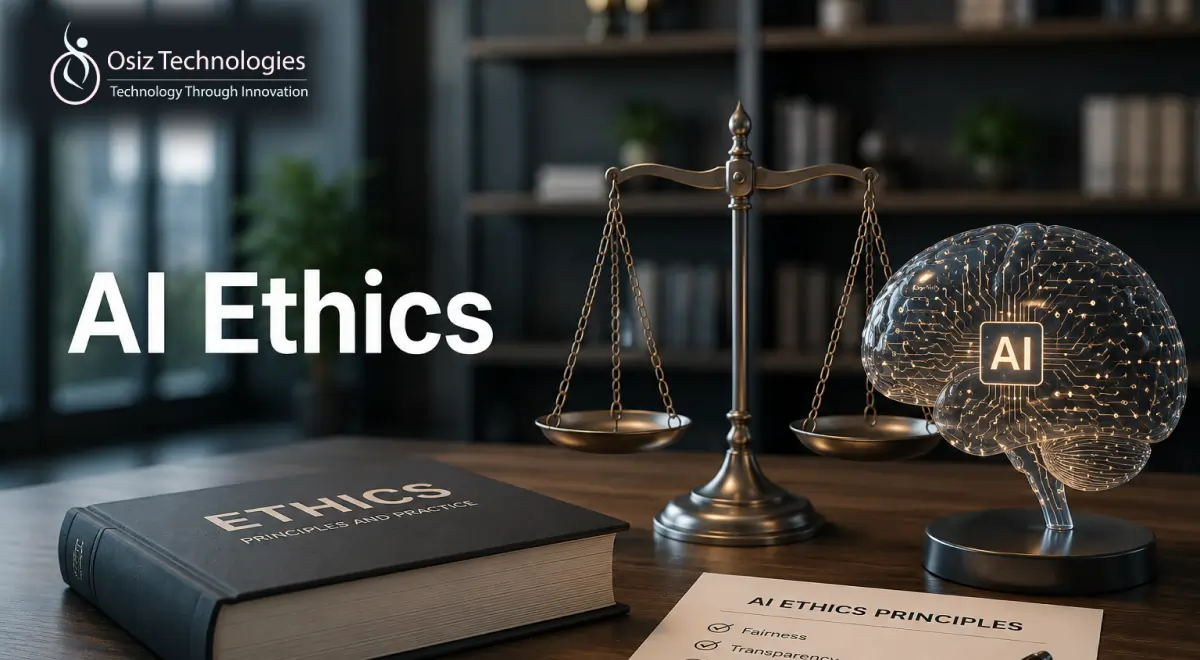
In the realm of artificial intelligence, where intelligence meets data and ethics, the concept of AI ethics emerges as a critical framework. Osiz's contributions to this field underscore how ethical considerations are essential in guiding the development and deployment of AI systems. This article delves into what AI ethics entails, its foundational principles, primary ethical concerns, strategies for establishing an AI code of conduct, and organizations dedicated to promoting these practices.
AI ethics, defined
Ethics is a set of moral principles that help us discern between right and wrong. AI ethics, then, is a multidisciplinary field that studies how to optimize the beneficial impact of artificial intelligence (AI) while reducing its potential risks and harms. This involves examining ethical considerations in areas such as data privacy, algorithmic fairness, transparency, accountability, and human-AI interaction.
The academic community has long relied on the ethical principles outlined in the 1979 “Belmont Report” to guide ethics in experimental research and algorithmic decision-making. These principles include respect for persons (which emphasizes autonomy and informed consent), beneficence (aiming to do good and prevent harm), and justice (ensuring fair treatment of all individuals). AI ethics extends these concepts to the digital age, considering how technology can be used ethically in contexts that were not foreseen when the Belmont Report was written.
Primary ethical considerations of AI today include data privacy, where personal information must be handled with utmost care to prevent misuse. Algorithmic fairness is another critical area, ensuring that AI systems do not perpetuate or exacerbate existing biases and inequalities. Transparency is essential for building public trust; users should understand how AI makes decisions so they can hold it accountable when necessary.
Foundation models and generative AI like OpenAI’s ChatGPT have brought new ethical challenges. These large language models (LLMs) are capable of generating text that mimics human writing, which can be both a powerful tool for creativity and an opportunity for misinformation or harmful content generation. Ensuring these systems remain aligned with societal values requires rigorous oversight and guidelines.
The concept of the technological singularity—where technological growth becomes uncontrollable and irreversible, culminating in profound and unpredictable changes—is also pertinent to AI ethics. As AI capabilities continue to advance, it is crucial to consider how society can prepare for such a scenario, ensuring that any future advancements serve human well-being rather than exacerbate existing problems.
Lastly, the impact of AI on jobs cannot be overlooked. While there are concerns about job displacement due to automation, this concern can also be reframed as an opportunity. With every disruptive new technology, humans adapt and find new roles in areas where AI complements or enhances their work. Emphasizing reskilling and upskilling programs alongside technological development is key to managing these transitions effectively.
Establishing principles for AI ethics
The academic community has long relied on the ethical principles outlined in the 1979 “Belmont Report” to guide ethics in experimental research and algorithmic development. These foundational guidelines—such as respect for persons, beneficence, and justice—are crucial for establishing a robust framework within which AI can operate ethically.
In today’s context, there are several primary ethical considerations of AI that reflect the broader potential impact on society. Issues such as privacy concerns, bias in decision-making systems, and the misuse of data all require careful consideration to ensure that AI technologies do not exacerbate existing social inequalities or cause harm.
Foundation models and generative AI have brought a new level of complexity to these discussions. The release of platforms like ChatGPT has highlighted how AI can be used for both creative expression and deceptive purposes, raising questions about the responsibilities of developers and users alike. These developments underscore the need for clear guidelines that address not only technical aspects but also societal implications.
As we grapple with the ethical challenges posed by AI, it is essential to consider broader theoretical frameworks such as the technological singularity—a point where technological progress becomes so rapid and transformative that it could lead to uncontrollable and irreversible changes. Understanding these long-term impacts can help inform short-term policy decisions and ensure that AI development aligns with human values.
Ultimately, establishing principles for AI ethics requires a multidisciplinary approach involving ethicists, technologists, policymakers, and the public. By building on existing ethical frameworks while addressing new challenges, we can create an environment where AI technologies are developed responsibly and ethically.
Primary ethical considerations of AI today
There are several issues at the forefront of ethical conversations surrounding AI technologies in the real world. These concerns reflect the broader potential impacts of AI on society. One such issue is the use of facial recognition systems by law enforcement and security agencies, which raises significant privacy concerns. The accuracy and reliability of these systems can lead to wrongful identifications and invasions of personal privacy.
Another critical area involves the development of foundation models and generative AI like ChatGPT. These technologies have the potential to generate content that mimics human writing but may also be used for malicious purposes, such as creating fake news or impersonating individuals online. Ensuring these systems adhere to ethical standards is crucial to prevent misuse.
The Belmont Report's principles—particularly those related to respect for persons and beneficence—are foundational in guiding AI ethics. Respect for persons emphasizes the importance of respecting individual autonomy and privacy, while beneficence focuses on ensuring that AI benefits society as a whole without causing harm. Adhering to these principles helps mitigate risks associated with AI technologies.
Lastly, concerns about AI’s impact on jobs are also prominent. While it is true that automation can lead to job displacement, the shift towards more skilled and creative roles may create new opportunities. Addressing this issue requires proactive policies and investments in retraining programs to ensure a smooth transition for affected workers.
How to establish a code of AI ethics?
Artificial intelligence performs according to how it is designed, developed, trained, tuned and used. AI ethics is all about establishing standards and guardrails around each of these phases of an AI system’s lifecycle. To effectively establish a code of AI ethics, it's crucial to define clear principles that guide the development and deployment of AI systems.
One key aspect involves setting ethical standards for models themselves. This includes ensuring fairness in training data to prevent biases from being encoded into algorithms. For instance, facial recognition technologies must be tested rigorously to avoid perpetuating racial or gender stereotypes. Additionally, transparency is paramount; users should understand how their data is used and by whom.
Another critical component of AI ethics involves human oversight. While AI can automate many tasks, it's essential to maintain a balance between automation and human judgment. This means incorporating ethical principles into the design phase itself, ensuring that developers are aware of potential pitfalls and have guidelines to follow during development. For example, in designing chatbots like ChatGPT, designers must consider how these systems might be used and ensure they align with societal values.
Lastly, it's important to continuously evaluate and update AI ethics codes as new technologies emerge. The rapid advancements in generative AI, such as those seen with models like DALL-E or Claude from Anthropic, necessitate ongoing reflection on what constitutes ethical behavior within these systems. By establishing a robust code of AI ethics, organizations can ensure that their AI initiatives not only function efficiently but also do so responsibly and ethically.
Organizations that promote AI ethics
Ethical standards are not the primary concern of data engineers and data scientists in the private sector. However, several organizations have emerged to fill this gap by promoting ethical conduct in the field of artificial intelligence. One such organization is the Partnership on Artificial Intelligence (PAI), founded in 2016 with members including major tech companies like Google, Amazon, and Microsoft. PAI aims to promote beneficial AI through research, education, and public engagement.
Another influential player is the Ethical Framework for Artificial Intelligence (EFAI) developed by researchers at the University of Oxford. EFAI provides a comprehensive framework that includes principles such as transparency, accountability, fairness, and human control in AI systems. This initiative has gained traction among both academic circles and industry leaders, fostering dialogue around ethical AI practices.
Additionally, initiatives like the Center for Human-Compatible Artificial Intelligence (HAI) at Stanford University are dedicated to ensuring that AI is aligned with human values. HAI focuses on developing AI systems that can be safely deployed in real-world applications without causing harm or bias. These organizations play a crucial role in shaping the ethical landscape of AI by setting standards and guidelines, thereby contributing to responsible technological advancement.
Listen To The Article

Founder & CEO Osiz Technologies
Mr. Thangapandi, the CEO of Osiz, has a proven track record of conceptualizing and architecting 100+ user-centric and scalable solutions for startups and enterprises. He brings a deep understanding of both technical and user experience aspects. The CEO, being an early adopter of new technology, said, "I believe in the transformative power of AI to revolutionize industries and improve lives. My goal is to integrate AI in ways that not only enhance operational efficiency but also drive sustainable development and innovation." Proving his commitment, Mr. Thangapandi has built a dedicated team of AI experts proficient in coming up with innovative AI solutions and have successfully completed several AI projects across diverse sectors.
Recent Blogs




No 22,Astalakshmi Nagar, Thanakankullam, (Opp Seetha lakshmi Mill gate Bus stop) Thirunagar, Madurai - 625 006.
(Corporate Office)


Canada Office address, 1150, Rue Patrick, Laval, Quebec - H7Y 2C4, Canada.
(Sales Office)


Explore Our
AI Portfolio

 Artificial Intelligence
- AI Development
- AI Predictive Analytics Services
- AI SaaS Development
- RAG Development
- AI Assistant Development
- ChatGPT Development
- Data Analytics Services
- AI Copilot Development
- Adaptive AI Development
- Machine Learning Development
- NLP
- AI Consulting Services
- AI Software Builder
- AI Token Development
- AI Integration Services
- Enterprise AI Solution
- AI As a Service
- AI Marketing Tools
- AI Video Generator
- Computer Vision Services
- Explore AI
- Dataset
- Machine Learning in Healthcare
- Machine Learning in Retail
- Hire AI Engineers
- Hire Prompt Engineers
- Hire ChatGPT Developers
- Hire Stable Diffusion Developers
- Hire Action Transformer Developers
- Blockchain
- Blockchain Development
- Private Blockchain Development
- Smart Contract Development
- Custom Blockchain Development
- Solana Blockchain Development
- Polygon Blockchain Development
- Public Blockchain Development
- DAO Blockchain Development
- Binance Smart Chain (BSC) Blockchain Development
- DApp Development
- Solana DApp Development
- White Label Blockchain Solutions
- Custom Blockchain On Avalanche
- Custom Blockchain On Polygon
- Blockchain Game Development
- Blockchain Consulting Services
- Blockchain Explorer Development
- Ethereum Blockchain Development
- TRON Blockchain Development
- Prediction Market Platform Development Company
Layer 1 & 2 Solutions- Layer-1 Blockchain Development
- Cross Chain Bridge Development
- Data Availability Layer Development
- Ethereum Layer 2 Scaling Solutions
- Cross-L2 DEX Solution
- Layer 2 Token Development
- Layer 2 Token Marketing
- Layer 2 Cryptocurrency Development
- Layer 2 Solutions For Blockchain Games
- Layer 2 Solutions For Web3 Gaming
- Layer 2 Blockchain Solutions
- Rollups As A Service
- Optimistic Rollups Development
- ZK Tech Development
- Bitcoin Layer 2 Solutions
Crypto Exchange- Cryptocurrency Exchange Development
- White Label Crypto Exchange
- Decentralized Exchange Development
- P2P Exchange Development
- Crypto Derivatives Exchange Development
- Centralized Exchange Development
- Crypto Exchange Clone Script
- Cryptocurrency Exchange App Development
- OTC Exchange Development
- Exchange Listing Services
- Binance Like Exchange Development
- Bitstamp Like Exchange Development
- Crypto Exchange Script
CryptoCrypto WalletToken Standards- Token Development
- AI Token Development
- RWA Tokenization Development
- Coinremitter Clone Script
- Asset Tokenization
- Real Estate Tokenization
- Tokenization Platform Development
- Crypto ETF Development
- Solona Token Development
- Semi-Fungible Token Development
- BEP20 Token Development
- Ethereum Token Development
- ERC1400 Token Development
- ERC998 Token Development
- ERC 721 Token Development
- ERC20 Token Development
- Defi Token Development
- ERC1155 Token Development
- BEP721 Token Development
- Utility Token Development
- ERC 777 Token Development
- ERC 827 Token Development
- Social Token Development
- Metaverse Token Development
- Tron Token Development
- ERC404 Token Development
- Governance Token
- Shibarium Token
- polygon Token
- BRC-20
- TRC20 Token Development
- TRC10 Token Development
- Soulbound Token Development
- NFT Token Development
Trading BotsClone- Crypto Exchange Clone Script
- Binance Clone Script
- Metamask Clone Script
- Coinbase Clone Script
- Kucoin Clone Script
- Paxful Clone Script
- Remitano Clone Script
- Wazirx Clone Script
- ByBit Clone Script
- Bitfinex Clone Script
- MEXC Clone Script
- Bitget Clone Script
- Cointool App Clone Script
- Trust Wallet Clone App
- Coinmarketcap Clone Script
- Changelly Clone Script
- BingX Clone Script
CybersecurityApp SecurityDigital Forensics & Incident ResponseAudit & ConsultingEducation & TrainingSolutionsWeb 3DeFi- Decentralized Finance (DeFi) Development
- DeFi Lending/ Borrowing Platform Development
- DeFi Staking Platform Development
- DeFi Token Development
- DeFi Wallet Development
- DeFi Smart Contract Development
- DeFi DApp Development
- Decentralized Exchange Development
- DeFi Insurance Development
- DeFi Crypto Synthetic Assets Development
Game Development- Game Development
- Android Game Development
- IOS Game Development
- Metaverse Game Development
- VR Game Development
- AI Game Development
- Unity 3D Game Development
- Unreal Engine Game Development
- Mobile Game Development
- Blockchain Game Development
- NFT Game Development
- Play to Earn Game Development
- Move to Earn Game Development
- Casino Game Development
- Slot Game Development
- Poker Game Development
- AAA Game Development
- AR Game Development
- Social Network Game Development
- Gamification Services
- Decentralized Sports Betting Platform
- Sports Betting Dapp Development
- Blockchain Casino Game Development
- Game Asset Creation
- Baccarat Game Development
- Rollbit Clone Script
- Fortnite Clone Script
- Slot Game Development
- Tap to Earn Game Development
- Slot Game Development
Metaverse Platforms- Metaverse Game Development
- Metaverse Event Platform Development
- Metaverse Virtual Mall Development
- Metaverse NFT Marketplace Development
- Metaverse Token Development
- Metaverse Virtual Land Development
- Metaverse Avatar Development
- Metaverse 3d Space Development
- Metaverse Real Estate Development
- Metaverse Social Media Platform Development
- Top 10 Metaverse Development Company
- Metaverse Business Ideas
- Metaverse Launchpad Development
- Metaverse App Development
- Metaverse Casino Game Development
NFT SolutionsNFT Platforms- NFT Minting Development
- NFT Token Development
- NFT Exchange Platform Development
- NFT Launchpad Development
- NFT Fashion Marketplace Development
- NFT Art Marketplace Development
- NFT Music Marketplace Development
- Carbon Credits NFT Marketplace Development
- Binance NFT Marketplace Development
- Polygon NFT Marketplace Development
- Solana NFT Marketplace Development
- Influencers NFT Marketplace Development
- NFT Ticketing Marketplace Development
- DeFi NFT Marketplace Development
- NFT Fantasy Sports Platform Development
- NFT Storage Development
- NFT Lending Platform Development
- Top10 NFT Business Ideas
NFT Game ClonesSustainabilityServiceNow - Blog
- Contact Us
- Works