
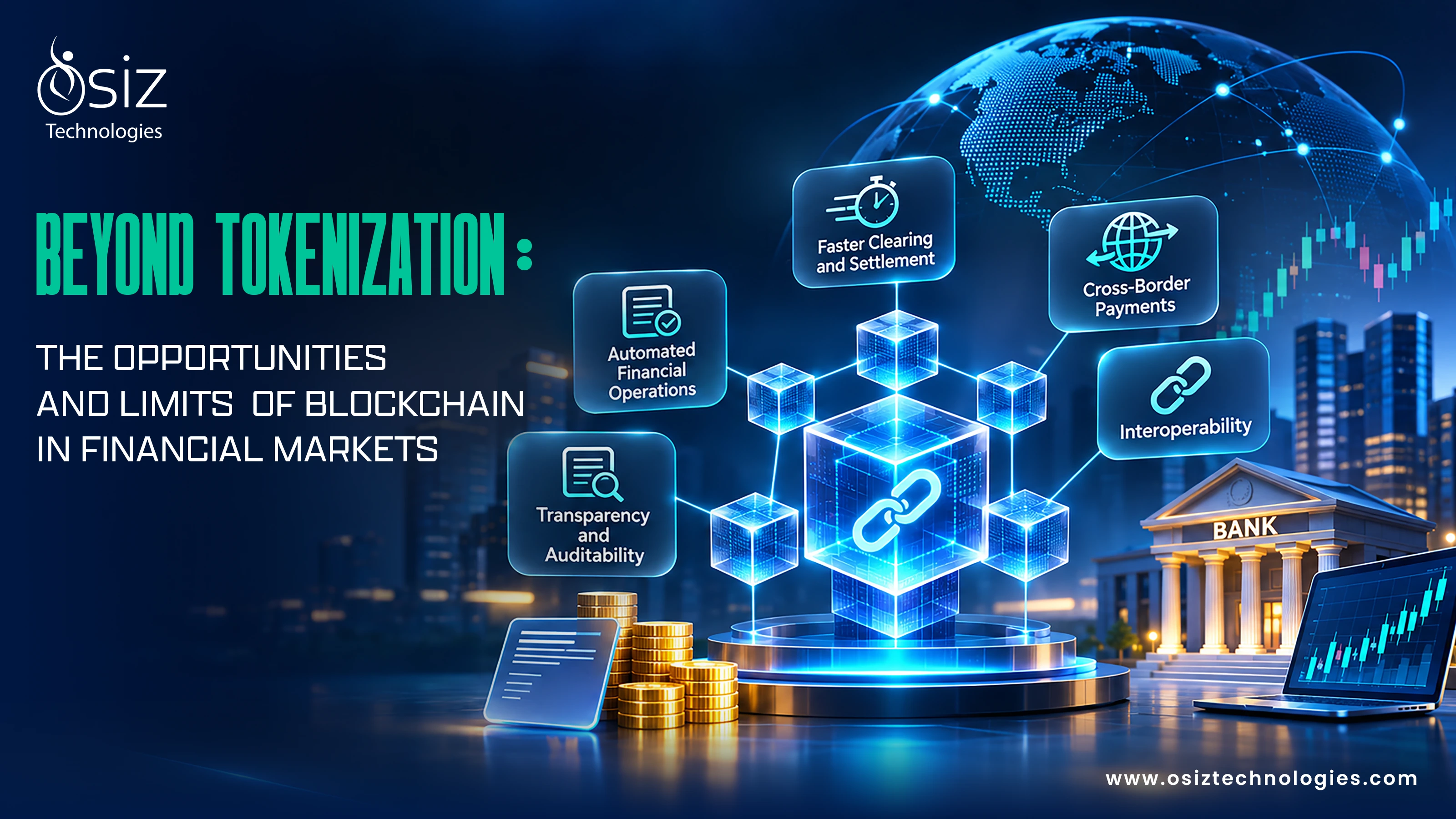
The emergence of blockchain based tokenization strategies revolutionize financial transactions where the assets move from one institution to another. However, better coordination is crucial among financial institutions and third parties to perform several activities such as ownership verification and transaction completion. Because each organization maintains separate records, which can make it difficult to keep financial information consistent. To handle such processes, blockchain technology offers a more efficient way through its distributed nature.
The value of the global blockchain technology market was reached at USD 57.7 billion in 2025 and it is projected to reach USD 9,055.5 billion by 2033, with a CAGR of 88.2%. North America accounted for 37.2% of the market revenue in 2025. Such results demonstrated that the distributed ledger technology
These results demonstrate that distributed ledger technology accomplishes its mainstream adoption across capital markets beyond cryptocurrency. This growth is driven by increasing the demand for secure and transparent transactions across industries.
Blockchain Technology in Financial Markets
The transformative technology referred to as blockchain records each and every transaction across a network by exploiting cryptographic verification and consensus algorithms.
Three major components that support the financial application are as follows.
Distributed Ledger: It maintains synchronized transaction records across authorized participants and diminish the discrepancies between separate institutional databases.
Smart Contract: It executes the predefined instructions for activities such as fund transfers along with interest distribution.
Permissioned Network: It restricts participation and validation to approved entities that provide support for controlled access within institutional environments.
Moreover, the transformative technology creates opportunities to coordinate financial activities without requiring every participant to maintain independent transaction records.
Opportunities Beyond Tokenization
Faster Clearing and Settlement
Generally, the settlements take a long time in conventional transaction scenarios that demand high security. The reason behind this is that the process passes through several stages.The distributed nature and smart contracts simplify this process by coordinating asset transfers and payments.
One other advantage is atomic settlement, where both sides of a transaction are completed at the same time, or neither is processed. It assists to limit settlement exposure and to reduce the need for reconciliation based on the network and legal framework.
Cross-Border Payments
Various currency conversions and different payment infrastructures make the cross-border payments as highly challenging, because they have to pass through correspondent banks. To address this issue effectively, blockchain-powered digital payment systems that support programmable transfers.
For example, the BIS-led Project Agorá examines how tokenized commercial bank deposits and central bank reserves can support multi-currency wholesale payments.
Automated Financial Operations
The smart contracts automatically carry out financial instructions once specific conditions are met.
Some of the applications are listed as follows.
- Release trade finance payments after document verification.
- Processing loan repayments.
- Managing collateral transfers.
- Securities-related payment distribution.
Notably, smart contract executions require external data, where the oracles act as a bridge to bring that data from the on-chain.
Transparency and Auditability
The nature of an immutable shared ledger creates traceable transaction histories which allows authorized participants to inspect. This property helps financial institutions to confirm who owns an asset and maintain accurate financial records for regulatory reviews.
However, it is crucial to consider privacy as financial records may contain sensitive customer information.
Interoperability
Usually, financial institutions operate across different databases and payment platforms. The interoperability protocol has the ability to connect such environments and allow compatible systems to exchange both information and digital assets.
A common standard is essential to connect isolated networks that create additional market fragmentation.
Key Limitations of Blockchain Adoption
Despite its capabilities, the technology faces several challenges in regulated financial environments.
Scalability: The increasing number of users escalate the network congestion that straightly slow down transactions and delay confirmations. Layer 2 solutions and alternative consensus mechanisms are best solutions to handle these performance concerns, but each introduces its own architectural trade-offs. .
Regulatory uncertainty: Clear and well-defined regulatory frameworks are important to address digital asset ownership, cross-border jurisdiction, AML requirements, and legal responsibility for executing the smart contracts.
Liquidity constraints: Tokenizing an asset does not guarantee that buyers and sellers will be available to trade it. It becomes more challenging when trading takes place across separate platforms, as asset movement between them may be limited.
Security vulnerabilities: Financial applications can face serious security risks if smart contracts contain vulnerabilities, private keys are compromised, attackers manipulate oracles and exploit cross-chain bridges.
Governance and accountability: Clear roles must be established for network administrators, validators, and participating institutions. So, they know who is responsible when protocol updates, system failures, and transaction disputes arise.
Institutional Adoption: Real-World Developments
Blockchain is no longer limited to discussions about its potential in financial markets. Already, several institutions have started testing how it works in actual financial operations. There are three examples given below.
Project Guardian – Singapore: The Monetary Authority of Singapore (MAS) started this initiative to study tokenization in financial markets. Its work looks at how tokenized funds and securities can be traded and settled, along with how different financial networks can work together.
Project Agorá – BIS: The Bank for International Settlements (BIS) is studying how commercial bank deposits and central bank reserves can be represented as digital tokens. The project looks at using this approach to settle wholesale payments across different currencies.
BlackRock BUIDL: BlackRock launched its USD Institutional Digital Liquidity Fund with decentralized network-based tokenized shares. The fund invests in cash, U.S. Treasury bills, and repurchase agreements, bringing a traditional financial product into transformative technology architecture.
Such three examples represent different stages of mass adoption of the disruptive technology. Project Guardian and Project Agorá are initiatives focused on testing new financial infrastructure, whereas BUIDL is an operational investment product. It demonstrates how far its adoption has progressed in institutional finance.
The Road Ahead for Blockchain in Financial Markets
The successful adoption of the transformative technology within the financial industry will depend on its compatibility with existing financial systems. Some of the areas which will impact the technology's future in the financial industry are as follows.
Institutional integration: The ability to integrate the transformative technology with existing banking infrastructure.
Privacy technologies: The addition of zero knowledge proofs can be added to verify transaction details without revealing private customer information.
Regulatory alignment: Clear regulations regarding digital asset ownership and international transactions can be implemented to ensure institutions are compliant with local regulations.
Programmable finance: Payments and asset transfers can be sent fully automatically using smart contracts.
As these areas develop, the shared ledger technology could become a more practical part of regulated financial operations.
Final Thoughts
Blockchain technology is becoming a fundamental part of modern financial applications, extending beyond the tokenization of physical assets. It is transforming traditional financial operations through faster settlement processes, seamless cross-border payments, and streamlined financial transactions.
However, the broader adoption of distributed ledger technology across financial institutions still faces challenges, including scalability, security, liquidity, governance, and regulatory compliance. Overcoming these barriers requires innovative blockchain solutions and decentralized network infrastructure that address existing industry limitations while creating new opportunities for financial innovation.
As blockchain continues to reshape financial markets, Osiz Technologies evolves alongside these technological advancements. As a leading Blockchain Development Company, we remain committed to exploring emerging technologies, adapting to industry developments, and building innovative solutions that address real-world business challenges. With every advancement, we strengthen our expertise in blockchain innovation and its potential to transform the future of finance.
Every Business Has a Problem. We Build the Solution.
Listen To The Article

Founder & CEO Osiz Technologies
Mr.Thangapandi, the founder and CEO of Osiz, is a pioneering figure in the field of blockchain technology. His deep understanding of both blockchain technology and user experience has led to the creation of innovative and successful blockchain solutions for businesses and startups, solidifying Osiz's reputation as a reliable service provider in the industry. Because of his unwavering quest for innovation, Mr.Thanga Pandi is well-positioned to be a thought leader and early adopter in the rapidly changing blockchain space. He keeps Osiz at the forefront of this exciting industry with his forward-thinking approach.
Recent Blogs



No 22,Astalakshmi Nagar, Thanakankullam, (Opp Seetha lakshmi Mill gate Bus stop) Thirunagar, Madurai - 625 006.
(Corporate Office)


Canada Office address, 1150, Rue Patrick, Laval, Quebec - H7Y 2C4, Canada.
(Sales Office)


Meydan Grandstand, 6th floor, Meydan Road, Nad Al Sheba, Dubai, U.A.E.
(Sales Office)


 Artificial Intelligence
- AI Development
- AI Predictive Analytics Services
- AI SaaS Development
- RAG Development
- AI Assistant Development
- ChatGPT Development
- Data Analytics Services
- AI Copilot Development
- Adaptive AI Development
- Machine Learning Development
- NLP
- AI Consulting Services
- AI Software Builder
- AI Token Development
- AI Integration Services
- AI Agent Bots
- Enterprise AI Solution
- AI As a Service
- AI Marketing Tools
- AI Video Generator
- Computer Vision Services
- Explore AI
- Dataset
- Machine Learning in Healthcare
- Machine Learning in Retail
- Hire AI Engineers
- Hire Prompt Engineers
- Hire ChatGPT Developers
- Hire Stable Diffusion Developers
- Hire Action Transformer Developers
Portfolio- AI Agriculture
- AI Healthcare
- NLP Services
- AI Brainstorming Tool
- Academic AI
- AI Dermatologist Software
- Best AI Tools
- Artificial Influencer Generator
- AI E-Learning Software
- AI Agriculture Software
- Generative AI Tool
- AI Assistant
- AI Sales Agent
- Intelligence OS For Medical Imaging
- Intelligence OS For Diagnosis Systems
- Intelligence OS For Control Systems
- Intelligence OS For Dialog Systems
- Intelligence OS For Health Management Systems
- Intelligence OS For Chat-Bots
- Intelligence OS For Crypto API
- Intelligence OS For Autocomplete In Search Engines
- Intelligence OS For CCTV To AI Camera
- Intelligence OS For Object Detection
- Intelligence OS For Voice Assistants
- Intelligence OS For Language
- Intelligence OS For Autonomous Vehicles
- Intelligence OS For Educational Assistant
- Intelligence OS For KYT
- Intelligence OS For Recommendation System
- Intelligence OS For Prediction System
- Intelligence OS For Finance
- Intelligence Fourier Transform Analysis
- AI Arbitrage Bot
- Intelligence OS For Multi-Lingual Assistant
- Blockchain
- Blockchain Development
- Private Blockchain Development
- Smart Contract Development
- Custom Blockchain Development
- Solana Blockchain Development
- Polygon Blockchain Development
- Public Blockchain Development
- DAO Blockchain Development
- Binance Smart Chain (BSC) Blockchain Development
- DApp Development
- Solana DApp Development
- White Label Blockchain Solutions
- Custom Blockchain On Avalanche
- Custom Blockchain On Polygon
- Blockchain Game Development
- Blockchain Consulting Services
- Blockchain Explorer Development
- Ethereum Blockchain Development
- TRON Blockchain Development
- Prediction Market Platform Development Company
Layer 1 & 2 Solutions- Layer-1 Blockchain Development
- Cross Chain Bridge Development
- Data Availability Layer Development
- Ethereum Layer 2 Scaling Solutions
- Cross-L2 DEX Solution
- Layer 2 Token Development
- Layer 2 Token Marketing
- Layer 2 Cryptocurrency Development
- Layer 2 Solutions For Blockchain Games
- Layer 2 Solutions For Web3 Gaming
- Layer 2 Blockchain Solutions
- Rollups As A Service
- Optimistic Rollups Development
- ZK Tech Development
- Bitcoin Layer 2 Solutions
Crypto Exchange- Cryptocurrency Exchange Development
- White Label Crypto Exchange
- Decentralized Exchange Development
- P2P Exchange Development
- Crypto Derivatives Exchange Development
- Centralized Exchange Development
- Crypto Exchange Clone Script
- Cryptocurrency Exchange App Development
- OTC Exchange Development
- Exchange Listing Services
- Binance Like Exchange Development
- Bitstamp Like Exchange Development
- Crypto Exchange Script
CryptoCrypto WalletToken Standards- Token Development
- AI Token Development
- RWA Tokenization Development
- Coinremitter Clone Script
- Asset Tokenization
- Real Estate Tokenization
- Tokenization Platform Development
- Crypto ETF Development
- Solona Token Development
- Semi-Fungible Token Development
- BEP20 Token Development
- Ethereum Token Development
- ERC1400 Token Development
- ERC998 Token Development
- ERC 721 Token Development
- ERC20 Token Development
- Defi Token Development
- ERC1155 Token Development
- BEP721 Token Development
- Utility Token Development
- ERC 777 Token Development
- ERC 827 Token Development
- Social Token Development
- Metaverse Token Development
- Tron Token Development
- ERC404 Token Development
- Governance Token
- Shibarium Token
- polygon Token
- BRC-20
- TRC20 Token Development
- TRC10 Token Development
- Soulbound Token Development
- NFT Token Development
Trading BotsClone- Crypto Exchange Clone Script
- Binance Clone Script
- Metamask Clone Script
- Coinbase Clone Script
- Kucoin Clone Script
- Paxful Clone Script
- Remitano Clone Script
- Wazirx Clone Script
- ByBit Clone Script
- Bitfinex Clone Script
- MEXC Clone Script
- Bitget Clone Script
- Cointool App Clone Script
- Trust Wallet Clone App
- Coinmarketcap Clone Script
- Changelly Clone Script
- BingX Clone Script
CybersecurityApp SecurityDigital Forensics & Incident ResponseAudit & ConsultingEducation & TrainingSolutionsWeb 3DeFi- Decentralized Finance (DeFi) Development
- DeFi Lending/ Borrowing Platform Development
- DeFi Staking Platform Development
- DeFi Token Development
- DeFi Wallet Development
- DeFi Smart Contract Development
- DeFi DApp Development
- Decentralized Exchange Development
- DeFi Insurance Development
- DeFi Crypto Synthetic Assets Development
Game Development- Game Development
- Android Game Development
- IOS Game Development
- Metaverse Game Development
- VR Game Development
- AI Game Development
- Unity 3D Game Development
- Unreal Engine Game Development
- Mobile Game Development
- Blockchain Game Development
- NFT Game Development
- Play to Earn Game Development
- Move to Earn Game Development
- Casino Game Development
- Slot Game Development
- Poker Game Development
- AAA Game Development
- AR Game Development
- Social Network Game Development
- Gamification Services
- Decentralized Sports Betting Platform
- Sports Betting Dapp Development
- Blockchain Casino Game Development
- Game Asset Creation
- Baccarat Game Development
- Rollbit Clone Script
- Fortnite Clone Script
- Slot Game Development
- Tap to Earn Game Development
- Slot Game Development
Metaverse Platforms- Metaverse Game Development
- Metaverse Event Platform Development
- Metaverse Virtual Mall Development
- Metaverse NFT Marketplace Development
- Metaverse Token Development
- Metaverse Virtual Land Development
- Metaverse Avatar Development
- Metaverse 3d Space Development
- Metaverse Real Estate Development
- Metaverse Social Media Platform Development
- Top 10 Metaverse Development Company
- Metaverse Business Ideas
- Metaverse Launchpad Development
- Metaverse App Development
- Metaverse Casino Game Development
NFT SolutionsNFT Platforms- NFT Minting Development
- NFT Token Development
- NFT Exchange Platform Development
- NFT Launchpad Development
- NFT Fashion Marketplace Development
- NFT Art Marketplace Development
- NFT Music Marketplace Development
- Carbon Credits NFT Marketplace Development
- Binance NFT Marketplace Development
- Polygon NFT Marketplace Development
- Solana NFT Marketplace Development
- Influencers NFT Marketplace Development
- NFT Ticketing Marketplace Development
- DeFi NFT Marketplace Development
- NFT Fantasy Sports Platform Development
- NFT Storage Development
- NFT Lending Platform Development
- Top10 NFT Business Ideas
NFT Game ClonesSustainabilityServiceNow - Blog
- Contact Us
- Works