
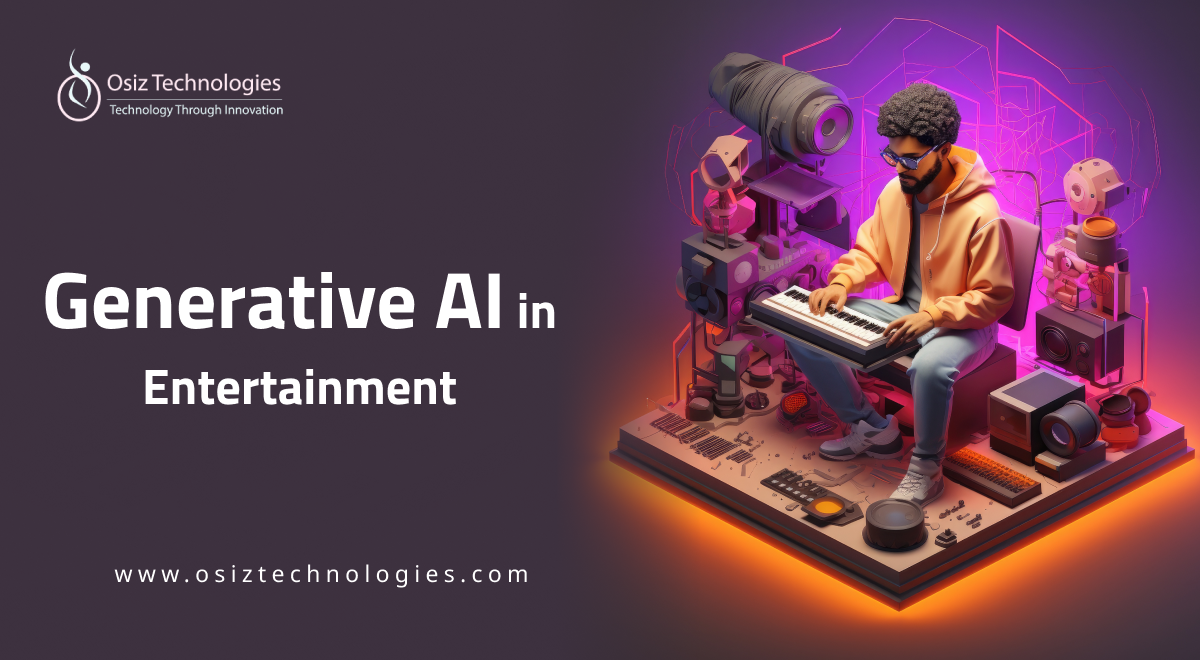
The entertainment world is changing because machines are helping, not hurting, creativity. Storytellers, studios, and brands are trying new things, with tech as their creative sidekick. Similar to how language models predict the next word, the industry is discovering what viewers prefer.
Introduction — Generative AI in Entertainment
Generative AI in entertainment involves using artificial intelligence to produce original content like images, music, text, and videos, thereby improving, automating, and customizing how media is created, shared, and consumed.
While traditional AI focuses on analyzing existing data, generative AI discovers patterns and structures within vast datasets to create original, often human-like creative content, providing creators with innovative tools and delivering fresh experiences for audiences.
How Generative AI Works - Simple Breakdown
Step 1: Data Understanding
The system studies large amounts of data. This includes text, images, audio, and games. It learns structures and trends from this data. This helps it understand how content is made.
Step 2: Pattern Recognition
It identifies links between styles, feelings, and context. This aids in making scenes, conversations, or resources that all feel like they match.
Step 3: Content Generation
Using what it's learned and your requests, the system makes new content. This could be scripts, images, textures, music, or voices.
Step 4: Refinement & Feedback
We refine the output using your edits, style choices, or system fixes. This helps the results better fit your creative ideas and project needs.
Step 5: Final Output Delivery
The content is rendered and prepped for use in film, music, gaming, or VR projects. Now it’s ready to see how these creations boost different parts of the entertainment world.
Applications of Generative AI Across Entertainment Sectors
In film and VFX, creators now use smart tech to speed up scenes, asset creation, physics, and visual effects, making AI VFX setups stronger. Studios can quickly preview projects and easily create new worlds.
Modern music tools empower artists to compose, craft compelling melodies, and mix tracks across diverse genres, fostering innovation and boosting creative productivity. Fostering a creative process that supports real-time collaboration, experimentation, and audio design.
AI in gaming enhances character behavior by making actions more lifelike and reactive, brings dynamic environments, introduce unforeseen features, reshaping the gameplay and delivering a more immersive and personalized experience for players.
Animation and making characters is getting easier. Now, models can make faces, movements, textures, expressions, and cool-looking scenes in just a few seconds, which means new ways to tell stories.
Voicing and getting content ready for different countries is changing, too. Tech can now make speech sound real, copy voices in an ethical way, and quickly handle versions in many languages. This means global releases can reach audiences sooner.
Advertising and making creative content is becoming more on point. You can quickly come up with ideas, create mood boards, visuals, and even virtual brand ambassadors that tell your brand's story just right.
Generative AI in Film Production
Automated scripting and story boarding enable filmmakers to generate video and animation ideas more quickly, so directors can spend more time on the art of filmmaking.
Virtual production and scene creation let teams design settings, lighting, and special effects that mix the real and digital, expanding what AI can do in VR and immersive movies.
Actor de-aging and digital doubles make things look real by recreating faces, expressions, and movement accurately, which keeps things consistent and gives more creative control.
AI in music and sound transforms movie audio by creating intelligent, mood-driven soundtracks that adapt to the narrative pace and tone. It generates and blends music instantly,
Multilingual Voice Replication make characters relatable everywhere by copying accents and delivering lines well.
Background music creation gives editors and directors fast soundtracks that fit the feelings of the scene, which leads to gaming.
Generative AI in Gaming
Procedural world creation makes environments bigger in a dynamic way. It creates terrains, cities, and full universes that change as people play. This helps the game be replayed more, and it makes the storytelling better. Each experience then feels unique.
NPC conversation creation allows characters to talk and react in natural conversations that fit the situation. These chats make interactions feel real, personal, and relevant, which makes the story deeper and people more emotionally attached.
Real-time adaptive play improves immersion by changing the difficulty, story, environments, and events depending on how someone plays. This makes systems react quickly and change all the time, which finishes the loop of smart entertainment changes.
Role of generative AI in VR makes these things even better by bringing worlds that change, characters that react, and personal experiences into full, spatial environments. It turns VR from a set simulation into an ecosystem that lives and changes as people move, think, and interact.
Conclusion
Generative tech isn't killing creativity; it's making it bigger than the entertainment biz has ever seen. As things move toward more automation and custom content, creators are getting cool tools that boost their ideas.
Synthetic media, AI-driven visual effects, and generative AI in video, music, gaming, and animation are transforming the way stories are created and distributed. Studios can now rapidly develop immersive worlds, produce stunning scenes, and generate content that evolves based on audience preferences.
With companies like Osiz leading the way as a Generative AI development company, entertainment will be more interactive and focused on people. When human creativity meets AI, things get really interesting. Ideas grow easily, production gets faster, and audiences get stories that feel real and endless.
Listen To The Article

Founder & CEO Osiz Technologies
Mr. Thangapandi, the CEO of Osiz, has a proven track record of conceptualizing and architecting 100+ user-centric and scalable solutions for startups and enterprises. He brings a deep understanding of both technical and user experience aspects. The CEO, being an early adopter of new technology, said, "I believe in the transformative power of AI to revolutionize industries and improve lives. My goal is to integrate AI in ways that not only enhance operational efficiency but also drive sustainable development and innovation." Proving his commitment, Mr. Thangapandi has built a dedicated team of AI experts proficient in coming up with innovative AI solutions and have successfully completed several AI projects across diverse sectors.
Recent Blogs



No 22,Astalakshmi Nagar, Thanakankullam, (Opp Seetha lakshmi Mill gate Bus stop) Thirunagar, Madurai - 625 006.
(Corporate Office)


Canada Office address, 1150, Rue Patrick, Laval, Quebec - H7Y 2C4, Canada.
(Sales Office)


Explore Our
AI Portfolio

 Artificial Intelligence
- AI Development
- AI Predictive Analytics Services
- AI SaaS Development
- RAG Development
- AI Assistant Development
- ChatGPT Development
- Data Analytics Services
- AI Copilot Development
- Adaptive AI Development
- Machine Learning Development
- NLP
- AI Consulting Services
- AI Software Builder
- AI Token Development
- AI Integration Services
- Enterprise AI Solution
- AI As a Service
- AI Marketing Tools
- AI Video Generator
- Computer Vision Services
- Explore AI
- Dataset
- Machine Learning in Healthcare
- Machine Learning in Retail
- Hire AI Engineers
- Hire Prompt Engineers
- Hire ChatGPT Developers
- Hire Stable Diffusion Developers
- Hire Action Transformer Developers
- Blockchain
- Blockchain Development
- Private Blockchain Development
- Smart Contract Development
- Custom Blockchain Development
- Solana Blockchain Development
- Polygon Blockchain Development
- Public Blockchain Development
- DAO Blockchain Development
- Binance Smart Chain (BSC) Blockchain Development
- DApp Development
- Solana DApp Development
- White Label Blockchain Solutions
- Custom Blockchain On Avalanche
- Custom Blockchain On Polygon
- Blockchain Game Development
- Blockchain Consulting Services
- Blockchain Explorer Development
- Ethereum Blockchain Development
- TRON Blockchain Development
- Prediction Market Platform Development Company
Layer 1 & 2 Solutions- Layer-1 Blockchain Development
- Cross Chain Bridge Development
- Data Availability Layer Development
- Ethereum Layer 2 Scaling Solutions
- Cross-L2 DEX Solution
- Layer 2 Token Development
- Layer 2 Token Marketing
- Layer 2 Cryptocurrency Development
- Layer 2 Solutions For Blockchain Games
- Layer 2 Solutions For Web3 Gaming
- Layer 2 Blockchain Solutions
- Rollups As A Service
- Optimistic Rollups Development
- ZK Tech Development
- Bitcoin Layer 2 Solutions
Crypto Exchange- Cryptocurrency Exchange Development
- White Label Crypto Exchange
- Decentralized Exchange Development
- P2P Exchange Development
- Crypto Derivatives Exchange Development
- Centralized Exchange Development
- Crypto Exchange Clone Script
- Cryptocurrency Exchange App Development
- OTC Exchange Development
- Exchange Listing Services
- Binance Like Exchange Development
- Bitstamp Like Exchange Development
- Crypto Exchange Script
CryptoCrypto WalletToken Standards- Token Development
- AI Token Development
- RWA Tokenization Development
- Coinremitter Clone Script
- Asset Tokenization
- Real Estate Tokenization
- Tokenization Platform Development
- Crypto ETF Development
- Solona Token Development
- Semi-Fungible Token Development
- BEP20 Token Development
- Ethereum Token Development
- ERC1400 Token Development
- ERC998 Token Development
- ERC 721 Token Development
- ERC20 Token Development
- Defi Token Development
- ERC1155 Token Development
- BEP721 Token Development
- Utility Token Development
- ERC 777 Token Development
- ERC 827 Token Development
- Social Token Development
- Metaverse Token Development
- Tron Token Development
- ERC404 Token Development
- Governance Token
- Shibarium Token
- polygon Token
- BRC-20
- TRC20 Token Development
- TRC10 Token Development
- Soulbound Token Development
- NFT Token Development
Trading BotsClone- Crypto Exchange Clone Script
- Binance Clone Script
- Metamask Clone Script
- Coinbase Clone Script
- Kucoin Clone Script
- Paxful Clone Script
- Remitano Clone Script
- Wazirx Clone Script
- ByBit Clone Script
- Bitfinex Clone Script
- MEXC Clone Script
- Bitget Clone Script
- Cointool App Clone Script
- Trust Wallet Clone App
- Coinmarketcap Clone Script
- Changelly Clone Script
- BingX Clone Script
CybersecurityApp SecurityDigital Forensics & Incident ResponseAudit & ConsultingEducation & TrainingSolutionsWeb 3DeFi- Decentralized Finance (DeFi) Development
- DeFi Lending/ Borrowing Platform Development
- DeFi Staking Platform Development
- DeFi Token Development
- DeFi Wallet Development
- DeFi Smart Contract Development
- DeFi DApp Development
- Decentralized Exchange Development
- DeFi Insurance Development
- DeFi Crypto Synthetic Assets Development
Game Development- Game Development
- Android Game Development
- IOS Game Development
- Metaverse Game Development
- VR Game Development
- AI Game Development
- Unity 3D Game Development
- Unreal Engine Game Development
- Mobile Game Development
- Blockchain Game Development
- NFT Game Development
- Play to Earn Game Development
- Move to Earn Game Development
- Casino Game Development
- Slot Game Development
- Poker Game Development
- AAA Game Development
- AR Game Development
- Social Network Game Development
- Gamification Services
- Decentralized Sports Betting Platform
- Sports Betting Dapp Development
- Blockchain Casino Game Development
- Game Asset Creation
- Baccarat Game Development
- Rollbit Clone Script
- Fortnite Clone Script
- Slot Game Development
- Tap to Earn Game Development
- Slot Game Development
Metaverse Platforms- Metaverse Game Development
- Metaverse Event Platform Development
- Metaverse Virtual Mall Development
- Metaverse NFT Marketplace Development
- Metaverse Token Development
- Metaverse Virtual Land Development
- Metaverse Avatar Development
- Metaverse 3d Space Development
- Metaverse Real Estate Development
- Metaverse Social Media Platform Development
- Top 10 Metaverse Development Company
- Metaverse Business Ideas
- Metaverse Launchpad Development
- Metaverse App Development
- Metaverse Casino Game Development
NFT SolutionsNFT Platforms- NFT Minting Development
- NFT Token Development
- NFT Exchange Platform Development
- NFT Launchpad Development
- NFT Fashion Marketplace Development
- NFT Art Marketplace Development
- NFT Music Marketplace Development
- Carbon Credits NFT Marketplace Development
- Binance NFT Marketplace Development
- Polygon NFT Marketplace Development
- Solana NFT Marketplace Development
- Influencers NFT Marketplace Development
- NFT Ticketing Marketplace Development
- DeFi NFT Marketplace Development
- NFT Fantasy Sports Platform Development
- NFT Storage Development
- NFT Lending Platform Development
- Top10 NFT Business Ideas
NFT Game ClonesSustainabilityServiceNow - Blog
- Contact Us
- Works