
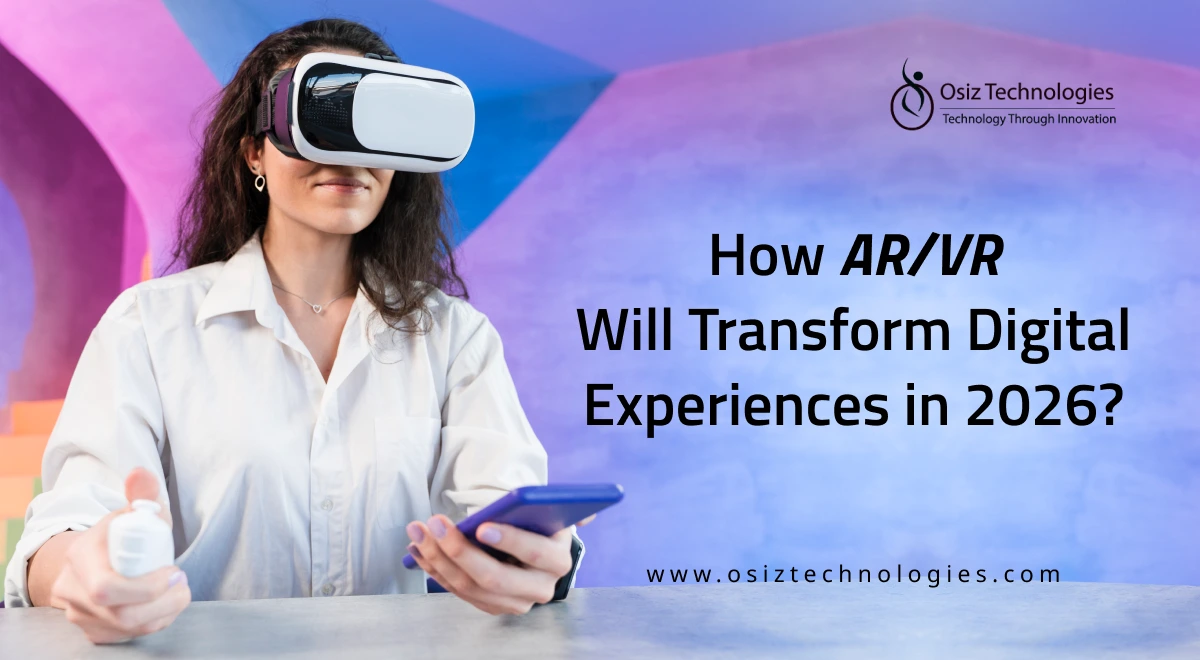
The digital world is changing. Screens are becoming less important as AR and VR technologies change how we interact with information every day. We expect digital experiences to be quicker and more natural. By 2026, immersive tech will likely be a must-have instead of a cool new thing in most industries.
Why 2026 becomes a turning point
AR and VR technology in digital world has come a long way, as seen in spatial apps, simple headsets, gesture controls, and mixed-reality interfaces. The next step? More natural interactions that smoothly mix the real and digital. All AR VR companies aim to make experiences more immersive and lifelike.
This will obviously make immersive tech a key part of changing how businesses work, not just something extra they might do. If companies use more connected ways of doing things, AR and VR will become even more important for industrial automation. That will cause 2026 will be the year when immersive tools become common. This move makes it a good time to figure out how AR/VR will change what we experience every day going forward.
AR/VR Transformation in Daily Digital Experiences
1. Shopping & retail
Shopping is moving away from simple browsing to a more involved experience. Now, shoppers can use AR to try on clothes virtually, explore online stores, view products in 3D virtual platform, or see items in their own space. This gives a clearer and more real feel, which makes shopping decisions easier and more fun. Instead of just looking, shoppers get to explore, compare, and change products as if they were right there.
As shoppers enjoy these new shopping ways, they want the same kind of experience in other online areas, especially at work. The things that make AR shopping good, like seeing things visually, real interactions, and a better sense of amongness, also make working together remotely easier. Because of this, workplaces are starting to use online spaces where teams can think together, look at designs, or meet around virtual items, making remote work feel more like being together.
2. Work & remote collaboration
Using 3D virtual environments improves remote work by bringing tasks, tools, and team members into a single digital space. VR headsets enable interactive dashboards, spatial audio, and lifelike meeting rooms, creating a realistic sense of presence. This setup improves discussions, cuts down on confusion, and lessens the distance that video calls can create. Instead of just looking at screens, teams work together in shared virtual settings where body language and real-time talks feel more human.
The main idea is to make remote collaboration more real and engaging. When meetings feel like immersive games, productivity goes up and people feel more connected. The things that make workplace talks better also make games and entertainment better: being real, immersive, and feeling present. As these worlds come together, companies get workspaces as interactive as VR games, and entertainment gets more social and realistic.
3. Gaming & entertainment
Games are moving from screens to mixed-reality spaces that react to you. Instead of just using buttons, you can use gestures, movement, and your voice to play. This makes stories feel real since you're part of them. You can walk through the game, change how it ends, and feel emotions more deeply.
This emphasis on participating in the game is also transforming the way we learn. By combining the real world with digital elements, games evolve as you play. These ideas can be used in learning to teach through doing, working together, and being present.
4. Education & learning
AR/VR is changing classrooms by mixing what's real with interactive tech. With AR in education, students can see tough subjects like anatomy or physics in 3D. VR puts students in fake worlds where they can practice things that would be hard or dangerous in real life. This hands-on approach helps them understand better and remember more.
When students do virtual labs or check out old places in 360°, they learn by doing, not just watching. This idea is catching on in healthcare too. Medical students can use VR to practice surgery, nurses can learn how to talk to patients through simulations, and patients can get AR help with getting better. AR/VR is upgrading how we learn and prepping us for the future in schools and jobs.
5. Healthcare & therapy
AR/VR is changing healthcare by offering hands-on medical training. Surgeons can now practice difficult procedures with lifelike simulations, leading to better results for patients. Also, therapists are using VR to treat phobias, PTSD, anxiety, and motor skills issues with secure, real-world experiences. Medical teams can also look at organs, data, and treatment strategies in 3D, turning tangled info into something easy to grasp and interactive.
As healthcare adopts reality tech, AR/VR is finding fresh applications. Virtual travel allows patients who are bedridden or old to visit places they enjoy, reducing stress and lifting spirits. VR directions help people get around large hospitals, and AR assists paramedics during emergencies by showing patient stats with step-by-step instructions instantly. These tools bring together medical attention, comfort, and easy access, creating a more thoughtful approach to patient healthcare.
6. Travel & navigation
Augmented Reality offers immediate, on-screen assistance that integrates with your real-world view. Street names show up on buildings, arrows guide you at each turn, and interesting locations appear as you look around. Instead of struggling with paper maps, people can use their phones or AR glasses for easy directions. Virtual Reality lets you visit places in advance. You can view hotels, landmarks, and neighborhoods as if you were there, which helps with swift planning.
The goal is to make travel simpler by removing confusion. AR turns navigation into a visual experience, offering information that adapts as you move. It knows your location, your viewpoint, and your destination. VR lets you explore locations remotely. Both systems simplify travel, aid in understanding new places faster, and make the whole trip a smooth, smart, digital experience.
Conclusion
By 2026, augmented and virtual reality should be common in shopping, work, education, healthcare, and even travel. Instead of just staring at screens, expect to interact with digital content in ways that are both real and useful. AR will likely give visual help for everyday tasks, while VR should change how we plan, work together, and learn new stuff. Expect immersive settings to improve things like shopping, learning, healthcare, entertainment, and travel based on what users do.
At Osiz, we're creating immersive tech for the times ahead. As an VR development company we build solutions that merge digital tech with what people need in the real world. We assist companies in applying immersive tools that make things better for customers and improve the way they work. As the world goes toward more spatial computing and realistic digital interactions, Osiz is ready to lead industries into a future where immersive tech is just part of what we do every day.
Listen To The Article

Founder & CEO Osiz Technologies
Osiz Technologies' CEO, Mr. Thangapandi celebrated a major milestone, signifying the company's progression into its next phase. With a strong team of over 300+ employees, Osiz has established itself as a globally recognized leader in the IT industry, known for its outstanding performance.
CEO, Mr. Thangapandi is thrilled to share the exciting progress of our VR Development Company. Our team’s dedication and innovation have propelled us to the forefront of the virtual reality industry, delivering groundbreaking applications across education, healthcare, and entertainment. We continue to push the boundaries of what's possible, creating immersive experiences that transform how we learn, work, and play!
Recent Blogs



No 22,Astalakshmi Nagar, Thanakankullam, (Opp Seetha lakshmi Mill gate Bus stop) Thirunagar, Madurai - 625 006.
(Corporate Office)


Canada Office address, 1150, Rue Patrick, Laval, Quebec - H7Y 2C4, Canada.
(Sales Office)


Explore
Our AI Portfolio

 Artificial Intelligence
- AI Development
- AI Predictive Analytics Services
- AI SaaS Development
- RAG Development
- AI Assistant Development
- ChatGPT Development
- Data Analytics Services
- AI Copilot Development
- Adaptive AI Development
- Machine Learning Development
- NLP
- AI Consulting Services
- AI Software Builder
- AI Token Development
- AI Integration Services
- Enterprise AI Solution
- AI As a Service
- AI Marketing Tools
- AI Video Generator
- Computer Vision Services
- Explore AI
- Dataset
- Machine Learning in Healthcare
- Machine Learning in Retail
- Hire AI Engineers
- Hire Prompt Engineers
- Hire ChatGPT Developers
- Hire Stable Diffusion Developers
- Hire Action Transformer Developers
- Blockchain
- Blockchain Development
- Private Blockchain Development
- Smart Contract Development
- Custom Blockchain Development
- Solana Blockchain Development
- Polygon Blockchain Development
- Public Blockchain Development
- DAO Blockchain Development
- Binance Smart Chain (BSC) Blockchain Development
- DApp Development
- Solana DApp Development
- White Label Blockchain Solutions
- Custom Blockchain On Avalanche
- Custom Blockchain On Polygon
- Blockchain Game Development
- Blockchain Consulting Services
- Blockchain Explorer Development
- Ethereum Blockchain Development
- TRON Blockchain Development
- Prediction Market Platform Development Company
Layer 1 & 2 Solutions- Layer-1 Blockchain Development
- Cross Chain Bridge Development
- Data Availability Layer Development
- Ethereum Layer 2 Scaling Solutions
- Cross-L2 DEX Solution
- Layer 2 Token Development
- Layer 2 Token Marketing
- Layer 2 Cryptocurrency Development
- Layer 2 Solutions For Blockchain Games
- Layer 2 Solutions For Web3 Gaming
- Layer 2 Blockchain Solutions
- Rollups As A Service
- Optimistic Rollups Development
- ZK Tech Development
- Bitcoin Layer 2 Solutions
Crypto Exchange- Cryptocurrency Exchange Development
- White Label Crypto Exchange
- Decentralized Exchange Development
- P2P Exchange Development
- Crypto Derivatives Exchange Development
- Centralized Exchange Development
- Crypto Exchange Clone Script
- Cryptocurrency Exchange App Development
- OTC Exchange Development
- Exchange Listing Services
- Binance Like Exchange Development
- Bitstamp Like Exchange Development
- Crypto Exchange Script
CryptoCrypto WalletToken Standards- Token Development
- AI Token Development
- RWA Tokenization Development
- Coinremitter Clone Script
- Asset Tokenization
- Real Estate Tokenization
- Tokenization Platform Development
- Crypto ETF Development
- Solona Token Development
- Semi-Fungible Token Development
- BEP20 Token Development
- Ethereum Token Development
- ERC1400 Token Development
- ERC998 Token Development
- ERC 721 Token Development
- ERC20 Token Development
- Defi Token Development
- ERC1155 Token Development
- BEP721 Token Development
- Utility Token Development
- ERC 777 Token Development
- ERC 827 Token Development
- Social Token Development
- Metaverse Token Development
- Tron Token Development
- ERC404 Token Development
- Governance Token
- Shibarium Token
- polygon Token
- BRC-20
- TRC20 Token Development
- TRC10 Token Development
- Soulbound Token Development
- NFT Token Development
Trading BotsClone- Crypto Exchange Clone Script
- Binance Clone Script
- Metamask Clone Script
- Coinbase Clone Script
- Kucoin Clone Script
- Paxful Clone Script
- Remitano Clone Script
- Wazirx Clone Script
- ByBit Clone Script
- Bitfinex Clone Script
- MEXC Clone Script
- Bitget Clone Script
- Cointool App Clone Script
- Trust Wallet Clone App
- Coinmarketcap Clone Script
- Changelly Clone Script
- BingX Clone Script
CybersecurityApp SecurityDigital Forensics & Incident ResponseAudit & ConsultingEducation & TrainingSolutionsWeb 3DeFi- Decentralized Finance (DeFi) Development
- DeFi Lending/ Borrowing Platform Development
- DeFi Staking Platform Development
- DeFi Token Development
- DeFi Wallet Development
- DeFi Smart Contract Development
- DeFi DApp Development
- Decentralized Exchange Development
- DeFi Insurance Development
- DeFi Crypto Synthetic Assets Development
Game Development- Game Development
- Android Game Development
- IOS Game Development
- Metaverse Game Development
- VR Game Development
- AI Game Development
- Unity 3D Game Development
- Unreal Engine Game Development
- Mobile Game Development
- Blockchain Game Development
- NFT Game Development
- Play to Earn Game Development
- Move to Earn Game Development
- Casino Game Development
- Slot Game Development
- Poker Game Development
- AAA Game Development
- AR Game Development
- Social Network Game Development
- Gamification Services
- Decentralized Sports Betting Platform
- Sports Betting Dapp Development
- Blockchain Casino Game Development
- Game Asset Creation
- Baccarat Game Development
- Rollbit Clone Script
- Fortnite Clone Script
- Slot Game Development
- Tap to Earn Game Development
- Slot Game Development
Metaverse Platforms- Metaverse Game Development
- Metaverse Event Platform Development
- Metaverse Virtual Mall Development
- Metaverse NFT Marketplace Development
- Metaverse Token Development
- Metaverse Virtual Land Development
- Metaverse Avatar Development
- Metaverse 3d Space Development
- Metaverse Real Estate Development
- Metaverse Social Media Platform Development
- Top 10 Metaverse Development Company
- Metaverse Business Ideas
- Metaverse Launchpad Development
- Metaverse App Development
- Metaverse Casino Game Development
NFT SolutionsNFT Platforms- NFT Minting Development
- NFT Token Development
- NFT Exchange Platform Development
- NFT Launchpad Development
- NFT Fashion Marketplace Development
- NFT Art Marketplace Development
- NFT Music Marketplace Development
- Carbon Credits NFT Marketplace Development
- Binance NFT Marketplace Development
- Polygon NFT Marketplace Development
- Solana NFT Marketplace Development
- Influencers NFT Marketplace Development
- NFT Ticketing Marketplace Development
- DeFi NFT Marketplace Development
- NFT Fantasy Sports Platform Development
- NFT Storage Development
- NFT Lending Platform Development
- Top10 NFT Business Ideas
NFT Game ClonesSustainabilityServiceNow - Blog
- Contact Us
- Works