
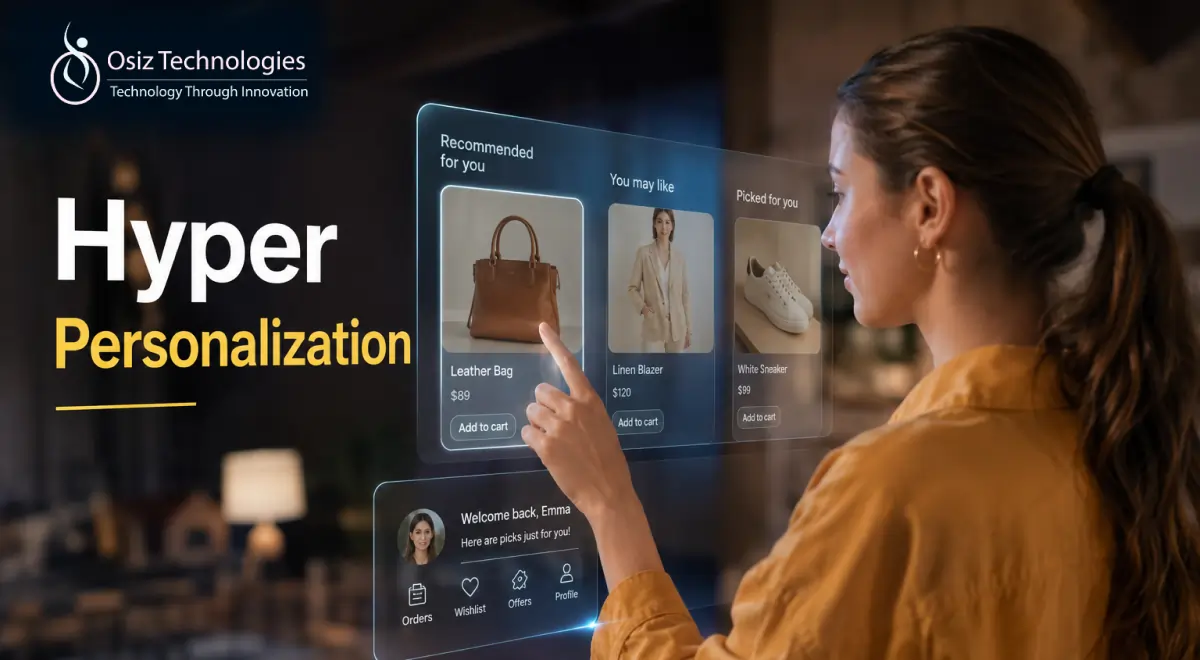
At Osiz Technologies, we understand the importance of delivering tailored experiences to customers. Hyper-personalization is a business strategy that leverages advanced technologies to create highly individualized interactions, products, or services based on a customer's unique preferences, behaviors, and needs.
What is Hyper-Personalization?
Hyper-personalization is a customer-centric approach that uses real-time data analytics, machine learning, and AI to deliver highly relevant and context-driven experiences. This approach goes beyond traditional personalization by using a deeper understanding of customer behavior, preferences, and needs to create tailored interactions.
Benefits of Hyper-Personalization
Hyper-personalization provides businesses with a powerful way to strengthen customer relationships and achieve sustainable growth. By leveraging real-time data and advanced analytics, organizations can deliver highly relevant and individualized experiences that increase customer satisfaction and engagement. These tailored interactions foster stronger customer loyalty, improve retention rates, and encourage repeat business. Moreover, businesses that adopt innovative hyper-personalization strategies can differentiate themselves in competitive markets, creating unique customer experiences that drive higher conversions, long-term value, and a significant competitive advantage.
Key Strategies for Hyper-Personalization
To implement hyper-personalization effectively, businesses should consider the following strategies:
- Use AI and machine learning to analyze customer data and behavior
- Leverage real-time data analytics to create tailored interactions
- Adopt omnichannel integration to deliver seamless experiences across channels
- Segment beyond demographics to create more nuanced customer profiles
- Invest in customer data platforms (CDPs) to centralize and manage customer data
- Use behavioral triggers to create relevant and timely interactions
- Combine personalization with context to create more effective experiences
- Prioritize data privacy and security to maintain customer trust
- Test and optimize continuously to refine and improve hyper-personalization efforts
Advanced Techniques for Hyper-Personalization
Predictive Analytics for Hyper-Personalization
Predictive analytics plays a crucial role in hyper-personalization by enabling businesses to forecast customer behavior and preferences. By leveraging machine learning algorithms and advanced statistical models, businesses can identify patterns and trends in customer data, allowing them to create more accurate and effective personalized experiences.
To implement predictive analytics for hyper-personalization, businesses can use techniques such as:
- Regression analysis: To identify the relationships between customer data and behavior
- Decision trees: To classify customers based on their behavior and preferences
- Clustering analysis: To segment customers based on their behavior and preferences
- Collaborative filtering: To recommend products or services based on customer behavior and preferences
Contextualization for Hyper-Personalization
Contextualization is the process of considering the context in which a customer interacts with a business. This includes factors such as location, time, device, and behavior. By incorporating contextual information into hyper-personalization, businesses can create more relevant and timely experiences for their customers.
To implement contextualization for hyper-personalization, businesses can use techniques such as:
- Geolocation: To deliver location-based experiences and offers
- Time-based personalization: To deliver experiences and offers based on the time of day or week
- Device-based personalization: To deliver experiences and offers based on the device used by the customer
- Behavioral triggers: To deliver experiences and offers based on customer behavior
Emotional Intelligence for Hyper-Personalization
Emotional intelligence is the ability to understand and respond to the emotions of customers. By incorporating emotional intelligence into hyper-personalization, businesses can create more empathetic and engaging experiences for their customers.
To incorporate emotional intelligence into hyper-personalization, businesses can leverage advanced technologies that better understand and respond to customer emotions. Sentiment analysis helps evaluate customer feedback, reviews, and conversations to uncover opinions and satisfaction levels, while emotion detection identifies emotional cues from customer behaviors and interactions. These insights enable businesses to deliver personalized messages, recommendations, and offers that resonate with individual emotional states. Additionally, adopting empathy-driven design ensures that digital experiences are thoughtful, responsive, and aligned with customer needs, fostering stronger emotional connections, increased engagement, and long-term brand loyalty.
Measuring the Success of Hyper-Personalization
Evaluating the effectiveness of hyper-personalization is essential for determining how well it enhances customer experiences and contributes to business growth. Organizations can assess its performance by tracking key metrics such as customer satisfaction, which reflects how well individual expectations are met; customer retention, which indicates the ability to build long-term loyalty; conversion rates, which measure how personalized interactions influence purchasing decisions; and return on investment (ROI), which evaluates the overall financial value generated from hyper-personalization initiatives. These insights help businesses refine their strategies and maximize customer engagement.
Overcoming Common Challenges in Hyper-Personalization
While hyper-personalization offers significant advantages, implementing it effectively comes with several challenges. Businesses must maintain high-quality, accurate, and up-to-date customer data to deliver relevant experiences. Protecting customer information through strong data privacy and security measures is equally important for building trust and meeting regulatory requirements. Organizations also need scalable solutions that can support growing customer bases without compromising performance. Additionally, seamless integration with existing systems, platforms, and business processes is essential to ensure consistent and efficient personalized experiences across every customer touchpoint.
To overcome these challenges, businesses can use techniques such as:
- Data cleansing: To ensure that customer data is accurate and up-to-date
- Data encryption: To ensure that customer data is protected and secure
- Cloud-based infrastructure: To ensure that hyper-personalization can be scaled to meet the needs of a large customer base
- Integration platforms: To ensure that hyper-personalization can be integrated with existing systems and processes
Best Practices for Hyper-Personalization
To implement hyper-personalization effectively, businesses should follow best practices such as:
- Start small: To begin with a small pilot program and scale up as needed
- Use data-driven decision making: To make decisions based on data and analytics
- Continuously test and optimize: To continuously test and optimize hyper-personalization efforts
- Prioritize data privacy and security: To ensure that customer data is protected and secure
- Invest in customer data platforms (CDPs): To centralize and manage customer data
By following these best practices, businesses can create more effective and engaging experiences for their customers, leading to increased customer satisfaction, engagement, and retention.
Advanced Techniques for Hyper-Personalization
Hyper-Personalization in the Age of Voice Assistants
The rise of voice assistants has revolutionized the way we interact with technology. With the increasing adoption of voice assistants like Amazon Alexa, Google Assistant, and Apple Siri, businesses have a new opportunity to deliver hyper-personalized experiences through voice-based interactions.
To successfully implement hyper-personalization in the era of voice assistants, businesses should leverage advanced voice-driven technologies that create more meaningful customer interactions. Voice-based personalization enables brands to deliver customized recommendations and offers through natural conversations, while contextual voice understanding helps interpret user intent and provide relevant responses based on the situation. Emotion detection through voice further enhances engagement by identifying customer sentiments and enabling more empathetic interactions. Additionally, personalized voice responses tailored to individual preferences and behaviors help create seamless, intuitive, and highly engaging experiences that strengthen customer relationships.
Hyper-Personalization in the Age of Augmented Reality
Augmented reality (AR) is changing the way we interact with technology. With the increasing adoption of AR-enabled devices and platforms, businesses have a new opportunity to deliver hyper-personalized experiences through immersive and interactive experiences.
To implement hyper-personalization in the age of augmented reality (AR), businesses can leverage immersive technologies to create highly customized customer experiences. AR-based personalization allows brands to deliver tailored product recommendations, promotions, and interactive content through engaging AR environments. By using contextual AR understanding, businesses can interpret user interactions and provide relevant experiences based on real-time behavior and surroundings. Emotion detection through AR interactions further enhances engagement by identifying customer responses and enabling more empathetic experiences. Additionally, personalized AR experiences designed around individual preferences and needs help improve customer satisfaction, increase engagement, and strengthen brand loyalty.
Hyper-Personalization in the Age of Artificial Intelligence
Artificial intelligence (AI) is transforming the way we interact with technology. With the increasing adoption of AI-powered platforms and tools, businesses have a new opportunity to deliver hyper-personalized experiences through intelligent and adaptive interactions.
To implement hyper-personalization in the age of AI, businesses can harness artificial intelligence to deliver intelligent, data-driven customer experiences. AI-powered personalization enables brands to provide tailored recommendations, content, and offers based on individual behaviors, preferences, and real-time interactions. Contextual AI understanding further enhances personalization by analyzing customer intent and delivering relevant responses across multiple touchpoints. Advanced emotion detection capabilities allow AI to recognize customer sentiment, making interactions more empathetic and engaging. By combining these capabilities, businesses can create personalized AI experiences that adapt to each customer's unique needs, improving satisfaction, engagement, and long-term loyalty.
The Role of Data in Hyper-Personalization
Data is the backbone of hyper-personalization. Businesses need to collect, analyze, and act on customer data to deliver personalized experiences and offers. However, with the increasing amount of data being generated, businesses face challenges such as:
Data quality: To ensure that customer data is accurate and up-to-date
Data privacy: To ensure that customer data is protected and secure
Data integration: To ensure that customer data is integrated with existing systems and processes
To overcome these challenges, businesses can use techniques such as:
Data cleansing: To ensure that customer data is accurate and up-to-date
Data encryption: To ensure that customer data is protected and secure
Data integration platforms: To ensure that customer data is integrated with existing systems and processes
Cloud-based infrastructure: To ensure that customer data can be scaled to meet the needs of a large customer base
The Future of Hyper-Personalization
Hyper-personalization is a rapidly evolving field, and businesses need to stay ahead of the curve to deliver personalized experiences and offers. The future of hyper-personalization will be driven by emerging technologies that enable more intelligent, immersive, and connected customer experiences. Artificial intelligence (AI) will continue to power adaptive interactions by analyzing customer behavior and delivering highly relevant recommendations in real time. Augmented reality (AR) will create immersive experiences that allow customers to interact with products and services in personalized ways, while voice assistants will make conversational, hands-free interactions more intuitive and engaging. Additionally, the Internet of Things (IoT) will connect smart devices and customer data to deliver seamless, context-aware experiences across multiple touchpoints, further enhancing personalization and customer satisfaction.
To stay ahead of the curve, businesses need to invest in emerging technologies, develop new skills and competencies, and create new business models that are centered around hyper-personalization.
Hyper-Personalization in the Age of Social Media
Social media has revolutionized the way we interact with businesses and brands. With the increasing adoption of social media platforms, businesses have a new opportunity to deliver hyper-personalized experiences through social media interactions.
To implement hyper-personalization in the age of social media, businesses can leverage data-driven strategies to create more relevant and engaging customer experiences. Social media listening helps brands monitor customer conversations, preferences, and sentiment in real time, while social media analytics provides valuable insights into user behavior and engagement patterns. These insights enable businesses to deliver personalized content, recommendations, and promotional offers that resonate with individual audiences. Additionally, active social media engagement allows brands to interact with customers in meaningful ways, respond with empathy, and build stronger relationships that foster trust, loyalty, and long-term customer satisfaction.
Hyper-Personalization in the Age of Mobile Devices
Mobile devices have become an essential part of our daily lives. With the increasing adoption of mobile devices, businesses have a new opportunity to deliver hyper-personalized experiences through mobile interactions.
To implement hyper-personalization in the age of mobile devices, businesses can utilize mobile-first strategies to deliver seamless and relevant customer experiences. Mobile personalization enables brands to provide tailored content, recommendations, and offers based on user preferences, location, and real-time behavior. Mobile analytics helps organizations gain deeper insights into customer interactions, enabling data-driven decisions that enhance engagement. By fostering meaningful communication through mobile channels and delivering personalized experiences across apps, websites, and notifications, businesses can strengthen customer relationships, improve satisfaction, and drive higher conversion and retention rates.
Hyper-Personalization in the Age of Digital Transformation
Digital transformation is changing the way we interact with businesses and brands. With the increasing adoption of digital technologies, businesses have a new opportunity to deliver hyper-personalized experiences through digital interactions.
To implement hyper-personalization in the era of digital transformation, businesses must adopt intelligent digital strategies that deliver highly relevant and seamless customer experiences. Digital personalization enables brands to provide customized content, recommendations, and offers across websites, applications, and other digital channels based on individual preferences and behaviors. By leveraging digital analytics, organizations can gain actionable insights into customer interactions and optimize engagement strategies in real time. Additionally, consistent digital engagement across multiple touchpoints helps businesses build meaningful relationships, while personalized digital experiences enhance customer satisfaction, increase conversions, and foster long-term loyalty.
The Role of Customer Experience in Hyper-Personalization
Customer experience is a crucial aspect of hyper-personalization. Businesses need to deliver personalized experiences and offers that meet the needs and preferences of their customers.
To deliver exceptional customer experiences, businesses should adopt customer-centric strategies that focus on understanding individual needs and preferences at every stage of the customer journey. Customer journey mapping helps identify key touchpoints and opportunities to provide personalized interactions, while customer feedback offers valuable insights for continuously improving products, services, and experiences. Leveraging customer analytics enables organizations to better understand user behavior, preferences, and purchasing patterns, allowing them to deliver more relevant recommendations and communications. Additionally, meaningful customer engagement across multiple channels helps build stronger relationships, foster trust, and create memorable experiences that drive long-term loyalty and business growth.
The Future of Hyper-Personalization
Hyper-personalization is a rapidly evolving field, and businesses need to stay ahead of the curve to deliver personalized experiences and offers. The future of hyper-personalization will be shaped by emerging technologies such as:
Artificial intelligence: To deliver intelligent and adaptive interactions
Augmented reality: To deliver immersive and interactive experiences
Voice assistants: To deliver voice-based interactions and experiences
Internet of Things (IoT): To deliver connected and personalized experiences
To stay ahead of the curve, businesses need to invest in emerging technologies, develop new skills and competencies, and create new business models that are centered around hyper-personalization.
Case Study: Hyper-Personalization in the Retail Industry
A leading retail company wanted to deliver hyper-personalized experiences to its customers. The company used a combination of AI, machine learning, and customer data analytics to create personalized experiences and offers.
The company implemented a hyper-personalization platform that used customer data and behavior to deliver personalized experiences and offers. The platform used machine learning algorithms to analyze customer data and behavior and create personalized experiences and offers.
The results were impressive. The company saw a significant increase in customer satisfaction and engagement, with customers reporting a 25% increase in satisfaction and a 30% increase in engagement.
The company also saw a significant increase in sales, with customers reporting a 20% increase in sales. The company's revenue increased by 15% year-over-year, with a significant portion of the increase attributed to hyper-personalization.
Conclusion
Hyper-personalization is transforming the way businesses engage with customers by enabling highly relevant, data-driven experiences across every touchpoint. By leveraging advanced technologies such as artificial intelligence, machine learning, and customer data analytics, organizations can deliver tailored recommendations, personalized interactions, and targeted offers that align with individual customer preferences and behaviors.
As a leading AI Development Company, Osiz empowers businesses to embrace hyper-personalization through innovative AI-powered solutions that enhance customer engagement, improve retention, and maximize operational efficiency. By adopting emerging technologies, strengthening digital capabilities, and building customer-centric business models, organizations can create exceptional experiences, gain a competitive edge, and drive sustainable business growth and revenue.
Listen To The Article

Founder & CEO Osiz Technologies
Mr. Thangapandi, the CEO of Osiz, has a proven track record of conceptualizing and architecting 100+ user-centric and scalable solutions for startups and enterprises. He brings a deep understanding of both technical and user experience aspects. The CEO, being an early adopter of new technology, said, "I believe in the transformative power of AI to revolutionize industries and improve lives. My goal is to integrate AI in ways that not only enhance operational efficiency but also drive sustainable development and innovation." Proving his commitment, Mr. Thangapandi has built a dedicated team of AI experts proficient in coming up with innovative AI solutions and have successfully completed several AI projects across diverse sectors.
Recent Blogs




No 22,Astalakshmi Nagar, Thanakankullam, (Opp Seetha lakshmi Mill gate Bus stop) Thirunagar, Madurai - 625 006.
(Corporate Office)


Canada Office address, 1150, Rue Patrick, Laval, Quebec - H7Y 2C4, Canada.
(Sales Office)


Explore Our
AI Portfolio

 Artificial Intelligence
- AI Development
- AI Predictive Analytics Services
- AI SaaS Development
- RAG Development
- AI Assistant Development
- ChatGPT Development
- Data Analytics Services
- AI Copilot Development
- Adaptive AI Development
- Machine Learning Development
- NLP
- AI Consulting Services
- AI Software Builder
- AI Token Development
- AI Integration Services
- Enterprise AI Solution
- AI As a Service
- AI Marketing Tools
- AI Video Generator
- Computer Vision Services
- Explore AI
- Dataset
- Machine Learning in Healthcare
- Machine Learning in Retail
- Hire AI Engineers
- Hire Prompt Engineers
- Hire ChatGPT Developers
- Hire Stable Diffusion Developers
- Hire Action Transformer Developers
- Blockchain
- Blockchain Development
- Private Blockchain Development
- Smart Contract Development
- Custom Blockchain Development
- Solana Blockchain Development
- Polygon Blockchain Development
- Public Blockchain Development
- DAO Blockchain Development
- Binance Smart Chain (BSC) Blockchain Development
- DApp Development
- Solana DApp Development
- White Label Blockchain Solutions
- Custom Blockchain On Avalanche
- Custom Blockchain On Polygon
- Blockchain Game Development
- Blockchain Consulting Services
- Blockchain Explorer Development
- Ethereum Blockchain Development
- TRON Blockchain Development
- Prediction Market Platform Development Company
Layer 1 & 2 Solutions- Layer-1 Blockchain Development
- Cross Chain Bridge Development
- Data Availability Layer Development
- Ethereum Layer 2 Scaling Solutions
- Cross-L2 DEX Solution
- Layer 2 Token Development
- Layer 2 Token Marketing
- Layer 2 Cryptocurrency Development
- Layer 2 Solutions For Blockchain Games
- Layer 2 Solutions For Web3 Gaming
- Layer 2 Blockchain Solutions
- Rollups As A Service
- Optimistic Rollups Development
- ZK Tech Development
- Bitcoin Layer 2 Solutions
Crypto Exchange- Cryptocurrency Exchange Development
- White Label Crypto Exchange
- Decentralized Exchange Development
- P2P Exchange Development
- Crypto Derivatives Exchange Development
- Centralized Exchange Development
- Crypto Exchange Clone Script
- Cryptocurrency Exchange App Development
- OTC Exchange Development
- Exchange Listing Services
- Binance Like Exchange Development
- Bitstamp Like Exchange Development
- Crypto Exchange Script
CryptoCrypto WalletToken Standards- Token Development
- AI Token Development
- RWA Tokenization Development
- Coinremitter Clone Script
- Asset Tokenization
- Real Estate Tokenization
- Tokenization Platform Development
- Crypto ETF Development
- Solona Token Development
- Semi-Fungible Token Development
- BEP20 Token Development
- Ethereum Token Development
- ERC1400 Token Development
- ERC998 Token Development
- ERC 721 Token Development
- ERC20 Token Development
- Defi Token Development
- ERC1155 Token Development
- BEP721 Token Development
- Utility Token Development
- ERC 777 Token Development
- ERC 827 Token Development
- Social Token Development
- Metaverse Token Development
- Tron Token Development
- ERC404 Token Development
- Governance Token
- Shibarium Token
- polygon Token
- BRC-20
- TRC20 Token Development
- TRC10 Token Development
- Soulbound Token Development
- NFT Token Development
Trading BotsClone- Crypto Exchange Clone Script
- Binance Clone Script
- Metamask Clone Script
- Coinbase Clone Script
- Kucoin Clone Script
- Paxful Clone Script
- Remitano Clone Script
- Wazirx Clone Script
- ByBit Clone Script
- Bitfinex Clone Script
- MEXC Clone Script
- Bitget Clone Script
- Cointool App Clone Script
- Trust Wallet Clone App
- Coinmarketcap Clone Script
- Changelly Clone Script
- BingX Clone Script
CybersecurityApp SecurityDigital Forensics & Incident ResponseAudit & ConsultingEducation & TrainingSolutionsWeb 3DeFi- Decentralized Finance (DeFi) Development
- DeFi Lending/ Borrowing Platform Development
- DeFi Staking Platform Development
- DeFi Token Development
- DeFi Wallet Development
- DeFi Smart Contract Development
- DeFi DApp Development
- Decentralized Exchange Development
- DeFi Insurance Development
- DeFi Crypto Synthetic Assets Development
Game Development- Game Development
- Android Game Development
- IOS Game Development
- Metaverse Game Development
- VR Game Development
- AI Game Development
- Unity 3D Game Development
- Unreal Engine Game Development
- Mobile Game Development
- Blockchain Game Development
- NFT Game Development
- Play to Earn Game Development
- Move to Earn Game Development
- Casino Game Development
- Slot Game Development
- Poker Game Development
- AAA Game Development
- AR Game Development
- Social Network Game Development
- Gamification Services
- Decentralized Sports Betting Platform
- Sports Betting Dapp Development
- Blockchain Casino Game Development
- Game Asset Creation
- Baccarat Game Development
- Rollbit Clone Script
- Fortnite Clone Script
- Slot Game Development
- Tap to Earn Game Development
- Slot Game Development
Metaverse Platforms- Metaverse Game Development
- Metaverse Event Platform Development
- Metaverse Virtual Mall Development
- Metaverse NFT Marketplace Development
- Metaverse Token Development
- Metaverse Virtual Land Development
- Metaverse Avatar Development
- Metaverse 3d Space Development
- Metaverse Real Estate Development
- Metaverse Social Media Platform Development
- Top 10 Metaverse Development Company
- Metaverse Business Ideas
- Metaverse Launchpad Development
- Metaverse App Development
- Metaverse Casino Game Development
NFT SolutionsNFT Platforms- NFT Minting Development
- NFT Token Development
- NFT Exchange Platform Development
- NFT Launchpad Development
- NFT Fashion Marketplace Development
- NFT Art Marketplace Development
- NFT Music Marketplace Development
- Carbon Credits NFT Marketplace Development
- Binance NFT Marketplace Development
- Polygon NFT Marketplace Development
- Solana NFT Marketplace Development
- Influencers NFT Marketplace Development
- NFT Ticketing Marketplace Development
- DeFi NFT Marketplace Development
- NFT Fantasy Sports Platform Development
- NFT Storage Development
- NFT Lending Platform Development
- Top10 NFT Business Ideas
NFT Game ClonesSustainabilityServiceNow - Blog
- Contact Us
- Works