
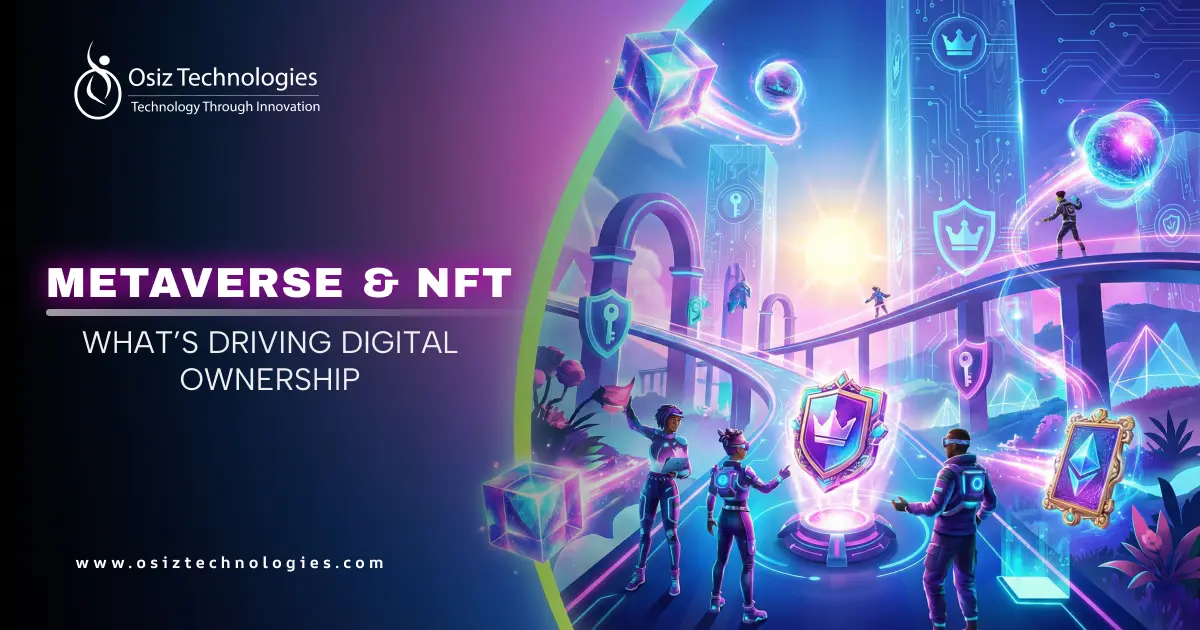
Digital experiences are changing. Now, it's about owning your identity and worth. This change impacts how people use immersive spaces in different fields. As virtual spaces grow, users want lasting control and actual ways to earn, not just short-term or borrowed experiences. Metaverse and NFTs, backed by Blockchain, are changing what we expect and shaping the next stage of digital ownership.
Why Metaverse Needs NFTs to Function Properly
Verified Digital Ownership
Trust is key to immersive online spaces. NFTs give people proof of ownership they can use on any platform. Without NFTs, your online stuff is stuck on one platform and easily lost, which makes people less likely to stick around or invest. Need systems where your stuff keeps its worth as you move between different online worlds.
Interoperability Across Virtual Worlds
NFTs enable you to transfer your digital assets across various platforms, giving you true ownership of your virtual items regardless of where you are. This freedom is highly desired and essential for a functional online economy. When more NFT platforms collaborate, your digital assets retain their value no matter which platform you use.
Scarcity and Value Creation
For a metaverse to work, things need to be limited so people want them. NFTs let us control how many of something there are using decentralized systems. This makes digital items into assets with real value. When value stays consistent, the virtual world becomes more stable and appealing for business.
User-Controlled Economies
NFTs empower individuals with greater control over financial transactions, enabling creators and users to earn directly. This fosters the expansion of creator-driven platforms and NFT innovation. As users gain autonomy, their engagement increases, leading to organic growth in the digital ecosystem.
Trust Through Blockchain Infrastructure
NFTs use clear records, which makes them great for a metaverse built on blockchain where trust is very important. Records that can't be changed cut down on fraud and make sure people are responsible for their online actions. This trust lets people do more complex things and gets the space ready for wider use.
Metaverse + NFT Synergy: How They Work Together
Step 1: Asset Creation and Tokenization
Virtual land, avatars, or items can be transformed into NFTs, embedding ownership details directly within the asset. Every digital item is unique and traceable within the metaverse. Once they're made, these assets start to build up economies that pull you in.
Step 2: Blockchain Validation and Storage
After assets are tokenized, they are recorded on networks that are not controlled by one entity. This keeps things open and lasting. This secures NFT deals in the metaverse and stops copies or changes that aren't allowed.
Step 3: Integration Into Virtual Environments
Validated NFTs go into metaverse platforms, where users can show, trade, or use them. This links ownership with real use, which gets users more involved. When use goes up, assets get more attention in virtual spaces.
Step 4: Marketplace Interaction and Monetization
NFT marketplaces let users buy, sell, or rent assets, which gets the economy going. These actions use smart contracts, helping Web3 ecosystems get stronger. Ways to earn money push creators and brands to get involved.
Step 5: Cross-Platform Expansion
Assets go past one world, helping with the ability to work together and keep value for a long time. This supports the partnership between metaverse platforms and NFTs. As ecosystems link up, owning digital items means more and is ready for the future.
Key Factors Driving Digital Ownership in 2026
Mainstream Web3 Adoption
Web3 development tools are getting easier to use, so more people can get involved with decentralized systems. Simple designs and educational resources are helping people who aren't tech experts.
Enterprise and Brand Participation
Big brands are joining the metaverse which proves that metaverses and NFTs can be good for business. Their involvement introduces best practices and grows the infrastructure. This shows they’re serious about digital economies for the long haul.
Regulatory Clarity and Compliance
Having clear rules for digital assets is helping users and investors feel safer. Rules protect digital ownership and lower risks. With better legal clarity, more big organizations start to participate.
Advancements in Immersive Technology
VR, AR, and spatial computing are getting better, making the experience more real and user-friendly. These improvements make virtual assets feel more valuable. As these experiences become more real, owning them feels more personal.
Why 2026 Is a Turning Point for Digital Ownership
-
By 2026, blockchain and metaverse technologies are expected to be stable and scalable, supporting large numbers of users, which will simplify digital asset management.
-
Users crave genuine ownership of their digital assets, not just temporary access. NFTs fully meet this growing demand.
-
Digital economies are linking through various platforms, maintaining stable asset values, which reinforces the concept of unified digital environments.
-
Creators are leading the way by making digital assets and communities. NFTs let them keep control and earn money, which supports steady growth.
-
Globally, an increasing number of people view digital assets as genuine value, fostering long-term confidence in digital ownership.
Future of Digital Ownership Beyond 2026
In the future, digital ownership will change from separate items to connected identities across work, fun, and shopping in lively online spaces. Metaverse platforms and NFTs will work together more closely, creating lasting value, economies that work across different worlds, and large-scale innovation driven by users. As businesses and creators look for dependable partners, a metaverse development company like osiz becomes important for creating safe, adaptable, and future-proof systems. With NFT marketplace creation and decentralized setups growing, digital ownership will become a normal desire instead of just a new thing.
Listen To The Article

Founder & CEO Osiz Technologies
Mr. Thangapandi, the Founder and CEO of Osiz Technologies, is deeply passionate about metaverse development solutions. Leading with a vision, he has driven Osiz Technologies to the forefront of technological innovation, propelling the company to new heights in the digital world. Under his guidance, the company has delivered groundbreaking solutions in blockchain, cryptocurrency, and virtual reality. His dedication to exploring and developing the metaverse highlights his commitment to staying ahead in the rapidly evolving tech industry.
Recent Blogs



No 22,Astalakshmi Nagar, Thanakankullam, (Opp Seetha lakshmi Mill gate Bus stop) Thirunagar, Madurai - 625 006.
(Corporate Office)


Canada Office address, 1150, Rue Patrick, Laval, Quebec - H7Y 2C4, Canada.
(Sales Office)


Explore
Our AI Portfolio

 Artificial Intelligence
- AI Development
- AI Predictive Analytics Services
- AI SaaS Development
- RAG Development
- AI Assistant Development
- ChatGPT Development
- Data Analytics Services
- AI Copilot Development
- Adaptive AI Development
- Machine Learning Development
- NLP
- AI Consulting Services
- AI Software Builder
- AI Token Development
- AI Integration Services
- Enterprise AI Solution
- AI As a Service
- AI Marketing Tools
- AI Video Generator
- Computer Vision Services
- Explore AI
- Dataset
- Machine Learning in Healthcare
- Machine Learning in Retail
- Hire AI Engineers
- Hire Prompt Engineers
- Hire ChatGPT Developers
- Hire Stable Diffusion Developers
- Hire Action Transformer Developers
- Blockchain
- Blockchain Development
- Private Blockchain Development
- Smart Contract Development
- Custom Blockchain Development
- Solana Blockchain Development
- Polygon Blockchain Development
- Public Blockchain Development
- DAO Blockchain Development
- Binance Smart Chain (BSC) Blockchain Development
- DApp Development
- Solana DApp Development
- White Label Blockchain Solutions
- Custom Blockchain On Avalanche
- Custom Blockchain On Polygon
- Blockchain Game Development
- Blockchain Consulting Services
- Blockchain Explorer Development
- Ethereum Blockchain Development
- TRON Blockchain Development
- Prediction Market Platform Development Company
Layer 1 & 2 Solutions- Layer-1 Blockchain Development
- Cross Chain Bridge Development
- Data Availability Layer Development
- Ethereum Layer 2 Scaling Solutions
- Cross-L2 DEX Solution
- Layer 2 Token Development
- Layer 2 Token Marketing
- Layer 2 Cryptocurrency Development
- Layer 2 Solutions For Blockchain Games
- Layer 2 Solutions For Web3 Gaming
- Layer 2 Blockchain Solutions
- Rollups As A Service
- Optimistic Rollups Development
- ZK Tech Development
- Bitcoin Layer 2 Solutions
Crypto Exchange- Cryptocurrency Exchange Development
- White Label Crypto Exchange
- Decentralized Exchange Development
- P2P Exchange Development
- Crypto Derivatives Exchange Development
- Centralized Exchange Development
- Crypto Exchange Clone Script
- Cryptocurrency Exchange App Development
- OTC Exchange Development
- Exchange Listing Services
- Binance Like Exchange Development
- Bitstamp Like Exchange Development
- Crypto Exchange Script
CryptoCrypto WalletToken Standards- Token Development
- AI Token Development
- RWA Tokenization Development
- Coinremitter Clone Script
- Asset Tokenization
- Real Estate Tokenization
- Tokenization Platform Development
- Crypto ETF Development
- Solona Token Development
- Semi-Fungible Token Development
- BEP20 Token Development
- Ethereum Token Development
- ERC1400 Token Development
- ERC998 Token Development
- ERC 721 Token Development
- ERC20 Token Development
- Defi Token Development
- ERC1155 Token Development
- BEP721 Token Development
- Utility Token Development
- ERC 777 Token Development
- ERC 827 Token Development
- Social Token Development
- Metaverse Token Development
- Tron Token Development
- ERC404 Token Development
- Governance Token
- Shibarium Token
- polygon Token
- BRC-20
- TRC20 Token Development
- TRC10 Token Development
- Soulbound Token Development
- NFT Token Development
Trading BotsClone- Crypto Exchange Clone Script
- Binance Clone Script
- Metamask Clone Script
- Coinbase Clone Script
- Kucoin Clone Script
- Paxful Clone Script
- Remitano Clone Script
- Wazirx Clone Script
- ByBit Clone Script
- Bitfinex Clone Script
- MEXC Clone Script
- Bitget Clone Script
- Cointool App Clone Script
- Trust Wallet Clone App
- Coinmarketcap Clone Script
- Changelly Clone Script
- BingX Clone Script
CybersecurityApp SecurityDigital Forensics & Incident ResponseAudit & ConsultingEducation & TrainingSolutionsWeb 3DeFi- Decentralized Finance (DeFi) Development
- DeFi Lending/ Borrowing Platform Development
- DeFi Staking Platform Development
- DeFi Token Development
- DeFi Wallet Development
- DeFi Smart Contract Development
- DeFi DApp Development
- Decentralized Exchange Development
- DeFi Insurance Development
- DeFi Crypto Synthetic Assets Development
Game Development- Game Development
- Android Game Development
- IOS Game Development
- Metaverse Game Development
- VR Game Development
- AI Game Development
- Unity 3D Game Development
- Unreal Engine Game Development
- Mobile Game Development
- Blockchain Game Development
- NFT Game Development
- Play to Earn Game Development
- Move to Earn Game Development
- Casino Game Development
- Slot Game Development
- Poker Game Development
- AAA Game Development
- AR Game Development
- Social Network Game Development
- Gamification Services
- Decentralized Sports Betting Platform
- Sports Betting Dapp Development
- Blockchain Casino Game Development
- Game Asset Creation
- Baccarat Game Development
- Rollbit Clone Script
- Fortnite Clone Script
- Slot Game Development
- Tap to Earn Game Development
- Slot Game Development
Metaverse Platforms- Metaverse Game Development
- Metaverse Event Platform Development
- Metaverse Virtual Mall Development
- Metaverse NFT Marketplace Development
- Metaverse Token Development
- Metaverse Virtual Land Development
- Metaverse Avatar Development
- Metaverse 3d Space Development
- Metaverse Real Estate Development
- Metaverse Social Media Platform Development
- Top 10 Metaverse Development Company
- Metaverse Business Ideas
- Metaverse Launchpad Development
- Metaverse App Development
- Metaverse Casino Game Development
NFT SolutionsNFT Platforms- NFT Minting Development
- NFT Token Development
- NFT Exchange Platform Development
- NFT Launchpad Development
- NFT Fashion Marketplace Development
- NFT Art Marketplace Development
- NFT Music Marketplace Development
- Carbon Credits NFT Marketplace Development
- Binance NFT Marketplace Development
- Polygon NFT Marketplace Development
- Solana NFT Marketplace Development
- Influencers NFT Marketplace Development
- NFT Ticketing Marketplace Development
- DeFi NFT Marketplace Development
- NFT Fantasy Sports Platform Development
- NFT Storage Development
- NFT Lending Platform Development
- Top10 NFT Business Ideas
NFT Game ClonesSustainabilityServiceNow - Blog
- Contact Us
- Works