
What is NLP?
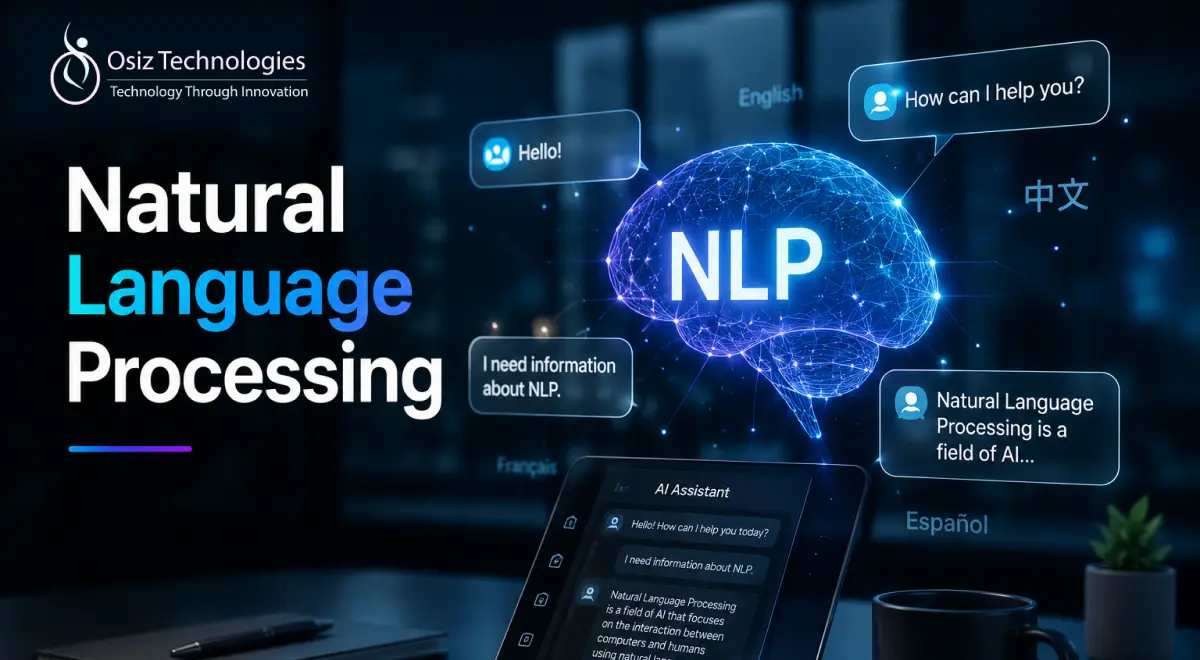
Natural language processing (NLP) is a subfield of computer science and artificial intelligence (AI) that uses machine learning to enable computers to understand and communicate with human language. At its core, NLP involves developing algorithms and models that can interpret, analyze, and generate text in ways that mimic human cognition. Organizations increasingly leverage NLP Services to build intelligent applications that can understand context, automate communication, and enhance user experiences across various industries.
NLP is built upon several key components: natural language understanding (NLU), which focuses on interpreting what a piece of text means, and natural language generation (NLG), which involves creating new text based on the input provided. These processes are often intertwined in NLP applications, with models like transformer architectures playing crucial roles by processing vast amounts of textual data to improve their accuracy over time through iterative learning from large datasets.
The integration of machine learning into NLP has significantly advanced these capabilities. Machine learning allows NLP systems to adapt and learn from new examples without being explicitly programmed for each case, making them more versatile and effective in handling a wide range of linguistic complexities found in human communication. As a result, NLP is not just about processing text; it's about creating intelligent interactions where machines can engage with humans using language as naturally as they do themselves.
Benefits of NLP
NLP makes it easier for humans to communicate and collaborate with machines by allowing them to do so in the natural human language they use every day. This offers benefits across many industries and applications.
One significant benefit is automation of repetitive tasks. NLP is especially useful in fully or partially automating tasks like customer support, data entry, and document handling. For example, NLP-powered chatbots can handle routine inquiries efficiently, freeing up human agents to focus on more complex issues. This not only improves operational efficiency but also enhances the overall customer experience by providing quick and accurate responses. Businesses often collaborate with an AI Development Company to implement these advanced NLP-driven automation solutions effectively.
Another key benefit is improved data analysis. NLP enhances data analysis by enabling the extraction of insights from unstructured text data such as customer reviews, social media posts, and news articles. By transforming these texts into structured information, organizations can gain deeper understanding of market trends, consumer preferences, and internal operations. This leads to more informed decision-making and better strategic planning.
Lastly, NLP benefits search by enabling systems to understand the intent behind user queries, providing more accurate and contextually relevant results. Instead of relying solely on keywords, which may not capture the true meaning or sentiment of a query, NLP can interpret nuances in language, ensuring that users receive answers that align closely with their needs. This improves both the usability and effectiveness of search engines and other information retrieval systems.
Approaches to NLP
NLP combines the power of computational linguistics together with machine learning algorithms and deep learning. Computational linguistics uses data science to analyze language and speech. It includes two main types of approaches:
- Rule-Based Systems: These systems rely on predefined rules that dictate how words should be interpreted in a sentence. While effective for simple tasks, they often struggle with ambiguity and context shifts.
- Statistical Models: This approach uses statistical techniques to analyze large datasets of text and speech patterns. Machine learning algorithms are employed here to learn from these patterns and make predictions or classifications about new inputs. Examples include Hidden Markov Models (HMMs) and Conditional Random Fields (CRFs).
In recent years, the advent of transformer models has revolutionized NLP. Transformer models like BERT, GPT-3, and T5 have achieved state-of-the-art performance on a wide range of natural language understanding and generation tasks. These models are based on the attention mechanism, which allows them to process sequences of data in parallel and capture long-range dependencies between words.
Foundation models, such as those created by Anthropic or Anthropic's Claude, offer a powerful starting point for many NLP applications. These models have been pre-trained on massive datasets and can be fine-tuned for specific tasks with minimal additional training data. This approach leverages the vast amount of information these foundation models already possess to improve their performance in targeted areas.
Deep learning has also played a significant role in advancing NLP techniques. Techniques like transfer learning, where knowledge from one task is transferred to another similar task, have been particularly useful. Additionally, advancements in generative adversarial networks (GANs) and reinforcement learning have contributed to the development of more sophisticated language models.
Overall, these approaches continue to evolve, pushing the boundaries of what NLP can achieve, making it an indispensable tool for understanding and interacting with natural human communication.
NLP Tasks
Several NLP tasks are crucial in enabling computers to understand and process natural human language effectively. These tasks include coreference resolution, named entity recognition, part-of-speech tagging, and sentiment analysis.
Coreference resolution is the task of identifying which words or phrases refer to the same entities within a text. For example, if someone says "John gave the book to Jane," coreference resolution would identify that 'John' and 'Jane' are referring to the same person, even though they appear in different parts of the sentence.
Named entity recognition involves identifying and categorizing named entities such as people, organizations, locations, dates, and quantities within text. This is particularly useful for extracting structured information from unstructured data like social media posts or news articles. For instance, when analyzing a tweet about Apple’s new product launch, NER can identify "Apple" as an organization entity and the date of the event.
Part-of-speech tagging assigns parts of speech to each word in a sentence, such as nouns, verbs, adjectives, and adverbs. This helps understand the grammatical structure of sentences and is essential for tasks like parsing or generating text. For example, identifying that "bark" in the phrase "the dog barked loudly" refers to an action performed by the noun "dog."
These NLP tasks form the foundation upon which more advanced applications are built, such as automated customer support systems, sentiment analysis tools, and content generation models like GPT-4. By automating repetitive tasks and enhancing data analysis capabilities, NLP is revolutionizing how we interact with technology and extract meaningful insights from vast amounts of text data.
How NLP works
NLP operates through a series of interconnected steps that transform raw natural language into structured data that machines can process and understand. At the heart of this process lies the ability to recognize and extract named entities from text—entities such as people, organizations, locations, dates, and more. Named entity recognition (NER) is a fundamental step in NLP where algorithms identify these key pieces of information within documents or conversations.
Once entities are identified, they can be further processed for deeper analysis. For instance, if an NLP system encounters the phrase "John Smith worked at Google from 2015 to 2018," it would recognize "John Smith" as a person's name and "Google" as an organization. This structured information allows for more precise understanding of context and can be used in various applications, such as improving search results by providing more accurate metadata.
Beyond entity recognition, NLP also involves making sense of the meaning behind words and phrases. This process includes tasks like sentiment analysis, where machines interpret whether a piece of text expresses positive, negative, or neutral emotions. Another critical aspect is understanding context—how different parts of a sentence relate to each other. For example, in the sentence "I saw John at the park yesterday," an NLP system must understand that "John" refers back to the person mentioned earlier rather than someone else named John.
By combining these techniques and more, NLP bridges the gap between human communication and machine processing, enabling a wide range of applications from automated customer service interactions to sophisticated content generation.
Challenges of NLP
Even state-of-the-art NLP models are not perfect, just as human speech is prone to error. As with any AI technology, NLP comes with potential pitfalls. Human language is filled with ambiguities that make it difficult for machines to fully understand and interpret every nuance. For instance, the use of sarcasm or idiomatic expressions can lead to misinterpretations by algorithms designed to process text data.
Entity recognition, a critical component in NLP, often struggles with identifying entities within complex sentences. This challenge is compounded when dealing with informal language or slang, where context becomes even more crucial for accurate interpretation. Named entity recognition (NER), while improving over time, still faces difficulties in accurately tagging all types of entities such as dates, numbers, and locations, especially in unstructured data like social media posts.
Understanding the nuances of human communication also poses challenges. NLP models can struggle with tasks that require deep emotional intelligence or cultural sensitivity. For example, humor, sarcasm, and irony are notoriously hard to grasp without a deeper understanding of context and intent. These complexities highlight why fully automating certain tasks might not always be feasible or desirable, as they often involve human judgment and empathy.
Moreover, the interpretability of NLP models is another significant challenge. As these systems become more complex and sophisticated, it becomes increasingly difficult for humans to understand how decisions are made within them. This lack of transparency can lead to distrust in AI-driven solutions, especially in critical applications where accountability is paramount.
Listen To The Article

Founder & CEO Osiz Technologies
Mr. Thangapandi, the CEO of Osiz, has a proven track record of conceptualizing and architecting 100+ user-centric and scalable solutions for startups and enterprises. He brings a deep understanding of both technical and user experience aspects. The CEO, being an early adopter of new technology, said, "I believe in the transformative power of AI to revolutionize industries and improve lives. My goal is to integrate AI in ways that not only enhance operational efficiency but also drive sustainable development and innovation." Proving his commitment, Mr. Thangapandi has built a dedicated team of AI experts proficient in coming up with innovative AI solutions and have successfully completed several AI projects across diverse sectors.
Recent Blogs




No 22,Astalakshmi Nagar, Thanakankullam, (Opp Seetha lakshmi Mill gate Bus stop) Thirunagar, Madurai - 625 006.
(Corporate Office)


Canada Office address, 1150, Rue Patrick, Laval, Quebec - H7Y 2C4, Canada.
(Sales Office)


Explore Our
AI Portfolio

 Artificial Intelligence
- AI Development
- AI Predictive Analytics Services
- AI SaaS Development
- RAG Development
- AI Assistant Development
- ChatGPT Development
- Data Analytics Services
- AI Copilot Development
- Adaptive AI Development
- Machine Learning Development
- NLP
- AI Consulting Services
- AI Software Builder
- AI Token Development
- AI Integration Services
- Enterprise AI Solution
- AI As a Service
- AI Marketing Tools
- AI Video Generator
- Computer Vision Services
- Explore AI
- Dataset
- Machine Learning in Healthcare
- Machine Learning in Retail
- Hire AI Engineers
- Hire Prompt Engineers
- Hire ChatGPT Developers
- Hire Stable Diffusion Developers
- Hire Action Transformer Developers
- Blockchain
- Blockchain Development
- Private Blockchain Development
- Smart Contract Development
- Custom Blockchain Development
- Solana Blockchain Development
- Polygon Blockchain Development
- Public Blockchain Development
- DAO Blockchain Development
- Binance Smart Chain (BSC) Blockchain Development
- DApp Development
- Solana DApp Development
- White Label Blockchain Solutions
- Custom Blockchain On Avalanche
- Custom Blockchain On Polygon
- Blockchain Game Development
- Blockchain Consulting Services
- Blockchain Explorer Development
- Ethereum Blockchain Development
- TRON Blockchain Development
- Prediction Market Platform Development Company
Layer 1 & 2 Solutions- Layer-1 Blockchain Development
- Cross Chain Bridge Development
- Data Availability Layer Development
- Ethereum Layer 2 Scaling Solutions
- Cross-L2 DEX Solution
- Layer 2 Token Development
- Layer 2 Token Marketing
- Layer 2 Cryptocurrency Development
- Layer 2 Solutions For Blockchain Games
- Layer 2 Solutions For Web3 Gaming
- Layer 2 Blockchain Solutions
- Rollups As A Service
- Optimistic Rollups Development
- ZK Tech Development
- Bitcoin Layer 2 Solutions
Crypto Exchange- Cryptocurrency Exchange Development
- White Label Crypto Exchange
- Decentralized Exchange Development
- P2P Exchange Development
- Crypto Derivatives Exchange Development
- Centralized Exchange Development
- Crypto Exchange Clone Script
- Cryptocurrency Exchange App Development
- OTC Exchange Development
- Exchange Listing Services
- Binance Like Exchange Development
- Bitstamp Like Exchange Development
- Crypto Exchange Script
CryptoCrypto WalletToken Standards- Token Development
- AI Token Development
- RWA Tokenization Development
- Coinremitter Clone Script
- Asset Tokenization
- Real Estate Tokenization
- Tokenization Platform Development
- Crypto ETF Development
- Solona Token Development
- Semi-Fungible Token Development
- BEP20 Token Development
- Ethereum Token Development
- ERC1400 Token Development
- ERC998 Token Development
- ERC 721 Token Development
- ERC20 Token Development
- Defi Token Development
- ERC1155 Token Development
- BEP721 Token Development
- Utility Token Development
- ERC 777 Token Development
- ERC 827 Token Development
- Social Token Development
- Metaverse Token Development
- Tron Token Development
- ERC404 Token Development
- Governance Token
- Shibarium Token
- polygon Token
- BRC-20
- TRC20 Token Development
- TRC10 Token Development
- Soulbound Token Development
- NFT Token Development
Trading BotsClone- Crypto Exchange Clone Script
- Binance Clone Script
- Metamask Clone Script
- Coinbase Clone Script
- Kucoin Clone Script
- Paxful Clone Script
- Remitano Clone Script
- Wazirx Clone Script
- ByBit Clone Script
- Bitfinex Clone Script
- MEXC Clone Script
- Bitget Clone Script
- Cointool App Clone Script
- Trust Wallet Clone App
- Coinmarketcap Clone Script
- Changelly Clone Script
- BingX Clone Script
CybersecurityApp SecurityDigital Forensics & Incident ResponseAudit & ConsultingEducation & TrainingSolutionsWeb 3DeFi- Decentralized Finance (DeFi) Development
- DeFi Lending/ Borrowing Platform Development
- DeFi Staking Platform Development
- DeFi Token Development
- DeFi Wallet Development
- DeFi Smart Contract Development
- DeFi DApp Development
- Decentralized Exchange Development
- DeFi Insurance Development
- DeFi Crypto Synthetic Assets Development
Game Development- Game Development
- Android Game Development
- IOS Game Development
- Metaverse Game Development
- VR Game Development
- AI Game Development
- Unity 3D Game Development
- Unreal Engine Game Development
- Mobile Game Development
- Blockchain Game Development
- NFT Game Development
- Play to Earn Game Development
- Move to Earn Game Development
- Casino Game Development
- Slot Game Development
- Poker Game Development
- AAA Game Development
- AR Game Development
- Social Network Game Development
- Gamification Services
- Decentralized Sports Betting Platform
- Sports Betting Dapp Development
- Blockchain Casino Game Development
- Game Asset Creation
- Baccarat Game Development
- Rollbit Clone Script
- Fortnite Clone Script
- Slot Game Development
- Tap to Earn Game Development
- Slot Game Development
Metaverse Platforms- Metaverse Game Development
- Metaverse Event Platform Development
- Metaverse Virtual Mall Development
- Metaverse NFT Marketplace Development
- Metaverse Token Development
- Metaverse Virtual Land Development
- Metaverse Avatar Development
- Metaverse 3d Space Development
- Metaverse Real Estate Development
- Metaverse Social Media Platform Development
- Top 10 Metaverse Development Company
- Metaverse Business Ideas
- Metaverse Launchpad Development
- Metaverse App Development
- Metaverse Casino Game Development
NFT SolutionsNFT Platforms- NFT Minting Development
- NFT Token Development
- NFT Exchange Platform Development
- NFT Launchpad Development
- NFT Fashion Marketplace Development
- NFT Art Marketplace Development
- NFT Music Marketplace Development
- Carbon Credits NFT Marketplace Development
- Binance NFT Marketplace Development
- Polygon NFT Marketplace Development
- Solana NFT Marketplace Development
- Influencers NFT Marketplace Development
- NFT Ticketing Marketplace Development
- DeFi NFT Marketplace Development
- NFT Fantasy Sports Platform Development
- NFT Storage Development
- NFT Lending Platform Development
- Top10 NFT Business Ideas
NFT Game ClonesSustainabilityServiceNow - Blog
- Contact Us
- Works