
Introduction
In today's digital landscape, the integration of virtual agents has become a cornerstone for enhancing customer experiences and streamlining business operations. Osiz Technologies, a leading AI Development Company, stands at the forefront of this technological revolution, offering innovative solutions that leverage advanced artificial intelligence to create seamless interactions between businesses and their users.
What is a virtual agent?
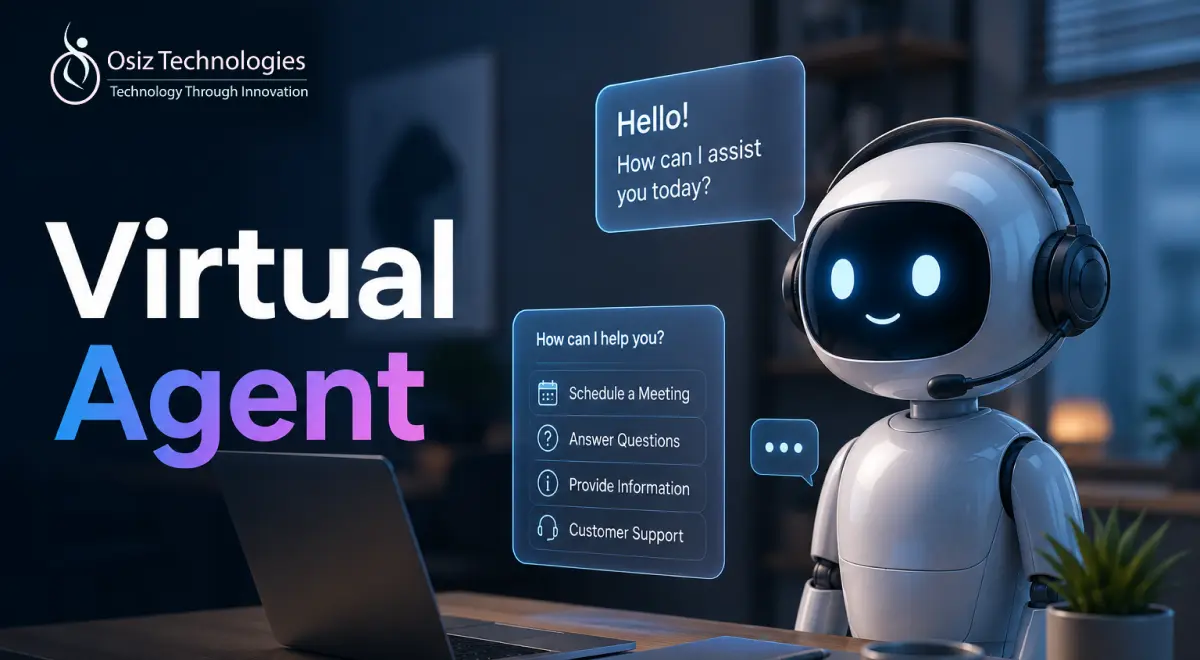
A virtual agent combines natural language processing (NLP), intelligent search, and robotic process automation (RPA) in a conversational user interface—typically a chatbot. This technology allows agents to understand human speech or text input, interpret the context, and respond appropriately, often through automated interactions rather than direct human intervention. Virtual agents are designed to handle various tasks such as customer service inquiries, order processing, scheduling appointments, and more, making them invaluable tools for businesses aiming to enhance efficiency and provide better customer experiences.
Virtual Agent vs. Chatbot vs. Virtual Assistant
There is some overlap between the uses and features of virtual agents, chatbots, and virtual assistants, which can sometimes lead to confusion about their distinctions. A virtual agent typically combines natural language processing (NLP), intelligent search capabilities, and robotic process automation (RPA) in a conversational user interface—often referred to as a chatbot. Virtual agents are designed to understand complex customer inquiries or tasks and respond appropriately.
In contrast, chatbots are often simpler in their functionality, focusing primarily on predefined responses based on keywords and simple rules. They excel at handling repetitive queries that require quick, straightforward answers without the need for deep understanding of context or previous interactions.
Virtual assistants, while also relying heavily on NLP and RPA, tend to offer more comprehensive capabilities by integrating additional features such as contextual awareness, personalization, and integration with various services outside the chatbot interface. They are designed to provide a more seamless experience across multiple platforms and can handle complex tasks that require understanding of user intent over time.
The distinction between these terms is not always clear-cut, reflecting the evolving nature of AI technologies in customer service and other applications. As technology advances, it's important for businesses to understand how each type of agent or assistant fits into their broader strategy for improving interactions with users.
Types of Virtual Agents
Enterprises looking to optimize their business with virtual agent technology have a wide array of options to choose from. Each offers varying degrees of customization and integration, catering to different needs and preferences. For instance, some virtual agents are designed for customer service, where they can understand user intent through natural language processing and provide personalized responses. Others excel in handling repetitive tasks via robotic process automation (RPA), freeing human employees from mundane chores.
User-centric virtual agents focus on understanding the nuances of individual users' needs, providing tailored interactions that mimic human-like conversation. These agents are particularly effective for customer support, where they can quickly resolve queries and escalate complex issues to human representatives when necessary. On the other hand, specialized virtual agents in industries like finance or healthcare might be more focused on specific tasks such as data entry or compliance checks.
Moreover, there is a growing trend towards hybrid virtual agents that combine both RPA capabilities with advanced natural language processing for handling a broader spectrum of interactions. These multi-faceted agents are ideal for businesses looking to streamline operations while maintaining high levels of customer service and support. Understanding the unique requirements of each type can help organizations select the most suitable virtual agent technology, ensuring they get the best return on investment in their digital transformation initiatives.
How to create a virtual agent
Creating a successful virtual agent involves more than just developing sophisticated chatbot software; it requires understanding the intricacies of your customer journey and tailoring the experience to meet their needs effectively. Businesses increasingly invest in AI Agent Development to build intelligent virtual agents that can automate interactions, improve operational efficiency, and deliver highly personalized user experiences.
Understanding human interaction is crucial because virtual agents must mimic natural conversations to build trust and credibility. This means incorporating elements like empathy, humor, and cultural sensitivity into the agent’s responses to create a more engaging dialogue. By doing so, you ensure that your virtual agent not only understands but also resonates with customers on an emotional level.
Moreover, integrating advanced language processing capabilities is essential for creating a seamless interaction. Natural Language Processing (NLP) enables the virtual agent to comprehend and respond appropriately to various tones of voice, dialects, and even slang used by different customer segments. This ensures that your agents can understand complex queries or ambiguous requests from users accurately.
Incorporating intelligent search functionality allows the virtual agent to provide relevant information quickly and efficiently. Whether it's answering frequently asked questions (FAQs) or directing customers to specific resources within your business, having an integrated search feature streamlines interactions and reduces customer frustration caused by lengthy wait times for responses.
Finally, integrating robotic process automation (RPA) can automate repetitive tasks such as data entry, form filling, and scheduling appointments. This not only saves time but also ensures consistency in service delivery across all channels. By automating these processes, your virtual agent can focus on handling more complex issues or providing personalized assistance where needed.
By combining these elements—human touch, advanced language processing, intelligent search, and RPA—you create a robust virtual agent capable of delivering exceptional customer experiences while streamlining operations within your business.
Benefits of virtual agent technology
Successfully implemented VAT has been proven to have a positive impact on your business’s finances, logistics, and employee morale. One of the most significant benefits is cost savings. By automating routine tasks through RPA, businesses can reduce labor costs significantly. Additionally, virtual agents handle customer inquiries 24/7 without breaks or vacations, which further cuts down operational expenses.
Another key benefit lies in improved efficiency. Virtual agents excel at processing large volumes of data and queries simultaneously, often outperforming human employees in terms of speed and accuracy. This capability is particularly advantageous for businesses handling high traffic on their websites or customer support channels during peak times. Moreover, by offloading repetitive tasks to virtual agents, employees can focus on more complex issues that require human judgment and creativity.
Lastly, the morale boost from reduced workload and increased efficiency can lead to higher job satisfaction among staff. Employees who no longer have to deal with mundane, time-consuming tasks are often happier and more engaged in their work. This positive environment not only enhances productivity but also contributes to a healthier company culture.
Use cases for virtual agent technology
Virtual agents offer a variety of opportunities to improve customer experience, market-facing business operations, and internal productivity and coordination. In the realm of customer service, virtual agents can handle inquiries in real-time, providing immediate responses that enhance user satisfaction. They also facilitate intelligent search capabilities, enabling users to find information quickly and accurately through conversational interfaces.
Moreover, virtual agents are instrumental in automating repetitive tasks within an organization, such as data entry or scheduling appointments, which significantly boosts employee productivity by freeing up time for more critical responsibilities. This not only reduces operational costs but also ensures that processes remain efficient and consistent across different departments.
In the market-facing aspect of business operations, virtual agents can serve as customer support channels, addressing common issues without human intervention to ensure a swift resolution. They are particularly effective in handling multiple customer queries simultaneously, which is challenging for human agents alone. By leveraging language processing and robotic process automation (RPA), virtual agents can also interpret complex user intents, making them more efficient at understanding nuanced requests.
Overall, the integration of virtual agent technology into various business processes demonstrates its versatility and potential to transform how companies interact with both their customers and employees.
Listen To The Article

Founder & CEO Osiz Technologies
Osiz Technologies' CEO, Mr. Thangapandi celebrated a major milestone, signifying the company's progression into its next phase. With a strong team of over 300+ employees, Osiz has established itself as a globally recognized leader in the IT industry, known for its outstanding performance.
CEO, Mr. Thangapandi is thrilled to share the exciting progress of our VR Development Company. Our team’s dedication and innovation have propelled us to the forefront of the virtual reality industry, delivering groundbreaking applications across education, healthcare, and entertainment. We continue to push the boundaries of what's possible, creating immersive experiences that transform how we learn, work, and play!
Recent Blogs




No 22,Astalakshmi Nagar, Thanakankullam, (Opp Seetha lakshmi Mill gate Bus stop) Thirunagar, Madurai - 625 006.
(Corporate Office)


Canada Office address, 1150, Rue Patrick, Laval, Quebec - H7Y 2C4, Canada.
(Sales Office)


Explore Our
AI Portfolio

 Artificial Intelligence
- AI Development
- AI Predictive Analytics Services
- AI SaaS Development
- RAG Development
- AI Assistant Development
- ChatGPT Development
- Data Analytics Services
- AI Copilot Development
- Adaptive AI Development
- Machine Learning Development
- NLP
- AI Consulting Services
- AI Software Builder
- AI Token Development
- AI Integration Services
- Enterprise AI Solution
- AI As a Service
- AI Marketing Tools
- AI Video Generator
- Computer Vision Services
- Explore AI
- Dataset
- Machine Learning in Healthcare
- Machine Learning in Retail
- Hire AI Engineers
- Hire Prompt Engineers
- Hire ChatGPT Developers
- Hire Stable Diffusion Developers
- Hire Action Transformer Developers
- Blockchain
- Blockchain Development
- Private Blockchain Development
- Smart Contract Development
- Custom Blockchain Development
- Solana Blockchain Development
- Polygon Blockchain Development
- Public Blockchain Development
- DAO Blockchain Development
- Binance Smart Chain (BSC) Blockchain Development
- DApp Development
- Solana DApp Development
- White Label Blockchain Solutions
- Custom Blockchain On Avalanche
- Custom Blockchain On Polygon
- Blockchain Game Development
- Blockchain Consulting Services
- Blockchain Explorer Development
- Ethereum Blockchain Development
- TRON Blockchain Development
- Prediction Market Platform Development Company
Layer 1 & 2 Solutions- Layer-1 Blockchain Development
- Cross Chain Bridge Development
- Data Availability Layer Development
- Ethereum Layer 2 Scaling Solutions
- Cross-L2 DEX Solution
- Layer 2 Token Development
- Layer 2 Token Marketing
- Layer 2 Cryptocurrency Development
- Layer 2 Solutions For Blockchain Games
- Layer 2 Solutions For Web3 Gaming
- Layer 2 Blockchain Solutions
- Rollups As A Service
- Optimistic Rollups Development
- ZK Tech Development
- Bitcoin Layer 2 Solutions
Crypto Exchange- Cryptocurrency Exchange Development
- White Label Crypto Exchange
- Decentralized Exchange Development
- P2P Exchange Development
- Crypto Derivatives Exchange Development
- Centralized Exchange Development
- Crypto Exchange Clone Script
- Cryptocurrency Exchange App Development
- OTC Exchange Development
- Exchange Listing Services
- Binance Like Exchange Development
- Bitstamp Like Exchange Development
- Crypto Exchange Script
CryptoCrypto WalletToken Standards- Token Development
- AI Token Development
- RWA Tokenization Development
- Coinremitter Clone Script
- Asset Tokenization
- Real Estate Tokenization
- Tokenization Platform Development
- Crypto ETF Development
- Solona Token Development
- Semi-Fungible Token Development
- BEP20 Token Development
- Ethereum Token Development
- ERC1400 Token Development
- ERC998 Token Development
- ERC 721 Token Development
- ERC20 Token Development
- Defi Token Development
- ERC1155 Token Development
- BEP721 Token Development
- Utility Token Development
- ERC 777 Token Development
- ERC 827 Token Development
- Social Token Development
- Metaverse Token Development
- Tron Token Development
- ERC404 Token Development
- Governance Token
- Shibarium Token
- polygon Token
- BRC-20
- TRC20 Token Development
- TRC10 Token Development
- Soulbound Token Development
- NFT Token Development
Trading BotsClone- Crypto Exchange Clone Script
- Binance Clone Script
- Metamask Clone Script
- Coinbase Clone Script
- Kucoin Clone Script
- Paxful Clone Script
- Remitano Clone Script
- Wazirx Clone Script
- ByBit Clone Script
- Bitfinex Clone Script
- MEXC Clone Script
- Bitget Clone Script
- Cointool App Clone Script
- Trust Wallet Clone App
- Coinmarketcap Clone Script
- Changelly Clone Script
- BingX Clone Script
CybersecurityApp SecurityDigital Forensics & Incident ResponseAudit & ConsultingEducation & TrainingSolutionsWeb 3DeFi- Decentralized Finance (DeFi) Development
- DeFi Lending/ Borrowing Platform Development
- DeFi Staking Platform Development
- DeFi Token Development
- DeFi Wallet Development
- DeFi Smart Contract Development
- DeFi DApp Development
- Decentralized Exchange Development
- DeFi Insurance Development
- DeFi Crypto Synthetic Assets Development
Game Development- Game Development
- Android Game Development
- IOS Game Development
- Metaverse Game Development
- VR Game Development
- AI Game Development
- Unity 3D Game Development
- Unreal Engine Game Development
- Mobile Game Development
- Blockchain Game Development
- NFT Game Development
- Play to Earn Game Development
- Move to Earn Game Development
- Casino Game Development
- Slot Game Development
- Poker Game Development
- AAA Game Development
- AR Game Development
- Social Network Game Development
- Gamification Services
- Decentralized Sports Betting Platform
- Sports Betting Dapp Development
- Blockchain Casino Game Development
- Game Asset Creation
- Baccarat Game Development
- Rollbit Clone Script
- Fortnite Clone Script
- Slot Game Development
- Tap to Earn Game Development
- Slot Game Development
Metaverse Platforms- Metaverse Game Development
- Metaverse Event Platform Development
- Metaverse Virtual Mall Development
- Metaverse NFT Marketplace Development
- Metaverse Token Development
- Metaverse Virtual Land Development
- Metaverse Avatar Development
- Metaverse 3d Space Development
- Metaverse Real Estate Development
- Metaverse Social Media Platform Development
- Top 10 Metaverse Development Company
- Metaverse Business Ideas
- Metaverse Launchpad Development
- Metaverse App Development
- Metaverse Casino Game Development
NFT SolutionsNFT Platforms- NFT Minting Development
- NFT Token Development
- NFT Exchange Platform Development
- NFT Launchpad Development
- NFT Fashion Marketplace Development
- NFT Art Marketplace Development
- NFT Music Marketplace Development
- Carbon Credits NFT Marketplace Development
- Binance NFT Marketplace Development
- Polygon NFT Marketplace Development
- Solana NFT Marketplace Development
- Influencers NFT Marketplace Development
- NFT Ticketing Marketplace Development
- DeFi NFT Marketplace Development
- NFT Fantasy Sports Platform Development
- NFT Storage Development
- NFT Lending Platform Development
- Top10 NFT Business Ideas
NFT Game ClonesSustainabilityServiceNow - Blog
- Contact Us
- Works