
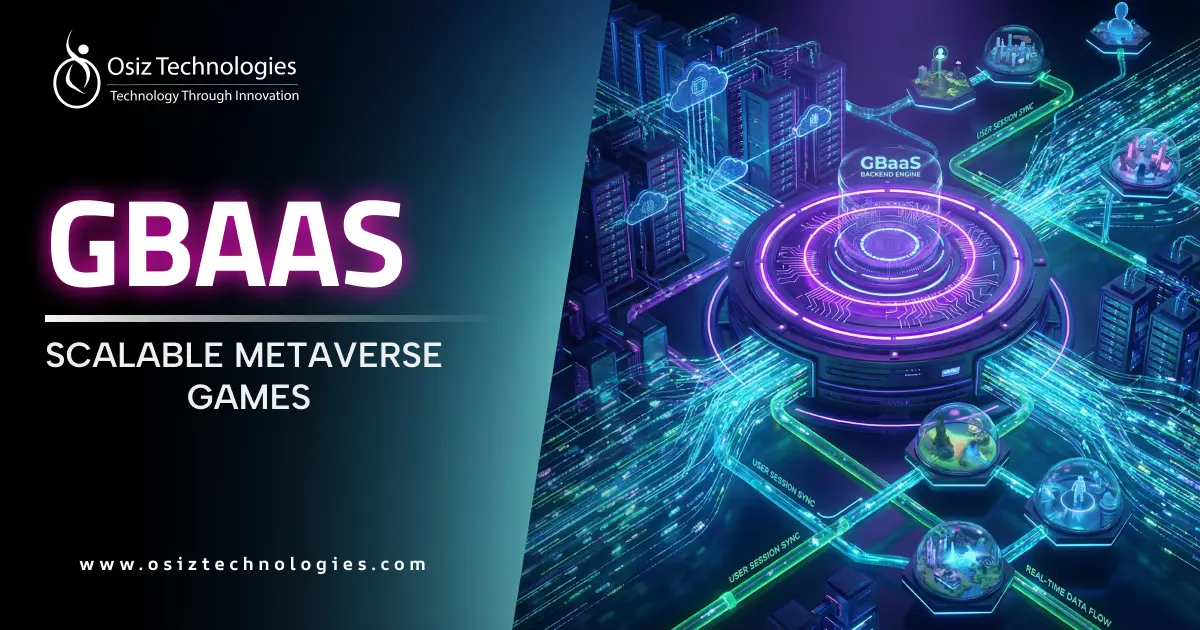
The metaverse continues to expand beyond gaming into immersive social, commercial, and enterprise ecosystems that demand strong Metaverse Backend Infrastructure and as digital worlds grow in complexity, developers seek scalable backend models that support persistent experiences, synchronized user interactions, and secure data handling through GBaaS for Metaverse Development.
What Is Game Backend as a Service (GBaaS)?
Game Backend as a Service (BaaS) is a cloud-based solution that offers game developers ready-to-use, managed server infrastructure through APIs and SDKs. It removes the necessity of developing and managing backend components such as databases, user authentication, and analytics, enabling developers to concentrate on frontend design, user experience, and core game mechanics.
Core Backend Challenges in Building a Scalable Metaverse
Server Load
System slowdowns appear not only from traffic but also from rigid architectures unable to adapt mid-session. Performance gaps widen unless resources shift fluidly with need, especially in live multiplayer settings. Flexibility becomes essential; frameworks such as GBaaS respond by stretching capacity where metaverse activity intensifies.
Data Sync
As metaverse environments grow larger, maintaining consistent user states across devices becomes more challenging. When updates don't sync properly, collaboration and the smooth progression of digital interactions are negatively impacted. Behind the scenes, robust architectures maintain alignment using decentralized network designs.
Latency Issues
In digital interactions, even tiny delays measured in milliseconds can disrupt immersion by affecting the timing of real-time responses. Instead of standard setups, specialized systems adjust how data travels across connections. These adjustments improve responsiveness in shared online spaces.
Asset Management Complexity
Digital spaces handle vast collections of items like characters, objects, and interactive worlds needing reliable ways to store and distribute data. When updates occur continuously, older infrastructure often fails to keep pace. Systems built on organized cloud architectures allow smoother handling of resources without sacrificing reach or growth potential.
How GBaaS Supports Metaverse Infrastructure
Elastic server scaling
System disruptions are prevented through efficient resource allocation, and continuous access to shared virtual environments is ensured by dynamic server management. Efficiency in Metaverse infrastructure relies fundamentally on flexible capacity adjustments.
Real-time data processing
With GBaaS, data syncs instantly among users, machines, and geographic zones, keeping virtual environments uniform. Consistency persists through peak usage, supporting seamless collaboration.
Automated backend management
With automated deployment, oversight, and upkeep in place, daily operations demand less effort even as backend reliability holds steady through shifts in metaverse environments. Rather than managing servers manually, creators shift attention toward new features.
Integrated player services
From secure logins to seamless play sessions, core tools handle access, pairing users, then guiding them through virtual spaces without interruption. Across phones, tablets, or desktops, synchronized backends maintain profile integrity and ongoing progress naturally.
Cross-platform synchronization
From any screen, GBaaS links actions smoothly mobile, desktop, headset, or controller all speaking through one shared system. Advancement never resets, regardless of the tool used to access it.
Key Features of GBaaS for Metaverse Development
Real-time multiplayer management
GBaaS enables numerous people to play together simultaneously, allowing everyone to share the experience and interact in real time, regardless of their location around the world. When a lot of people are playing together the system can handle it without slowing down.
Cloud data storage
Cloud storage excels at securely storing player profiles and virtual items, and it also maintains an accurate record of the game world, ensuring all data stays synchronized across different networks.
User authentication systems
To ensure user safety, we must confirm that users are indeed who they claim to be, which is why we've implemented secure identity verification processes. These mechanisms make it easy for users to get started with us while keeping their accounts and digital assets.
Matchmaking & session handling
When we play games with people, the system tries to find the right people for us to play with. It looks at what we like and how good we're at the game. The system ensures that every user gets a shared playing time within the Multiplayer Metaverse Development.
Analytics & performance tracking
The people who make the Metaverse Platform Development use tools to see what the users are doing, how the servers are working, and how well the platform is performing. The developers get information that they can use to make the games more fun and to keep people engaged.
Cross-platform integration
GBaaS frameworks support multiple platforms through unified APIs that synchronize gameplay, assets, and communication channels across devices. Cross-platform compatibility ensures consistent user experiences regardless of hardware or operating systems.
How Traditional Backend differs from GBaaS for Metaverse Projects
Infrastructure management complexity
Traditional backend systems need people to set up and take care of servers, which takes a lot of time and work. The Scalable Game Backend Solutions become more scalable because of this automation, which is a big plus, for Scalable Game Backend Solutions.
Scalability limitations
The backend systems that are not able to change are having a time keeping up with the number of users that is going up and down in the metaverse. Game Backend, as a Service gives us the ability to add or remove resources as needed so that it can adjust to what the users doing.
Development time and cost
Backend models involve extensive coding and setup, requiring dedicated time from developers and continuous maintenance. Faster deployment is crucial for Metaverse Companies initiatives because it allows them to try out things and see what works.
Real-time performance efficiency
Traditional backends typically lack routing capabilities for live multiplayer sessions, making Game Backend as a Service (GBaaS) platforms especially well-suited for real-time communication and efficient handling of extensive computing tasks.people do online.
Cross-platform adaptability
Traditional systems require separate backend configurations for each device or platform, complicating development and maintenance. Cross-platform readiness enhances global accessibility in Multiplayer Metaverse Development.
Best Practices for Integrating GBaaS in Metaverse Development
Adopt a Modular Backend Design
When we use modular backend components, developers can make features bigger or smaller on their own without messing up the system. Using components is a good idea for GBaaS for Metaverse Development because it helps make sure everything works well for a long time.
Focus on Low-Latency Infrastructure
So when we think about edge computing and putting servers in regions, it really helps to reduce the time it takes for things to happen. The design of these systems is crucial to make sure that everything runs smoothly in virtual reality or other immersive environments.
Integrate Scalable Authentication Layers
Using authentication frameworks is really important for secure onboarding and consistent identity management when you have a lot of users. The Metaverse Backend Infrastructure can grow over time because flexible authentication frameworks support this growth
Implement Robust Analytics Monitoring
People who make games need to keep an eye on how the game's doing and what the players are doing. The servers operate efficiently, enabling the team to assess what works and what doesn’t, so they can refine the game to boost player satisfaction and avoid platform crashes.
Ensure Cross-Platform Compatibility from Start
Designing backend architecture with cross-platform support ensures consistent experiences across VR, mobile, desktop, and console environments. Unified APIs and synchronized data layers simplify development while expanding accessibility.
Conclusion: Why GBaaS Becomes the Backbone of Scalable Metaverse
The Metaverse Platform is expanding rapidly, requiring its developers to establish reliable systems to support its growth and ensure dependability. Game Backend as a Service is a way to make this happen. This means they can focus on making exciting things instead of worrying about how the systems work. Osiz as a metaverse development company leveraging a game backend-as-a-service (GBaaS) platform offers scalable, high-demand solutions with seamless cross-platform access, enabling faster progress and efficient execution. It also helps them make sure that lots of people can use the Metaverse Platform at the time without any problems. This works on lots of devices and platforms.
Listen To The Article

Founder & CEO Osiz Technologies
Mr. Thangapandi, the Founder and CEO of Osiz Technologies, is deeply passionate about metaverse development solutions. Leading with a vision, he has driven Osiz Technologies to the forefront of technological innovation, propelling the company to new heights in the digital world. Under his guidance, the company has delivered groundbreaking solutions in blockchain, cryptocurrency, and virtual reality. His dedication to exploring and developing the metaverse highlights his commitment to staying ahead in the rapidly evolving tech industry.
Recent Blogs





No 22,Astalakshmi Nagar, Thanakankullam, (Opp Seetha lakshmi Mill gate Bus stop) Thirunagar, Madurai - 625 006.
(Corporate Office)


Canada Office address, 1150, Rue Patrick, Laval, Quebec - H7Y 2C4, Canada.
(Sales Office)


Explore Our
AI Portfolio

 Artificial Intelligence
- AI Development
- AI Predictive Analytics Services
- AI SaaS Development
- RAG Development
- AI Assistant Development
- ChatGPT Development
- Data Analytics Services
- AI Copilot Development
- Adaptive AI Development
- Machine Learning Development
- NLP
- AI Consulting Services
- AI Software Builder
- AI Token Development
- AI Integration Services
- Enterprise AI Solution
- AI As a Service
- AI Marketing Tools
- AI Video Generator
- Computer Vision Services
- Explore AI
- Dataset
- Machine Learning in Healthcare
- Machine Learning in Retail
- Hire AI Engineers
- Hire Prompt Engineers
- Hire ChatGPT Developers
- Hire Stable Diffusion Developers
- Hire Action Transformer Developers
- Blockchain
- Blockchain Development
- Private Blockchain Development
- Smart Contract Development
- Custom Blockchain Development
- Solana Blockchain Development
- Polygon Blockchain Development
- Public Blockchain Development
- DAO Blockchain Development
- Binance Smart Chain (BSC) Blockchain Development
- DApp Development
- Solana DApp Development
- White Label Blockchain Solutions
- Custom Blockchain On Avalanche
- Custom Blockchain On Polygon
- Blockchain Game Development
- Blockchain Consulting Services
- Blockchain Explorer Development
- Ethereum Blockchain Development
- TRON Blockchain Development
- Prediction Market Platform Development Company
Layer 1 & 2 Solutions- Layer-1 Blockchain Development
- Cross Chain Bridge Development
- Data Availability Layer Development
- Ethereum Layer 2 Scaling Solutions
- Cross-L2 DEX Solution
- Layer 2 Token Development
- Layer 2 Token Marketing
- Layer 2 Cryptocurrency Development
- Layer 2 Solutions For Blockchain Games
- Layer 2 Solutions For Web3 Gaming
- Layer 2 Blockchain Solutions
- Rollups As A Service
- Optimistic Rollups Development
- ZK Tech Development
- Bitcoin Layer 2 Solutions
Crypto Exchange- Cryptocurrency Exchange Development
- White Label Crypto Exchange
- Decentralized Exchange Development
- P2P Exchange Development
- Crypto Derivatives Exchange Development
- Centralized Exchange Development
- Crypto Exchange Clone Script
- Cryptocurrency Exchange App Development
- OTC Exchange Development
- Exchange Listing Services
- Binance Like Exchange Development
- Bitstamp Like Exchange Development
- Crypto Exchange Script
CryptoCrypto WalletToken Standards- Token Development
- AI Token Development
- RWA Tokenization Development
- Coinremitter Clone Script
- Asset Tokenization
- Real Estate Tokenization
- Tokenization Platform Development
- Crypto ETF Development
- Solona Token Development
- Semi-Fungible Token Development
- BEP20 Token Development
- Ethereum Token Development
- ERC1400 Token Development
- ERC998 Token Development
- ERC 721 Token Development
- ERC20 Token Development
- Defi Token Development
- ERC1155 Token Development
- BEP721 Token Development
- Utility Token Development
- ERC 777 Token Development
- ERC 827 Token Development
- Social Token Development
- Metaverse Token Development
- Tron Token Development
- ERC404 Token Development
- Governance Token
- Shibarium Token
- polygon Token
- BRC-20
- TRC20 Token Development
- TRC10 Token Development
- Soulbound Token Development
- NFT Token Development
Trading BotsClone- Crypto Exchange Clone Script
- Binance Clone Script
- Metamask Clone Script
- Coinbase Clone Script
- Kucoin Clone Script
- Paxful Clone Script
- Remitano Clone Script
- Wazirx Clone Script
- ByBit Clone Script
- Bitfinex Clone Script
- MEXC Clone Script
- Bitget Clone Script
- Cointool App Clone Script
- Trust Wallet Clone App
- Coinmarketcap Clone Script
- Changelly Clone Script
- BingX Clone Script
CybersecurityApp SecurityDigital Forensics & Incident ResponseAudit & ConsultingEducation & TrainingSolutionsWeb 3DeFi- Decentralized Finance (DeFi) Development
- DeFi Lending/ Borrowing Platform Development
- DeFi Staking Platform Development
- DeFi Token Development
- DeFi Wallet Development
- DeFi Smart Contract Development
- DeFi DApp Development
- Decentralized Exchange Development
- DeFi Insurance Development
- DeFi Crypto Synthetic Assets Development
Game Development- Game Development
- Android Game Development
- IOS Game Development
- Metaverse Game Development
- VR Game Development
- AI Game Development
- Unity 3D Game Development
- Unreal Engine Game Development
- Mobile Game Development
- Blockchain Game Development
- NFT Game Development
- Play to Earn Game Development
- Move to Earn Game Development
- Casino Game Development
- Slot Game Development
- Poker Game Development
- AAA Game Development
- AR Game Development
- Social Network Game Development
- Gamification Services
- Decentralized Sports Betting Platform
- Sports Betting Dapp Development
- Blockchain Casino Game Development
- Game Asset Creation
- Baccarat Game Development
- Rollbit Clone Script
- Fortnite Clone Script
- Slot Game Development
- Tap to Earn Game Development
- Slot Game Development
Metaverse Platforms- Metaverse Game Development
- Metaverse Event Platform Development
- Metaverse Virtual Mall Development
- Metaverse NFT Marketplace Development
- Metaverse Token Development
- Metaverse Virtual Land Development
- Metaverse Avatar Development
- Metaverse 3d Space Development
- Metaverse Real Estate Development
- Metaverse Social Media Platform Development
- Top 10 Metaverse Development Company
- Metaverse Business Ideas
- Metaverse Launchpad Development
- Metaverse App Development
- Metaverse Casino Game Development
NFT SolutionsNFT Platforms- NFT Minting Development
- NFT Token Development
- NFT Exchange Platform Development
- NFT Launchpad Development
- NFT Fashion Marketplace Development
- NFT Art Marketplace Development
- NFT Music Marketplace Development
- Carbon Credits NFT Marketplace Development
- Binance NFT Marketplace Development
- Polygon NFT Marketplace Development
- Solana NFT Marketplace Development
- Influencers NFT Marketplace Development
- NFT Ticketing Marketplace Development
- DeFi NFT Marketplace Development
- NFT Fantasy Sports Platform Development
- NFT Storage Development
- NFT Lending Platform Development
- Top10 NFT Business Ideas
NFT Game ClonesSustainabilityServiceNow - Blog
- Contact Us
- Works