
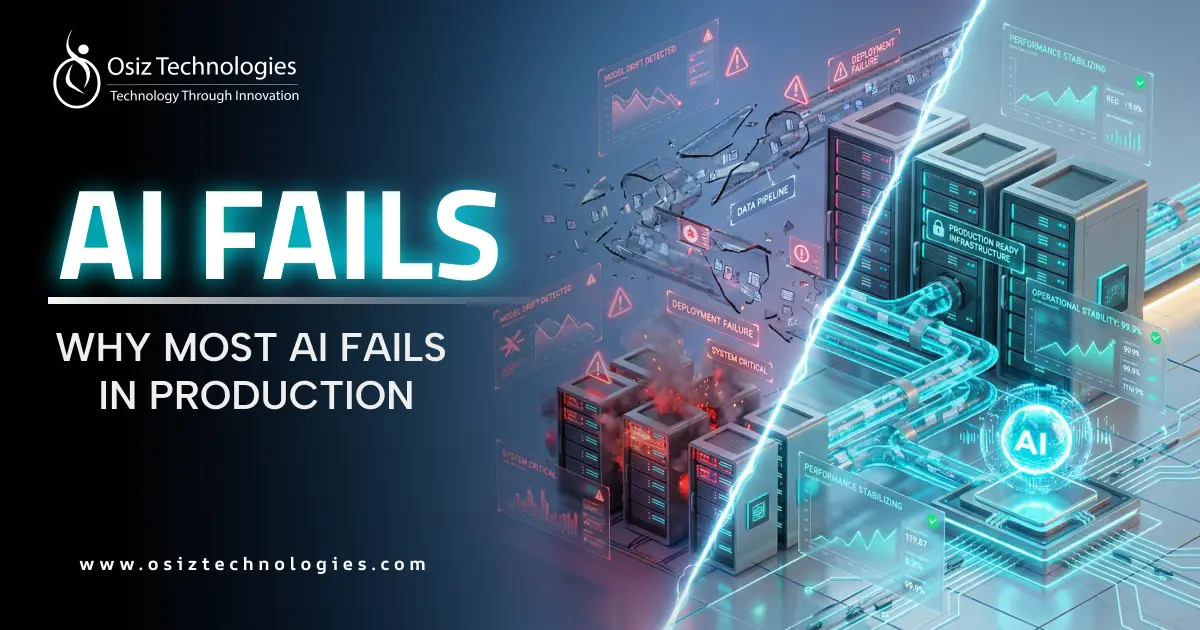
Introducing artificial intelligence into wider applications without careful structural planning or an understanding of how components interact frequently leads to unpredictable performance and subpar results. Sustainable growth depends on solid deployment strategies, scalable frameworks, and processes grounded in real business needs rather than abstract assumptions.
Why Most AI Fails in Production
The majority of AI initiatives collapse in real-world deployment, with failure rates frequently exceeding 80%, primarily because of a significant gap between the controlled settings of labs and the unpredictable nature of live data, weak data systems, and insufficient oversight. Key contributors to these failures include low data quality, inability to scale, unrealistic goals, and the mistaken view of AI as a single-time experiment rather than an ongoing engineering effort.
Top Reasons Why Most AI Systems Fail in Production
1. Inconsistent and Unreliable Data Sources
When data flows shift unpredictably, changing shape, access patterns, or stability production systems often respond in unforeseen ways, especially if underlying ML pipelines lack adaptability at scale. Reliance on unstable inputs weakens output consistency, even within AI in architectures built for growth, slowly eroding confidence in daily operations across large organizations.
Monitoring falters under such conditions; subtle model degradations go unnoticed until deeper issues arise in tracking accuracy or verifying data correctness. Unseen gaps emerge where validation should be strongest, exposing structural fragility in how information is managed and confirmed over time.
2. Data Integrity Challenges in AI Systems
Even when data inputs appear reliable, issues such as missing values, duplicates, or outdated information can significantly impact the accuracy of real-time AI systems, eroding trust in the insights they provide. Without robust data validation, flawed data pipelines can disrupt structured development processes, leading to unpredictable behaviors that become increasingly difficult to track as AI tools are adopted across teams and daily operations.
As organizations develop more systems, ensuring accurate and trustworthy data becomes crucial since this accuracy is directly tied to the quality and consistency of the original model setup. Any inconsistencies or errors in the setup can propagate through the system, leading to flawed outputs. Ensuring data integrity from the outset supports trustworthy and effective AI performance over time.
3. Low-Quality Training Data Issues
Where models learn from partial or old data, adaptation to changing conditions becomes difficult. Predictions become less reliable due to an absence of up-to-date information, and trust diminishes when results differ from what was anticipated. Systems grow brittle without exposure to varied examples during learning phases. Uncommon situations expose weaknesses quickly under operational pressure.
The adoption of advanced AI faces hurdles because of inherent instability, and business implementation stalls when reliability is questionable. Mismatches between training inputs and live environments force reassessment of how information is collected. Data readiness issues surface more frequently at implementation stages. Validation processes reveal inconsistencies only after deployment begins.
4. Data Preparation and Validation Gaps
When data steps are missing, mismatches appear across test and live setups, causing shifts in behavior that interfere with ML rollout while slowing down issue resolution. Because outputs shift unexpectedly, teams face challenges keeping system responses consistent during daily operations.
Unseen variations enter the pipeline where checks are absent, affecting both prediction quality and long-term trust in results. Over time, small flaws grow harder to trace if foundational corrections are skipped early on. Hidden distortions linger when raw information lacks uniform treatment before processing begins.
5. Inaccurate or Biased Data Problems
Unbalanced datasets lead to flawed outcomes, producing predictions so unreliable they undermine trust in corporate AI and raise widespread ethical and operational concerns. Models that perform well in controlled testing frequently fail in real-world settings due to the diversity of actual data, especially when biased patterns are overlooked initially, weakening the effectiveness of strategic AI initiatives.
Over time, these shortcomings become entrenched as institutions struggle with poor data management. Declining performance exposes systemic weaknesses, prompting stricter oversight measures. The lack of effective data governance makes it difficult to identify and address issues promptly. As a result, organizations implement tighter controls, often reacting rather than preventing problems. This cycle perpetuates inefficiencies and undermines long-term improvement.
6. Weak Data Governance Practices
When ownership lacks structure, inconsistencies appear in how data gets used, causing misalignment between departments. Because access rules and oversight are missing, managing AI systems grows harder over time. Where governance is weak, standard methods fade, complicating coordination across divisions and platforms. With unclear policies, reliability drops just as risks rise silently beneath the surface.
Oversight mechanisms bring structure, eliminating the disorder that previously hindered advancement. They enable steady, dependable processes in automated systems, minimizing errors as operations transition into real-world environments. Clear role definitions within these frameworks prevent misunderstandings and minimize disruptions during daily operations. This stability enhances system performance and trust in automated processes.
7. Data Pipeline Failures in Production
Without consistent monitoring, pipeline performance declines, leading to delayed predictions and inconsistent outcomes, which erodes confidence in enterprise AI solutions. Errors small in origin grow severe without automatic alerts or recovery paths, distorting both system behavior tracking and dependable operation over time.
Stable workflows guarantee dependable and consistent performance of real-time AI techniques by offering a clear, organized framework that reduces errors and unforeseen results. By standardizing processes, these workflows support scalability and maintainability. Ultimately, stable workflows form the backbone of dependable and scalable AI deployments.
Best Practices to fix AI Failure in Production
Build Strong Data Foundations
Starting with structured approaches to collect data establishes a foundation for reliable technology performance at every stage of artificial intelligence system development and deployment. Consistency is achieved when validation processes and monitoring frameworks remain in place from the system's inception through ongoing operation.
Adopt Structured MLOps Workflows
Testing handled automatically, together with careful tracking of changes, helps machine learning systems run without unexpected issues during live operation. Following deployment steps in a clear, structured sequence significantly reduces human mistakes and improves alignment between model development and infrastructure teams.
Design Scalable AI System Architecture
When demand grows within large organizations, a strong AI framework keeps data levels, models, interfaces, and application links working together smoothly. Because the structure adapts easily, overseeing AI resources becomes more efficient, so work volume may rise while speed and stability remain steady.
Implement Continuous Monitoring and Maintenance
Monitoring artificial intelligence as it operates allows detection of shifts, irregularities, outliers - risks emerge before impacting results or user interaction. Insights appear steadily; these shape adjustments, refinements, and long-term efficiency when observed without pause. Alignment persists between systems and shifting objectives only through consistent oversight.
Focus on Real-World Testing and Iteration
When test models face actual usage conditions, reliability holds steady despite shifting user patterns or unforeseen data streams. Rather than halting active processes, repeated refinements enable the expansion of AI capabilities over time. Sustainable progress emerges through cycles of adjustment, matching the demands of live deployment at scale.
Strengthen Governance and Operational Alignment
When rules are clear, trust grows among teams handling large AI systems and information networks. Because decisions follow structured paths, actions match company aims, legal standards, and lasting outcomes more closely. With oversight guiding choices, results stay reliable even as automated tools grow more advanced over time.
Conclusion
Moving ahead, production AI adopts scalable frameworks rooted in solid deployment methods, streamlined operations, and linked with stable infrastructure oversight. Instead of isolated tests, firms now embed AI across enterprises using disciplined MLOps paired with constant output tracking. With rising system demands, attention shifts toward flexible designs, live data processing, tied to full-cycle supervision ensuring steady operation. Some opt for experienced partners like Osiz, an AI development company, to create ready-to-deploy environments that support continuous growth. In the future, advanced AI will focus on reliable performance and quick responsiveness, continuously improved to deliver long-term value to organizations.
Listen To The Article

Founder & CEO Osiz Technologies
Mr. Thangapandi, the CEO of Osiz, has a proven track record of conceptualizing and architecting 100+ user-centric and scalable solutions for startups and enterprises. He brings a deep understanding of both technical and user experience aspects. The CEO, being an early adopter of new technology, said, "I believe in the transformative power of AI to revolutionize industries and improve lives. My goal is to integrate AI in ways that not only enhance operational efficiency but also drive sustainable development and innovation." Proving his commitment, Mr. Thangapandi has built a dedicated team of AI experts proficient in coming up with innovative AI solutions and have successfully completed several AI projects across diverse sectors.
Recent Blogs





No 22,Astalakshmi Nagar, Thanakankullam, (Opp Seetha lakshmi Mill gate Bus stop) Thirunagar, Madurai - 625 006.
(Corporate Office)


Canada Office address, 1150, Rue Patrick, Laval, Quebec - H7Y 2C4, Canada.
(Sales Office)


Explore Our
AI Portfolio

 Artificial Intelligence
- AI Development
- AI Predictive Analytics Services
- AI SaaS Development
- RAG Development
- AI Assistant Development
- ChatGPT Development
- Data Analytics Services
- AI Copilot Development
- Adaptive AI Development
- Machine Learning Development
- NLP
- AI Consulting Services
- AI Software Builder
- AI Token Development
- AI Integration Services
- Enterprise AI Solution
- AI As a Service
- AI Marketing Tools
- AI Video Generator
- Computer Vision Services
- Explore AI
- Dataset
- Machine Learning in Healthcare
- Machine Learning in Retail
- Hire AI Engineers
- Hire Prompt Engineers
- Hire ChatGPT Developers
- Hire Stable Diffusion Developers
- Hire Action Transformer Developers
- Blockchain
- Blockchain Development
- Private Blockchain Development
- Smart Contract Development
- Custom Blockchain Development
- Solana Blockchain Development
- Polygon Blockchain Development
- Public Blockchain Development
- DAO Blockchain Development
- Binance Smart Chain (BSC) Blockchain Development
- DApp Development
- Solana DApp Development
- White Label Blockchain Solutions
- Custom Blockchain On Avalanche
- Custom Blockchain On Polygon
- Blockchain Game Development
- Blockchain Consulting Services
- Blockchain Explorer Development
- Ethereum Blockchain Development
- TRON Blockchain Development
- Prediction Market Platform Development Company
Layer 1 & 2 Solutions- Layer-1 Blockchain Development
- Cross Chain Bridge Development
- Data Availability Layer Development
- Ethereum Layer 2 Scaling Solutions
- Cross-L2 DEX Solution
- Layer 2 Token Development
- Layer 2 Token Marketing
- Layer 2 Cryptocurrency Development
- Layer 2 Solutions For Blockchain Games
- Layer 2 Solutions For Web3 Gaming
- Layer 2 Blockchain Solutions
- Rollups As A Service
- Optimistic Rollups Development
- ZK Tech Development
- Bitcoin Layer 2 Solutions
Crypto Exchange- Cryptocurrency Exchange Development
- White Label Crypto Exchange
- Decentralized Exchange Development
- P2P Exchange Development
- Crypto Derivatives Exchange Development
- Centralized Exchange Development
- Crypto Exchange Clone Script
- Cryptocurrency Exchange App Development
- OTC Exchange Development
- Exchange Listing Services
- Binance Like Exchange Development
- Bitstamp Like Exchange Development
- Crypto Exchange Script
CryptoCrypto WalletToken Standards- Token Development
- AI Token Development
- RWA Tokenization Development
- Coinremitter Clone Script
- Asset Tokenization
- Real Estate Tokenization
- Tokenization Platform Development
- Crypto ETF Development
- Solona Token Development
- Semi-Fungible Token Development
- BEP20 Token Development
- Ethereum Token Development
- ERC1400 Token Development
- ERC998 Token Development
- ERC 721 Token Development
- ERC20 Token Development
- Defi Token Development
- ERC1155 Token Development
- BEP721 Token Development
- Utility Token Development
- ERC 777 Token Development
- ERC 827 Token Development
- Social Token Development
- Metaverse Token Development
- Tron Token Development
- ERC404 Token Development
- Governance Token
- Shibarium Token
- polygon Token
- BRC-20
- TRC20 Token Development
- TRC10 Token Development
- Soulbound Token Development
- NFT Token Development
Trading BotsClone- Crypto Exchange Clone Script
- Binance Clone Script
- Metamask Clone Script
- Coinbase Clone Script
- Kucoin Clone Script
- Paxful Clone Script
- Remitano Clone Script
- Wazirx Clone Script
- ByBit Clone Script
- Bitfinex Clone Script
- MEXC Clone Script
- Bitget Clone Script
- Cointool App Clone Script
- Trust Wallet Clone App
- Coinmarketcap Clone Script
- Changelly Clone Script
- BingX Clone Script
CybersecurityApp SecurityDigital Forensics & Incident ResponseAudit & ConsultingEducation & TrainingSolutionsWeb 3DeFi- Decentralized Finance (DeFi) Development
- DeFi Lending/ Borrowing Platform Development
- DeFi Staking Platform Development
- DeFi Token Development
- DeFi Wallet Development
- DeFi Smart Contract Development
- DeFi DApp Development
- Decentralized Exchange Development
- DeFi Insurance Development
- DeFi Crypto Synthetic Assets Development
Game Development- Game Development
- Android Game Development
- IOS Game Development
- Metaverse Game Development
- VR Game Development
- AI Game Development
- Unity 3D Game Development
- Unreal Engine Game Development
- Mobile Game Development
- Blockchain Game Development
- NFT Game Development
- Play to Earn Game Development
- Move to Earn Game Development
- Casino Game Development
- Slot Game Development
- Poker Game Development
- AAA Game Development
- AR Game Development
- Social Network Game Development
- Gamification Services
- Decentralized Sports Betting Platform
- Sports Betting Dapp Development
- Blockchain Casino Game Development
- Game Asset Creation
- Baccarat Game Development
- Rollbit Clone Script
- Fortnite Clone Script
- Slot Game Development
- Tap to Earn Game Development
- Slot Game Development
Metaverse Platforms- Metaverse Game Development
- Metaverse Event Platform Development
- Metaverse Virtual Mall Development
- Metaverse NFT Marketplace Development
- Metaverse Token Development
- Metaverse Virtual Land Development
- Metaverse Avatar Development
- Metaverse 3d Space Development
- Metaverse Real Estate Development
- Metaverse Social Media Platform Development
- Top 10 Metaverse Development Company
- Metaverse Business Ideas
- Metaverse Launchpad Development
- Metaverse App Development
- Metaverse Casino Game Development
NFT SolutionsNFT Platforms- NFT Minting Development
- NFT Token Development
- NFT Exchange Platform Development
- NFT Launchpad Development
- NFT Fashion Marketplace Development
- NFT Art Marketplace Development
- NFT Music Marketplace Development
- Carbon Credits NFT Marketplace Development
- Binance NFT Marketplace Development
- Polygon NFT Marketplace Development
- Solana NFT Marketplace Development
- Influencers NFT Marketplace Development
- NFT Ticketing Marketplace Development
- DeFi NFT Marketplace Development
- NFT Fantasy Sports Platform Development
- NFT Storage Development
- NFT Lending Platform Development
- Top10 NFT Business Ideas
NFT Game ClonesSustainabilityServiceNow - Blog
- Contact Us
- Works