
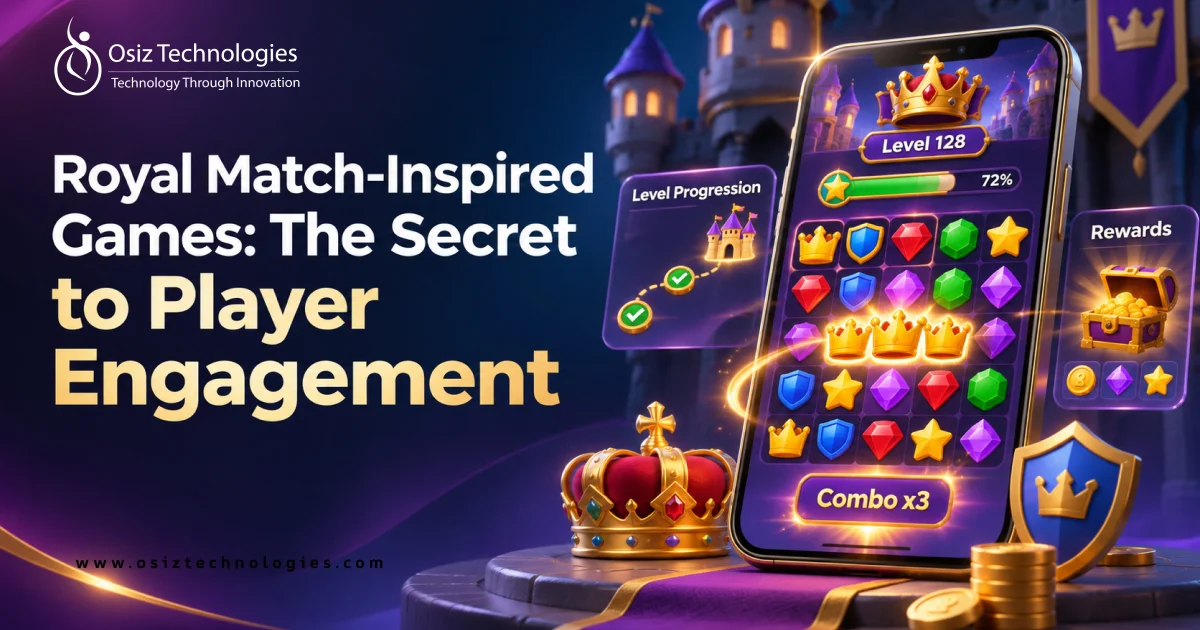
Mobile puzzle games continue to attract players with simple gameplay, creative challenges, and rewarding progression systems. Among them, Royal Match has become a strong example of how match-3 mechanics can create long-term player engagement. Its combination of colourful puzzles, castle decoration, special events, and regular content updates offers more than just a traditional matching experience.
In 2026, the mobile puzzle gaming market is also evolving with new formats, deeper progression systems, and improved monetization approaches. For game developers, understanding what makes titles like Royal Match successful can provide useful insights into building engaging mobile gaming experiences.
Understanding the Gameplay Mechanics Behind Royal Match
Royal Match follows the match-3 puzzle format, where players match three or more similar-colored objects to complete level objectives. Although the core mechanic is simple, different challenges and level designs keep the experience interesting.
Some important gameplay elements include:
-
Progressive Level Design: Different objectives, limited moves, and changing board layouts encourage players to develop new strategies as they advance.
-
Boosters and Power-ups: Special items help players clear obstacles, complete difficult levels, and create satisfying combinations.
-
Castle Restoration: Completing puzzles allows players to unlock and decorate different areas of the castle, connecting gameplay with a larger progression system.
-
Reward-Based Progression: Coins, stars, and other rewards give players a reason to continue completing levels.
The combination of puzzle-solving and long-term progression makes the gameplay more engaging than a simple matching experience.
The Psychology Behind Player Engagement in Puzzle Games
Successful puzzle games understand how players respond to challenges, rewards, and progress. Royal Match uses several engagement principles that encourage players to continue playing.
-
Instant Gratification: Completing a level and receiving rewards provides immediate feedback and a sense of achievement.
-
Challenge and Mastery: Gradually increasing difficulty encourages players to improve their problem-solving skills without making every level feel overwhelming.
-
Progress Motivation: Visible progress through levels and castle improvements gives players a clear reason to return.
-
Short Gaming Sessions: Quick levels make it convenient for players to enjoy the game during short breaks throughout the day.
These elements create a balance between accessibility and challenge. For developers, the goal is to make players feel rewarded while ensuring that progression remains enjoyable rather than frustrating.
Key Features That Make Mobile Puzzle Games Engaging
Beyond basic puzzle mechanics, additional features help mobile games build stronger player connections.
-
Attractive Visual Design: Bright colours, smooth animations, clear effects, and responsive controls make every interaction satisfying. A consistent visual style also helps establish a recognisable game identity.
-
Storyline and Meta-Game Progression: Connecting puzzle levels with castle restoration, character interactions, or other progression systems gives players a bigger objective beyond completing individual stages.
-
Social and Competitive Features: Team challenges, leaderboards, and cooperative events create opportunities for players to interact, compare achievements, and participate together.
-
Personalization Options: Customizable environments, collectible items, and different visual elements allow players to make their gaming experience feel more personal.
-
Live Events and Seasonal Content: Limited-time challenges and themed activities introduce new objectives without changing the fundamental gameplay.
Together, these features create a more complete mobile gaming experience and help differentiate a title in a competitive market.
2026 Mobile Puzzle Gaming Trends and Market Insights
The mobile puzzle gaming market continues to offer opportunities, but player expectations and competition are changing.
According to AppMagic's Casual Games Report H1 2026, puzzle games generated approximately $4.9 billion in in-app purchase revenue during the first half of 2026, accounting for more than 44% of the casual gaming market.
The report also highlights important changes across puzzle subgenres:
-
Match-3 Games: Generated approximately $2.5 billion in H1 2026 revenue, remaining one of the largest puzzle categories.
-
Merge Games: Reached approximately $1.3 billion, recording 74% year-over-year revenue growth.
-
Hybrid Puzzle Formats: Sort, Block, and other emerging puzzle formats are attracting attention through different gameplay mechanics and monetization opportunities.
These developments indicate that traditional match-3 gameplay remains important, while alternative puzzle formats are creating new opportunities for developers.
How LiveOps and Player Feedback Improve Game Retention
Keeping players interested after the initial download is one of the major challenges in mobile game development. Regular content updates and community-driven improvements can help maintain player interest.
-
LiveOps and Seasonal Events: Time-limited challenges, special rewards, and seasonal competitions introduce fresh activities and encourage players to revisit the game.
-
Player Feedback Integration: Reviews, surveys, and community discussions help developers identify gameplay issues, understand player expectations, and improve existing features.
-
Game Analytics: Monitoring level completion rates, player progression, session duration, and drop-off points helps development teams understand where players experience difficulties.
-
Continuous Content Updates: Adding new levels, challenges, and gameplay improvements prevents the experience from becoming repetitive.
Royal Match demonstrates how regular events and new content can complement its core match-3 gameplay. Its Google Play listing in November 2026 features seasonal Royal Pass content and the Train Journey event, reflecting the importance of ongoing updates.
Monetization Models Behind Successful Puzzle Games
A sustainable monetization strategy should support the gaming experience without making players feel forced to spend money.
Common approaches include:
-
In-App Purchases: Players can purchase boosters, additional moves, coins, and other optional items to support their progression.
-
Rewarded Advertisements: Players voluntarily watch advertisements in exchange for additional rewards or gameplay benefits.
-
Seasonal Passes: Premium progression tracks offer additional rewards and exclusive content over a limited period.
-
Limited-Time Offers: Special bundles and event-based promotions create additional purchasing opportunities.
A hybrid monetization model that combines suitable advertising and in-app purchase options can help developers serve different player preferences. However, monetization should be balanced with fair progression, transparent offers, and a positive user experience.
The Future of Royal Match-Inspired Mobile Game Development
The next generation of puzzle games is likely to focus on more varied gameplay, smarter personalization, and deeper player progression.
Some emerging development opportunities include:
-
AI-Powered Personalization: AI can help analyse gameplay patterns and support personalized challenges, recommendations, and player experiences.
-
Hybrid Puzzle Mechanics: Combining match-3 gameplay with merge, sorting, collection, or simulation elements can introduce new experiences.
-
Advanced LiveOps Systems: Flexible event frameworks allow developers to introduce seasonal activities, limited-time challenges, and evolving content.
-
Improved Social Experiences: Team-based competitions, shared achievements, and cooperative challenges can strengthen player communities.
-
Data-Driven Level Balancing: Gameplay analytics can help developers identify difficulty issues and improve level design based on actual player behaviour.
These developments create opportunities to build puzzle games that offer more than repetitive level completion. The focus is shifting towards complete gaming experiences that combine engaging mechanics, meaningful progression, and long-term content.
Why Choose Osiz Technologies for Mobile Puzzle Game Development?
As an experienced Game Development Company, Osiz Technologies develops customized mobile puzzle games with engaging match-3 mechanics, creative level designs, attractive visuals, and rewarding progression systems. We help businesses integrate multiplayer features, live events, player engagement elements, and flexible monetization options to build interactive puzzle gaming platforms.
Our development approach focuses on smooth gameplay, scalable architecture, and cross-platform compatibility. From game design and development to testing and deployment, we support every stage of the development process. Whether you're planning a Royal Match-inspired game or a unique puzzle gaming concept, We helps turn your idea into an engaging mobile gaming experience.
Listen To The Article

Founder & CEO Osiz Technologies
As the CEO of Osiz Technologies, Mr. Thangapandi has exhibited exceptional leadership and innovation in the field of game development. An early adopter of new technology, Mr. Thangapandi asserts, "The world of games has always held a special place in my heart. It's a realm of boundless creativity, where imagination takes form and stories come alive. As CEO of Osiz Technologies, it's been an immense privilege to be a part of the gaming universe" With Osiz on the verge of game development, the future of gaming is bright, brimming with innovative experiences and captivating narratives.
Recent Blogs




No 22,Astalakshmi Nagar, Thanakankullam, (Opp Seetha lakshmi Mill gate Bus stop) Thirunagar, Madurai - 625 006.
(Corporate Office)


Canada Office address, 1150, Rue Patrick, Laval, Quebec - H7Y 2C4, Canada.
(Sales Office)


Meydan Grandstand, 6th floor, Meydan Road, Nad Al Sheba, Dubai, U.A.E.
(Sales Office)


 Artificial Intelligence
- AI Development
- AI Predictive Analytics Services
- AI SaaS Development
- RAG Development
- AI Assistant Development
- ChatGPT Development
- Data Analytics Services
- AI Copilot Development
- Adaptive AI Development
- Machine Learning Development
- NLP
- AI Consulting Services
- AI Software Builder
- AI Token Development
- AI Integration Services
- AI Agent Bots
- Enterprise AI Solution
- AI As a Service
- AI Marketing Tools
- AI Video Generator
- Computer Vision Services
- Explore AI
- Dataset
- Machine Learning in Healthcare
- Machine Learning in Retail
- Hire AI Engineers
- Hire Prompt Engineers
- Hire ChatGPT Developers
- Hire Stable Diffusion Developers
- Hire Action Transformer Developers
Portfolio- AI Agriculture
- AI Healthcare
- NLP Services
- AI Brainstorming Tool
- Academic AI
- AI Dermatologist Software
- Best AI Tools
- Artificial Influencer Generator
- AI E-Learning Software
- AI Agriculture Software
- Generative AI Tool
- AI Assistant
- AI Sales Agent
- Intelligence OS For Medical Imaging
- Intelligence OS For Diagnosis Systems
- Intelligence OS For Control Systems
- Intelligence OS For Dialog Systems
- Intelligence OS For Health Management Systems
- Intelligence OS For Chat-Bots
- Intelligence OS For Crypto API
- Intelligence OS For Autocomplete In Search Engines
- Intelligence OS For CCTV To AI Camera
- Intelligence OS For Object Detection
- Intelligence OS For Voice Assistants
- Intelligence OS For Language
- Intelligence OS For Autonomous Vehicles
- Intelligence OS For Educational Assistant
- Intelligence OS For KYT
- Intelligence OS For Recommendation System
- Intelligence OS For Prediction System
- Intelligence OS For Finance
- Intelligence Fourier Transform Analysis
- AI Arbitrage Bot
- Intelligence OS For Multi-Lingual Assistant
- Blockchain
- Blockchain Development
- Private Blockchain Development
- Smart Contract Development
- Custom Blockchain Development
- Solana Blockchain Development
- Polygon Blockchain Development
- Public Blockchain Development
- DAO Blockchain Development
- Binance Smart Chain (BSC) Blockchain Development
- DApp Development
- Solana DApp Development
- White Label Blockchain Solutions
- Custom Blockchain On Avalanche
- Custom Blockchain On Polygon
- Blockchain Game Development
- Blockchain Consulting Services
- Blockchain Explorer Development
- Ethereum Blockchain Development
- TRON Blockchain Development
- Prediction Market Platform Development Company
Layer 1 & 2 Solutions- Layer-1 Blockchain Development
- Cross Chain Bridge Development
- Data Availability Layer Development
- Ethereum Layer 2 Scaling Solutions
- Cross-L2 DEX Solution
- Layer 2 Token Development
- Layer 2 Token Marketing
- Layer 2 Cryptocurrency Development
- Layer 2 Solutions For Blockchain Games
- Layer 2 Solutions For Web3 Gaming
- Layer 2 Blockchain Solutions
- Rollups As A Service
- Optimistic Rollups Development
- ZK Tech Development
- Bitcoin Layer 2 Solutions
Crypto Exchange- Cryptocurrency Exchange Development
- White Label Crypto Exchange
- Decentralized Exchange Development
- P2P Exchange Development
- Crypto Derivatives Exchange Development
- Centralized Exchange Development
- Crypto Exchange Clone Script
- Cryptocurrency Exchange App Development
- OTC Exchange Development
- Exchange Listing Services
- Binance Like Exchange Development
- Bitstamp Like Exchange Development
- Crypto Exchange Script
CryptoCrypto WalletToken Standards- Token Development
- AI Token Development
- Coinremitter Clone Script
- Tokenization Platform Development
- Crypto ETF Development
- Solona Token Development
- Semi-Fungible Token Development
- BEP20 Token Development
- Ethereum Token Development
- ERC1400 Token Development
- ERC998 Token Development
- ERC 721 Token Development
- ERC20 Token Development
- Defi Token Development
- ERC1155 Token Development
- BEP721 Token Development
- Utility Token Development
- ERC 777 Token Development
- ERC 827 Token Development
- Social Token Development
- Metaverse Token Development
- Tron Token Development
- ERC404 Token Development
- Governance Token
- Shibarium Token
- polygon Token
- BRC-20
- TRC20 Token Development
- TRC10 Token Development
- Soulbound Token Development
- NFT Token Development
Trading BotsClone- Crypto Exchange Clone Script
- Binance Clone Script
- Metamask Clone Script
- Coinbase Clone Script
- Kucoin Clone Script
- Paxful Clone Script
- Remitano Clone Script
- Wazirx Clone Script
- ByBit Clone Script
- Bitfinex Clone Script
- MEXC Clone Script
- Bitget Clone Script
- Cointool App Clone Script
- Trust Wallet Clone App
- Coinmarketcap Clone Script
- Changelly Clone Script
- BingX Clone Script
CybersecurityApp SecurityDigital Forensics & Incident ResponseAudit & ConsultingEducation & TrainingSolutionsWeb 3DeFi- Decentralized Finance (DeFi) Development
- DeFi Lending/ Borrowing Platform Development
- DeFi Staking Platform Development
- DeFi Token Development
- DeFi Wallet Development
- DeFi Smart Contract Development
- DeFi DApp Development
- Decentralized Exchange Development
- DeFi Insurance Development
- DeFi Crypto Synthetic Assets Development
Game Development- Game Development
- Android Game Development
- IOS Game Development
- Metaverse Game Development
- VR Game Development
- AI Game Development
- Unity 3D Game Development
- Unreal Engine Game Development
- Mobile Game Development
- Blockchain Game Development
- NFT Game Development
- Play to Earn Game Development
- Move to Earn Game Development
- Casino Game Development
- Slot Game Development
- Poker Game Development
- AAA Game Development
- AR Game Development
- Social Network Game Development
- Gamification Services
- Decentralized Sports Betting Platform
- Sports Betting Dapp Development
- Blockchain Casino Game Development
- Game Asset Creation
- Baccarat Game Development
- Rollbit Clone Script
- Fortnite Clone Script
- Slot Game Development
- Tap to Earn Game Development
- Slot Game Development
Metaverse Platforms- Metaverse Game Development
- Metaverse Event Platform Development
- Metaverse Virtual Mall Development
- Metaverse NFT Marketplace Development
- Metaverse Token Development
- Metaverse Virtual Land Development
- Metaverse Avatar Development
- Metaverse 3d Space Development
- Metaverse Real Estate Development
- Metaverse Social Media Platform Development
- Top 10 Metaverse Development Company
- Metaverse Business Ideas
- Metaverse Launchpad Development
- Metaverse App Development
- Metaverse Casino Game Development
NFT SolutionsNFT Platforms- NFT Minting Development
- NFT Token Development
- NFT Exchange Platform Development
- NFT Launchpad Development
- NFT Fashion Marketplace Development
- NFT Art Marketplace Development
- NFT Music Marketplace Development
- Carbon Credits NFT Marketplace Development
- Binance NFT Marketplace Development
- Polygon NFT Marketplace Development
- Solana NFT Marketplace Development
- Influencers NFT Marketplace Development
- NFT Ticketing Marketplace Development
- DeFi NFT Marketplace Development
- NFT Fantasy Sports Platform Development
- NFT Storage Development
- NFT Lending Platform Development
- Top10 NFT Business Ideas
NFT Game ClonesSustainabilityServiceNow - Blog
- Contact Us
- Works