
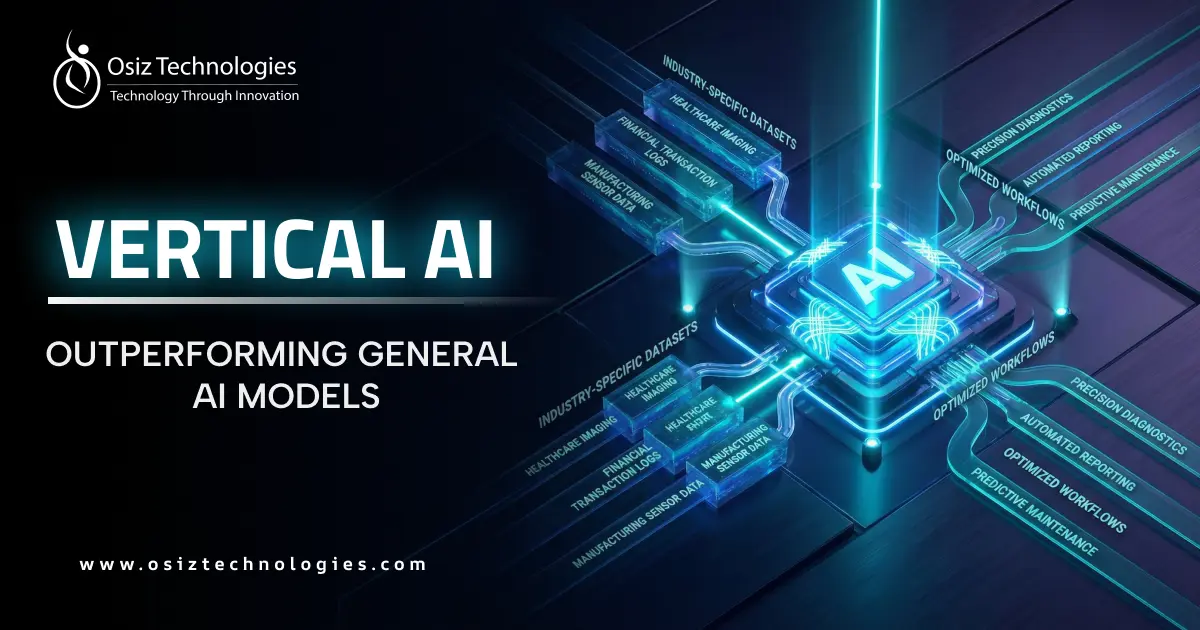
Industry-specific artificial intelligence sees increasing use because it supports actual work requirements while producing clear outcomes. Moving past broad AI tools, companies now look toward focused platforms fitting exact procedures, information formats, and choices made daily. Future development leans into designing smart applications capable of expanding within defined fields over time.
What Are General AI Models?
General AI models, commonly known as Artificial General Intelligence (AGI) or general-purpose AI, are sophisticated, theoretical systems designed to understand, learn, and apply knowledge across diverse tasks, demonstrating cognitive capabilities comparable to humans. Unlike narrow AI, which is limited to specific functions, these models possess the ability to adapt, reason, and generalize to tackle new and unforeseen challenges.
How Vertical AI Is Outperforming General AI Models
Vertical AI represents a focused form of artificial intelligence that is currently surpassing general-purpose AI by concentrating on deep, sector-specific knowledge instead of offering broad, all-encompassing capabilities.
Unlike general AI models such as GPT-4 vision, which are built for versatility across diverse topics, Vertical AI is tailored for particular industries, trained on specialized or proprietary data, and optimized to handle intricate, high-impact tasks in fields like healthcare, finance, or legal services.
Vertical AI vs General AI – Core Differences
Precision vs Generalization
Despite broader capabilities, General AI models sometimes lack sharpness in targeted tasks compared to Vertical AI, where narrow goals allow refined outcomes. Where one system adapts widely, another excels by design within limits. Training on specific data gives Domain-focused edge AI accuracy emerges from alignment with actual work patterns. Such gains prompt closer study of how each type influences daily operations and task handling across industries.
Workflow Alignment vs Broad Functionality
Where industry-focused artificial intelligence fits naturally into existing procedures, broad applications demand significant adjustment before consistent performance. Instead of heavy setup, specialized platforms support smooth task execution, minimizing human intervention while shortening rollout periods within large-scale operations. Due to these benefits, businesses often assess how difficult implementation is in relation to its growth potential.
Faster Deployment vs Complex Adaptation
Because they come with ready-made structures designed for particular sectors, Vertical AI systems allow quicker setup than broad alternatives needing extensive adjustments. Where standard models demand customization, specialized integrations reduce startup effort. Teams managing daily operations find these tools easier to adopt. Speedier roll outs lead organizations to assess how each approach handles growth and upkeep over time.
Performance Consistency vs Variable Outputs
When a model focuses on one domain, its outputs tend to stay predictable, unlike broad AI that can behave unpredictably when faced with varied tasks. Predictability supports trustworthiness during essential functions where errors carry weight. Over time, steady behavior leads institutions toward reviewing frameworks and support structures required for dependable automation.
Scalable Specialization vs Generic Expansion
Because specialized artificial intelligence operates within narrow industry boundaries, it supports growth aligned with specific functional demands instead of broad capabilities. Where general systems add features indiscriminately, targeted models refine performance through precision. As a result, companies begin questioning whether wide-ranging automation truly matches the efficiency of concentrated expertise.
Why Businesses Are Moving Toward Vertical AI
Higher Operational Accuracy
Precision improves when organizations adopt Vertical AI, given its grasp of sector-specific terms, procedures, and subtle context missed by broader General AI approaches. As accuracy rises, so does smoothness in operations, while mistakes in intricate business tasks become less frequent.
Improved Automation Efficiency
By aligning automated processes with specific operational needs, vertical systems limit hands-on involvement while smoothing repeated actions throughout various divisions. Where artificial intelligence manages workflows effectively, output rises alongside quicker choices within daily functions.
Faster Return on Investment
Immediate results emerge when artificial intelligence fits a specific field since narrow systems outperform general ones needing long setup periods. Rather than wait months for impact, businesses see progress quickly through models built for particular tasks. Custom designs shorten deployment time, yielding clear benefits sooner.
Enhanced Data Utilization
When vertical systems apply organized industry information, Domain-specific AI models gain clarity in identifying patterns useful for future projections and direction setting. Because training relies on targeted datasets, relevance increases within artificial intelligence outcomes, supporting better judgment in corporate settings.
Competitive Industry Advantage
Through focused artificial intelligence, companies address specific industry obstacles, shifting user patterns, and internal targets. Because of these targeted systems, businesses adapt quickly without sacrificing reliability or output levels. Driven by such gains, investment flows toward niche networks that sustain advancement over time.
Role of Domain-Specific Data in Performance
Healthcare – Clinical Decision Intelligence
Within medical settings, artificial intelligence in healthcare increases precision in identifying conditions, tracking individuals’ health states, not only guiding care plans but also aligning with organized digital frameworks suited to hospital procedures. Specialized machine learning systems support better results for patients via continuous evaluation of physiological signals, yet they uphold adherence to legal standards.
Finance – Risk Analysis and Fraud Detection
Because financial rules shape technology choices, firms apply specialized artificial intelligence to study money movements and spot dishonest activity, one benefit being better oversight of threats. Instead of broad tools, customized systems handle repetitive tasks automatically, which leads to faster judgments and clearer workflow tracking. Results in banking show focused reasoning engines perform well where information demands high care.
Manufacturing – Predictive Maintenance and Optimization
Equipment behavior gains clearer insight when dedicated artificial intelligence enters industrial processes. Through adaptive models, factories observe output patterns while anticipating service intervals without waiting for breakdowns. Instead of reacting, operations shift toward prediction - guided by systems built to grow alongside production demands. Efficiency rises not from speed alone, but from timing refined by continuous data flow.
Retail – Personalized Customer Intelligence
Retail companies use targeted AI tools to analyze purchasing patterns, enabling more efficient inventory management through recognition of consumer behavior trends. Customer engagement improves gradually without relying on broad, one-size-fits-all messaging. Store performance often results from subtle, behind-the-scenes optimizations driven by precise algorithms.
Logistics – Supply Chain Optimization
Beginning with precision, domain-focused artificial intelligence supports delivery forecasts within transport networks. Instead of generic tools, tailored algorithms shape efficient paths across shifting landscapes. Through systematic coordination, automated processes maintain flow amid live adjustments. Rather than static designs, flexible frameworks respond when traffic patterns evolve.
Conclusion
Specialized forms of artificial intelligence are gaining ground due to their focus on accuracy, adaptability, followed by integration into live operations. Because they match existing processes, unique datasets matter more - outcomes become clearer when tied directly to performance metrics. In evolving corporate landscapes, targeted models accelerate progress while streamlining repetitive tasks across intricate settings. Many organizations collaborate with an AI development company like Osiz to build scalable, customized AI systems that support reliable, industry-focused automation. Architectural designs grow smarter; automation adjusts smoothly; future setups gain durability within adaptive networks.
Listen To The Article

Founder & CEO Osiz Technologies
Mr. Thangapandi, the CEO of Osiz, has a proven track record of conceptualizing and architecting 100+ user-centric and scalable solutions for startups and enterprises. He brings a deep understanding of both technical and user experience aspects. The CEO, being an early adopter of new technology, said, "I believe in the transformative power of AI to revolutionize industries and improve lives. My goal is to integrate AI in ways that not only enhance operational efficiency but also drive sustainable development and innovation." Proving his commitment, Mr. Thangapandi has built a dedicated team of AI experts proficient in coming up with innovative AI solutions and have successfully completed several AI projects across diverse sectors.
Recent Blogs





No 22,Astalakshmi Nagar, Thanakankullam, (Opp Seetha lakshmi Mill gate Bus stop) Thirunagar, Madurai - 625 006.
(Corporate Office)


Canada Office address, 1150, Rue Patrick, Laval, Quebec - H7Y 2C4, Canada.
(Sales Office)


Explore Our
AI Portfolio

 Artificial Intelligence
- AI Development
- AI Predictive Analytics Services
- AI SaaS Development
- RAG Development
- AI Assistant Development
- ChatGPT Development
- Data Analytics Services
- AI Copilot Development
- Adaptive AI Development
- Machine Learning Development
- NLP
- AI Consulting Services
- AI Software Builder
- AI Token Development
- AI Integration Services
- Enterprise AI Solution
- AI As a Service
- AI Marketing Tools
- AI Video Generator
- Computer Vision Services
- Explore AI
- Dataset
- Machine Learning in Healthcare
- Machine Learning in Retail
- Hire AI Engineers
- Hire Prompt Engineers
- Hire ChatGPT Developers
- Hire Stable Diffusion Developers
- Hire Action Transformer Developers
- Blockchain
- Blockchain Development
- Private Blockchain Development
- Smart Contract Development
- Custom Blockchain Development
- Solana Blockchain Development
- Polygon Blockchain Development
- Public Blockchain Development
- DAO Blockchain Development
- Binance Smart Chain (BSC) Blockchain Development
- DApp Development
- Solana DApp Development
- White Label Blockchain Solutions
- Custom Blockchain On Avalanche
- Custom Blockchain On Polygon
- Blockchain Game Development
- Blockchain Consulting Services
- Blockchain Explorer Development
- Ethereum Blockchain Development
- TRON Blockchain Development
- Prediction Market Platform Development Company
Layer 1 & 2 Solutions- Layer-1 Blockchain Development
- Cross Chain Bridge Development
- Data Availability Layer Development
- Ethereum Layer 2 Scaling Solutions
- Cross-L2 DEX Solution
- Layer 2 Token Development
- Layer 2 Token Marketing
- Layer 2 Cryptocurrency Development
- Layer 2 Solutions For Blockchain Games
- Layer 2 Solutions For Web3 Gaming
- Layer 2 Blockchain Solutions
- Rollups As A Service
- Optimistic Rollups Development
- ZK Tech Development
- Bitcoin Layer 2 Solutions
Crypto Exchange- Cryptocurrency Exchange Development
- White Label Crypto Exchange
- Decentralized Exchange Development
- P2P Exchange Development
- Crypto Derivatives Exchange Development
- Centralized Exchange Development
- Crypto Exchange Clone Script
- Cryptocurrency Exchange App Development
- OTC Exchange Development
- Exchange Listing Services
- Binance Like Exchange Development
- Bitstamp Like Exchange Development
- Crypto Exchange Script
CryptoCrypto WalletToken Standards- Token Development
- AI Token Development
- RWA Tokenization Development
- Coinremitter Clone Script
- Asset Tokenization
- Real Estate Tokenization
- Tokenization Platform Development
- Crypto ETF Development
- Solona Token Development
- Semi-Fungible Token Development
- BEP20 Token Development
- Ethereum Token Development
- ERC1400 Token Development
- ERC998 Token Development
- ERC 721 Token Development
- ERC20 Token Development
- Defi Token Development
- ERC1155 Token Development
- BEP721 Token Development
- Utility Token Development
- ERC 777 Token Development
- ERC 827 Token Development
- Social Token Development
- Metaverse Token Development
- Tron Token Development
- ERC404 Token Development
- Governance Token
- Shibarium Token
- polygon Token
- BRC-20
- TRC20 Token Development
- TRC10 Token Development
- Soulbound Token Development
- NFT Token Development
Trading BotsClone- Crypto Exchange Clone Script
- Binance Clone Script
- Metamask Clone Script
- Coinbase Clone Script
- Kucoin Clone Script
- Paxful Clone Script
- Remitano Clone Script
- Wazirx Clone Script
- ByBit Clone Script
- Bitfinex Clone Script
- MEXC Clone Script
- Bitget Clone Script
- Cointool App Clone Script
- Trust Wallet Clone App
- Coinmarketcap Clone Script
- Changelly Clone Script
- BingX Clone Script
CybersecurityApp SecurityDigital Forensics & Incident ResponseAudit & ConsultingEducation & TrainingSolutionsWeb 3DeFi- Decentralized Finance (DeFi) Development
- DeFi Lending/ Borrowing Platform Development
- DeFi Staking Platform Development
- DeFi Token Development
- DeFi Wallet Development
- DeFi Smart Contract Development
- DeFi DApp Development
- Decentralized Exchange Development
- DeFi Insurance Development
- DeFi Crypto Synthetic Assets Development
Game Development- Game Development
- Android Game Development
- IOS Game Development
- Metaverse Game Development
- VR Game Development
- AI Game Development
- Unity 3D Game Development
- Unreal Engine Game Development
- Mobile Game Development
- Blockchain Game Development
- NFT Game Development
- Play to Earn Game Development
- Move to Earn Game Development
- Casino Game Development
- Slot Game Development
- Poker Game Development
- AAA Game Development
- AR Game Development
- Social Network Game Development
- Gamification Services
- Decentralized Sports Betting Platform
- Sports Betting Dapp Development
- Blockchain Casino Game Development
- Game Asset Creation
- Baccarat Game Development
- Rollbit Clone Script
- Fortnite Clone Script
- Slot Game Development
- Tap to Earn Game Development
- Slot Game Development
Metaverse Platforms- Metaverse Game Development
- Metaverse Event Platform Development
- Metaverse Virtual Mall Development
- Metaverse NFT Marketplace Development
- Metaverse Token Development
- Metaverse Virtual Land Development
- Metaverse Avatar Development
- Metaverse 3d Space Development
- Metaverse Real Estate Development
- Metaverse Social Media Platform Development
- Top 10 Metaverse Development Company
- Metaverse Business Ideas
- Metaverse Launchpad Development
- Metaverse App Development
- Metaverse Casino Game Development
NFT SolutionsNFT Platforms- NFT Minting Development
- NFT Token Development
- NFT Exchange Platform Development
- NFT Launchpad Development
- NFT Fashion Marketplace Development
- NFT Art Marketplace Development
- NFT Music Marketplace Development
- Carbon Credits NFT Marketplace Development
- Binance NFT Marketplace Development
- Polygon NFT Marketplace Development
- Solana NFT Marketplace Development
- Influencers NFT Marketplace Development
- NFT Ticketing Marketplace Development
- DeFi NFT Marketplace Development
- NFT Fantasy Sports Platform Development
- NFT Storage Development
- NFT Lending Platform Development
- Top10 NFT Business Ideas
NFT Game ClonesSustainabilityServiceNow - Blog
- Contact Us
- Works